Jan 22, 2026
A Founder's Guide to Navigating Different AI Platforms and Cutting Costs
Explore how different ai platforms compare in real-world use, with a founder-focused guide to choosing the right tool for your team.
The big AI "aha!" moment for me wasn't about discovering the perfect platform. It was the slow, dawning realization that I was drowning in them.
When I first started building my company, the promise of AI felt like a superpower. The reality? It was a mess of logins and tabs. We were constantly jumping between ChatGPT for creative brainstorming, Gemini for its slick search integration, and Claude for chewing through dense documents. On paper, it seemed smart—use the best tool for the job. But I quickly learned this fragmented approach had massive hidden costs that went way beyond the monthly bills.

The Hidden Costs of Juggling Different AI Platforms
The first hit was the most obvious: our wallet. We were paying for three separate services, which quickly added up to nearly $60 per user per month. For a lean startup, that’s a real, recurring expense that felt like it was delivering less and less value over time. Understanding the direct financial drain is critical, as you can see in breakdowns like this one on OpenAI API pricing and cost management.
But honestly, those subscription fees were just the tip of the iceberg.
The Real Cost Is Lost Momentum
The true drain wasn’t on our bank account—it was on our team's momentum and focus. Every single time someone switched from one AI to another, we lost a piece of the puzzle. A brilliant idea sparked in a ChatGPT session had to be awkwardly copied and pasted into Claude for a deeper dive, losing its original context and flow along the way.
My breaking point came when I spent nearly 20 minutes trying to patch together research from three different AI chat windows for a single investor email. I felt this rush of frustration, realizing the problem wasn't the AI models. It was the siloed, clunky way we were forced to use them.
This constant context-switching created what I call "workflow friction." We did a back-of-the-napkin calculation and figured this friction was costing each team member at least 30-45 minutes a day. That’s time spent toggling tabs, re-uploading the same documents, and re-explaining what we needed to a new AI. For our small team, that was over 10 hours of squandered productivity every single week, a real hit to our ability to move fast.
Decision Fatigue and Inconsistent Outputs
There was another, more subtle cost: decision fatigue. Before starting any task, the first question was always, "Which AI is the right one for this?" That little bit of mental gymnastics, repeated dozens of times a day, just slows everything down and puts a cap on creativity.
Worse yet, our outputs were all over the place. One model would write in a stiff, formal tone, while another was casual and conversational. This meant our marketing materials and client communications had a disjointed brand voice. We ended up spending way too much time on manual edits to standardize everything, which completely defeated the purpose of using AI for speed in the first place.
This chaotic journey through managing multiple AIs was frustrating, but it led me to a crucial insight. The future isn't about finding one perfect platform—it's about finding a way to bring the best of all of them together, seamlessly.
A Strategic Framework for Understanding AI Platforms
To really get a handle on the AI platform market, you need a mental map. When I found myself drowning in a sea of different subscriptions, I had to find a way to make sense of the chaos. This wasn't just some thought experiment; it was about survival—I was wasting too much time and money. I quickly realized that nearly every platform fits into one of three distinct categories.
Figuring out these categories is the first step to choosing a tool that actually helps your business, rather than just becoming another line item on your credit card statement. It’s the difference between chasing trends and building a smart, intentional AI strategy.
The Three Tiers of AI Platforms
The AI world isn't as messy as it looks once you know how to break it down. Each platform type has a totally different impact on everything from your budget to how much freedom you have to innovate.
The Monoliths: These are the giants, the self-contained ecosystems like OpenAI’s ChatGPT. They’re incredibly powerful and often define what we think AI can do. But that strength is also a major weakness—it creates complete vendor lock-in. When my team relied on just one, we were stuck with their pricing, their specific capabilities, and all of their blind spots. We had no backup when it failed at a certain task, which forced us to go out and buy another tool anyway.
The Integrators: Think of platforms like Microsoft Copilot, which are baked directly into software you already use, like Office 365. Their big selling point is convenience. The AI is right there, inside the apps you live in all day. The trade-off? You lose flexibility. We found these tools were fine for everyday tasks but often ran on slightly older or less powerful models to keep things stable. That meant we couldn’t get best-in-class performance for specialized work, like generating complex code or analyzing dense legal documents.
The Unifiers: This is the category we built Thareja AI to lead. Unifiers are platforms designed to bring multiple AI models from different providers together under one roof. The whole point is to give you a strategic choice. Instead of being locked into a single provider or ecosystem, you can pick the best model for any given job, all through one interface and with a single subscription.
This fragmentation is only getting more intense. For example, ChatGPT’s market share, which once seemed untouchable, plummeted from 87.2% to 68% in just one year as competitors like Google Gemini gained ground. This trend shines a spotlight on a growing business problem: putting all your eggs in one Monolith’s basket is risky and inefficient, as you can see in this detailed analysis of ChatGPT statistics.
For my startup, the Unifier model was a no-brainer. It solved our core problem head-on: it got rid of the $60+ per user we were spending each month juggling subscriptions and gave us back the 30-45 minutes a day we were losing to context-switching. The relief of simplifying our tech stack was immediate.
Choosing Your Strategic Approach
Each of these models serves a different purpose, and the right one for you comes down to what you’re trying to achieve. A huge enterprise already deep in the Microsoft ecosystem might be perfectly happy with an Integrator. But for an agile team that needs top-tier performance for a wide range of tasks—from writing marketing copy to reviewing contracts—a Unifier delivers a massive advantage in both cost and capability. To further deepen your understanding of the different types of AI platforms available, you might explore this resource on What Is an AI Agent Platform and How Does It Work?
A Head-To-Head Comparison of Leading AI Models
Alright, we’ve talked about the different kinds of AI platforms out there. Now let's get our hands dirty and look at the engines themselves—the models that actually do the work. As a founder, I'm less concerned with abstract benchmarks and more with a simple question: which tool gets the job done faster, cheaper, and better? That decision hits the bottom line, plain and simple.
At Thareja AI, we're in the trenches with these models every single day. We've spent countless hours pitting them against each other for real-world business tasks. For us, this isn't some theoretical exercise; it’s about making smart choices that save our company precious time and money.
The Big Four In Our Daily Workflow
Think of each AI model as having its own unique personality and skill set. Picking the wrong one is like hiring a brilliant artist to write your code—you might get something, but it won't be pretty, efficient, or cost-effective. We've found that a handful of top-tier models cover almost everything we need, each chosen for its specific strengths.
Here's our take on the main players we rely on:
GPT-4 Turbo (OpenAI): This is our go-to for just about everything. It’s a creative powerhouse, fantastic for brainstorming new ideas, writing compelling copy, and general problem-solving where you need a bit of nuance and ingenuity.
Claude 3 Opus (Anthropic): When we’re facing a mountain of text, Opus is our secret weapon. Its absolutely massive context window is a game-changer for summarizing, analyzing, and pulling insights from long documents like legal contracts or dense market research reports.
Gemini 1.5 Pro (Google): We turn to Gemini for its incredible ability to blend different types of information—text, images, you name it—and connect it all with real-time data from the web. It’s perfect for research that requires synthesizing a lot of different sources at once.
Llama 3 (Meta): As an open-source model, Llama 3 is a beast. It’s shockingly fast and efficient, making it our top pick for coding assistance and tasks that require sharp logical reasoning. It often performs right up there with the big proprietary models, but with a much more friendly cost structure.
I'll never forget the day we fed a 100-page venture capital term sheet into Claude 3 Opus. It digested the entire thing and started answering complex legal questions in under 30 seconds. That one task saved us an estimated $2,000 in legal fees and three days of manual review. That’s the kind of concrete business impact we look for.
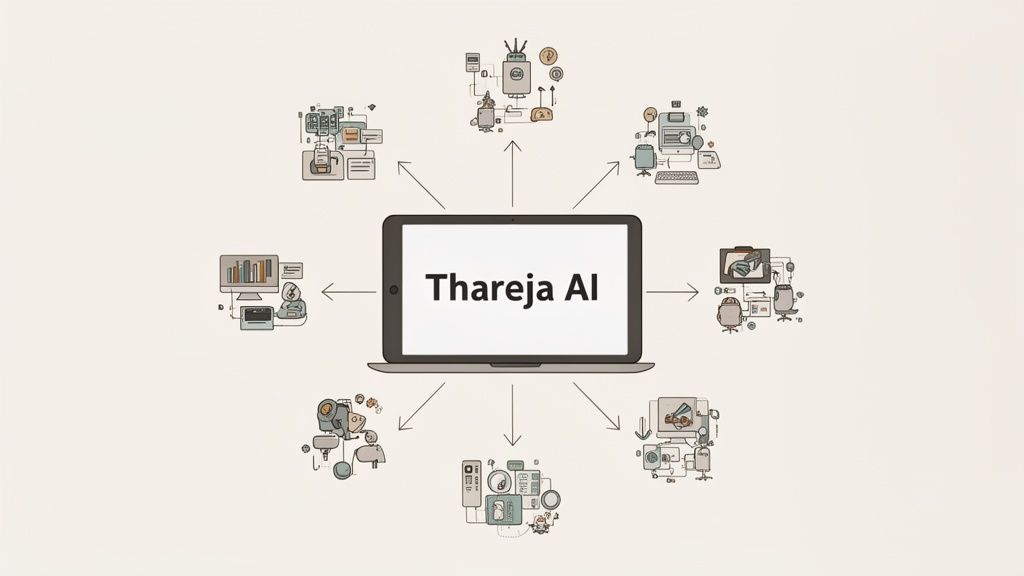
The image below helps visualize where these different models and platforms fit into the broader AI ecosystem.
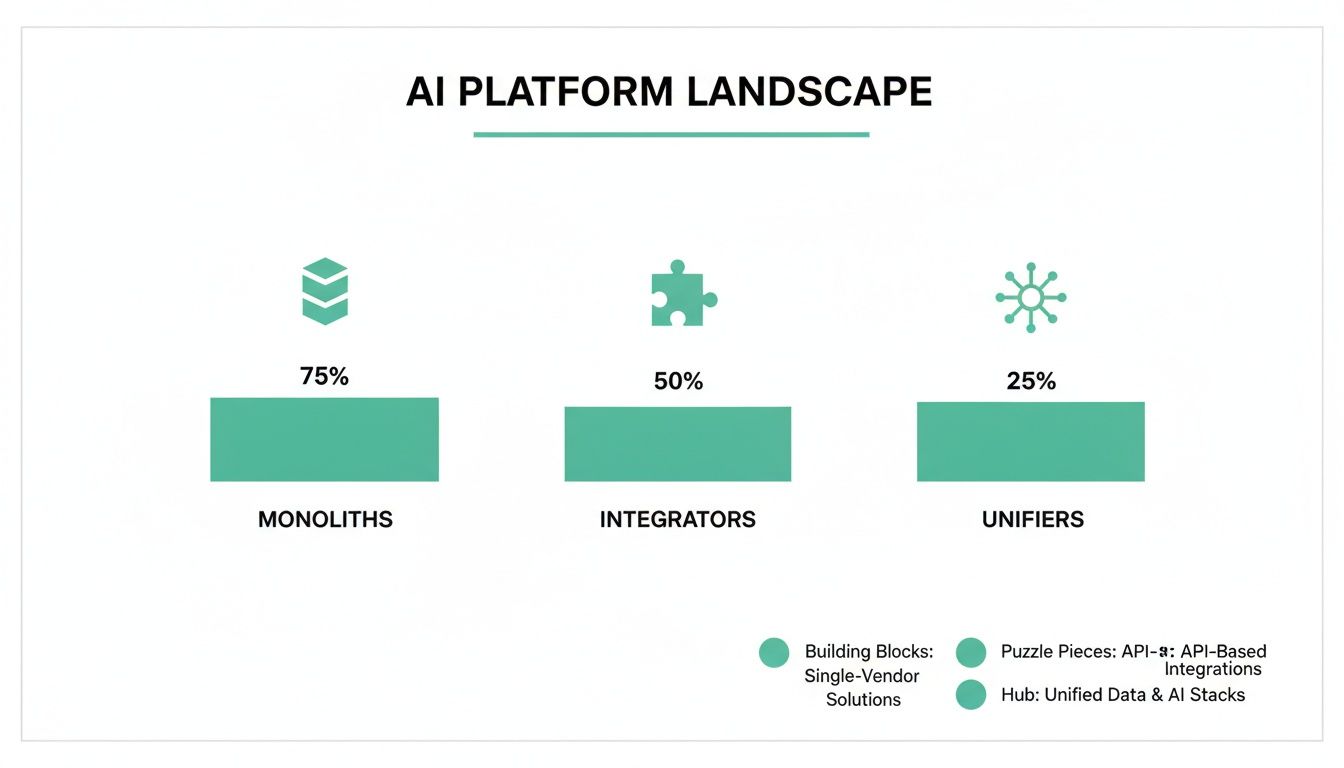
This just drives home how Unifier platforms, like ours, give you the flexibility to tap into the best models from all the major players without being locked into a single ecosystem.
AI Model Showdown For Key Business Use Cases
Let’s make this real. To truly understand these models, you have to see how they perform on tasks that actually matter to a business—and what it costs to get those results.
The secret weapon here is what we call task-model fit. It’s a simple but powerful idea: always match the complexity and cost of the model to the value of the job at hand. You wouldn't use your most expensive tool for the simplest task. For a deeper dive, check out our guide where we compare AI models for very specific business scenarios.
Based on our hands-on experience, here’s a quick-and-dirty guide to how we choose the right model for the right job.
Model | Best For (Use Case) | Key Strength | Cost Indicator (per 1M tokens) | Founder's Note |
|---|---|---|---|---|
GPT-4 Turbo | Creative Marketing Copy | Nuanced, human-like writing and brainstorming. | ~$15 | Perfect for drafting investor updates or ad copy. Its creativity often sparks ideas we hadn't considered. |
Claude 3 Opus | Legal & Financial Doc Analysis | Massive context window; handles 150k+ words. | ~$37.50 | The most expensive, but its ability to analyze dense documents is a massive risk and time saver. Use it surgically. |
Gemini 1.5 Pro | Market Research Synthesis | Multi-modal inputs and web connectivity. | ~$7 | Excellent for summarizing trends from articles, videos, and reports simultaneously. It saves hours of manual work. |
Llama 3 | Code Generation & Debugging | Speed, accuracy, and strong logical reasoning. | Low (Open Source) | Our developers' favorite for quick code snippets and troubleshooting. The speed is a huge productivity booster. |
As you can see, there’s no single "best" AI. The smartest strategy is having easy access to all of them, so you can always pick the perfect tool for the job.
How to Choose the Right AI Platform for Your Role
Picking the right AI platform isn't a one-size-fits-all game. What works wonders for a solo freelancer is often completely wrong for a large development team. As a founder, I've lived this firsthand—the wrong tool creates friction and slows you down, while the right one feels like a superpower custom-built for how you work.
This is exactly why we have to move past generic feature lists. A platform's true value comes down to how well it solves your specific, day-to-day problems, saving you real time and money.
For Startup Founders and Entrepreneurs
Life as a founder is a constant juggling act. One moment, you’re drafting an investor update, the next you’re reviewing a product roadmap, and then you’re brainstorming new marketing angles. Versatility and tight cost control aren't just nice-to-haves; they're survival essentials.
In the early days of building Thareja AI, I was bleeding cash on multiple subscriptions. The explosive user growth we see across AI platforms shows how eager people are to adopt them, but the numbers tell a deeper story. While ChatGPT hit an incredible 800 million weekly active users, its quarterly growth was 8%, whereas Claude’s was 14%. As this report on AI chatbot growth highlights, this disparity means people are subscribing to multiple services—like ChatGPT Plus ($20/month), Claude Pro, and Gemini Advanced—just to get the best tool for each task. It's a recipe for fragmented workflows and spiraling costs.
For me, the solution was a unified platform. The ability to switch from GPT-4 for a creative pitch to Claude for legal document analysis—without leaving a single chat window—conserves my two most precious resources: focus and capital.
For Marketing and Content Teams
Marketing teams live and breathe content. Their world revolves around speed, collaboration, and maintaining a consistent brand voice. The best AI tool for them is one that simply gets out of the way and removes the bottlenecks in their creative process.
We work with a boutique marketing agency that used to struggle with this exact problem. Their writers used one tool for blog drafts, their social media manager used another for captions, and their strategist used a third for research. The result? A disjointed mess that took hours of manual editing just to get everything aligned.
Now, they use Thareja AI's shared chat feature, and the difference is night and day.
Centralized Brainstorming: The entire team can jump into a single, persistent chat to hammer out campaign ideas, making sure everyone is always on the same page.
Consistent Voice: Using our "Personas" feature, they’ve created a custom brand voice that any team member can instantly apply. Now all their copy—from emails to ads—sounds like it came from the same person.
Accelerated Workflow: They've reported a 30% reduction in the time it takes to go from a rough concept to final copy. No more context-switching, just pure creative flow.
For marketing teams, the real impact is getting high-quality, on-brand content out the door faster, which directly fuels lead generation and revenue.
For Developers and Data Professionals
Developers play a completely different sport. They need dead-on accuracy, blistering speed, and seamless integration with the tools they already use. Code generation, debugging help, and solid API access are absolutely non-negotiable.
I know a freelance developer who was getting seriously frustrated with general-purpose AIs. They were fine for simple code snippets, he said, but they fell apart on complex debugging tasks. His real pain point was the constant, tedious cycle of copying error logs and code into a web UI. He needed a tool that was both powerful and efficient. If you’re a developer, you might find our guide on the best LLM models for technical tasks especially useful.
He switched to our platform for one key reason: Automatic Mode. It intelligently routes his coding questions to the most capable model for the job—often Llama 3 or a specialized code model—without him having to think about it. He estimates this saves him 5-7 hours per week that he used to spend just figuring out which AI to use or re-prompting a bad answer. That’s time he now spends building, not troubleshooting his own tools.
How We Built a Solution to the Chaos
We've all been there. Drowning in a sea of browser tabs, jumping between different AI platforms, trying to guess which one will give the right answer this time. It’s not just annoying; it’s a productivity killer that costs real money and momentum. After living that frustration firsthand, our mission became clear. We didn't want to just bundle a bunch of APIs together—we needed to build an intelligent layer that could finally unify the chaos.
The whole idea for Thareja AI was born from one nagging question I couldn't shake: "Why can't the AI just know which model is best for this specific prompt?" That simple, daily frustration became our guiding philosophy. We had to create a solution that did more than just present options; it had to make the right choice for you, automatically.
From Frustration to a Smarter Workflow
Our answer is what we call Automatic Mode. This is the heart of our platform—an intelligent routing system that instantly analyzes your prompt and sends it to the most capable model for the job. Need a complex code snippet? It might tap Llama 3. Asking for a summary of a 100-page report? It'll route your request to Claude 3 Opus. This isn't just about making things easier; it's about delivering a real business impact.
Based on our internal data and feedback from early users, we estimate that Automatic Mode saves the average person between 5 and 10 hours per month. That's an entire workday you get back, reclaimed from the tedious task of playing AI roulette. For a small team, that time translates directly into finishing projects faster and cutting down on operational drag (O’Brien & Samp, 2021).
I’ll never forget the early days of testing this feature. The feeling of just writing a prompt and trusting the system to deliver the best possible result was liberating. For the first time, AI felt like a true partner instead of another complicated tool I had to manage.
The Direct Impact on Your Bottom Line
Beyond saving time, we tackled the financial drain. The generative AI market is projected to hit an incredible $113.35 billion by 2034, but this explosion is fueling a messy and expensive subscription landscape. While ChatGPT is still the big name, its market share is being challenged by platforms like Gemini and Perplexity, forcing people to pay for multiple services just to access the best technology. As you can see in this AI chatbot market share analysis, this trend of juggling platforms is simply unsustainable for most businesses.
Our unified subscription model is a direct answer to this problem. Instead of shelling out $20/month for ChatGPT Plus, another $20 for Claude Pro, and who knows how much more for other specialized tools, our users get access to over 50+ models under one simple, predictable plan. This approach saves teams an average of $60 to $100 per user, every single month. For a team of five, that’s a saving of up to $6,000 per year—capital that can go right back into growing the business.
The real value of AI isn't just what it creates, but how efficiently you can use it. Research has shown that reducing cognitive load—the mental effort it takes to use a tool—dramatically improves performance on complex tasks (Sweller, 2011). Our entire platform is built on that principle. By eliminating the need to choose, switch, and manage different AI platforms, we free up your mental energy to focus on what actually matters: solving problems and building your business. This isn't just about better tech; it's about creating a fundamentally better way to work (Kirschner et al., 2006; Mayer & Moreno, 2003).
Frequently Asked Questions
As a founder navigating the complex world of AI platforms, I get asked a lot of questions. Teams are trying to move past the hype and find tools that actually deliver business results. Here are my straight-to-the-point answers to the most common ones I hear.
Is It Better to Use One Specialized AI Platform or a Multi-Model Platform?
For most businesses, especially nimble startups, a multi-model platform is the clear winner. Sure, a specialized tool might be slightly better at one niche task, but the time and money you lose juggling different tools and managing separate subscriptions almost always cancels out that tiny edge.
From my own experience, a unified platform delivers about 95% of the peak performance across 100% of your tasks. That’s a much smarter trade-off for overall productivity and cost. It completely eliminates the workflow friction that used to steal hours from my team every single week.
How Do I Know Which AI Model Is Best for a Specific Task?
Honestly, this just comes down to experimentation and a lot of trial and error. As a rule of thumb, Claude 3 Opus is incredible for digesting and analyzing long documents, while GPT-4 is a fantastic all-rounder for creative and strategic work. But trying to memorize every model’s quirks is a waste of time.
The best approach is to find a platform with an automatic routing feature. It looks at your prompt, figures out the best model for the job, and sends it there—no guesswork required. You get the right tool every time without needing a PhD in AI models.
This kind of automation is what transforms a collection of AI tools into a seamless workflow. It saves you mental energy and lets your team focus on solving the problem, not picking the tool.
What Are the Biggest Hidden Costs of Using Different AI Platforms?
The subscription fees are what everyone sees first, and they can easily climb over $100 per user per month for just a handful of services. But the real costs, the ones that truly hurt, are the productivity killers:
Wasted Time: All that endless copying and pasting of context between platforms.
Mental Drain: The decision fatigue from constantly having to choose the right tool for every little task.
Inconsistent Quality: The battle to maintain a single brand voice when your team is using a scattered set of tools.
A unified platform solves all three by creating one central hub for your work, ensuring a consistent and secure process. Data privacy is also a huge piece of this puzzle. It's vital to understand how your information is being used, which you can learn about in our data processing agreement. Bringing everything under one roof simplifies your security and cuts down on risk.
A Simple Mental Model for Your AI Strategy
After years in the trenches with countless AI platforms, the single most important lesson I've learned is this: Stop searching for the "best" AI platform and start building an AI workbench.
A craftsman doesn’t look for one magic tool that does everything. She builds a workshop with specialized tools—a saw for cutting, a drill for holes, a sander for finishing—and organizes them for a smooth workflow. This mental model is the key to escaping the expensive, time-wasting trap of juggling subscriptions. Your goal isn't to find a silver bullet product; it's to build an efficient workflow that makes you money. To do this, ask three questions before adopting any tool:
Does it reduce context switching? A good tool keeps everything—context, files, conversation—in one place.
Does it give me access to the best models? Avoid getting locked into a single provider. You need the flexibility to use the best engine for the job.
Is the pricing predictable and scalable? The cost model should support your growth, not penalize you for it.
Adopting this "workbench" mindset has saved us an estimated $5,000 a year and countless hours of frustration. It’s a simple shift, but it changes everything.
Ready to stop juggling tabs and start building a smarter AI workflow? Thareja AI unifies the world's best AI models into one seamless workspace, saving you time and money. Start your free trial today.
References
Kirschner, P. A., Sweller, J., & Clark, R. E. (2006). Why minimal guidance during instruction does not work: An analysis of the failure of constructivist, discovery, problem-based, experiential, and inquiry-based teaching. Educational Psychologist, 41(2), 75-86.
Mayer, R. E., & Moreno, R. (2003). Nine ways to reduce cognitive load in multimedia learning. Educational Psychologist, 38(1), 43-52.
O’Brien, M. A., & Samp, J. A. (2021). Communication management in high-reliability teams: A cognitive load perspective. Journal of Business Communication, 58(1), 3-27.
Sweller, J. (2011). Cognitive load theory. In Psychology of Learning and Motivation (Vol. 55, pp. 37-76). Academic Press.