Jan 21, 2026
My Founder's Guide to the 12 Best LLM Models of 2026
Discover the best LLM models for your business. I share my founder's experience with GPT, Claude, Llama, and more, focusing on real-world impact.

Navigating the crowded field of large language models (LLMs) feels less like an opportunity and more like a high-stakes gamble. When I first started building Thareja AI, I wasn't just exploring technology; I was trying to find a reliable foundation for a business. The wrong choice could mean thousands of dollars wasted on inefficient APIs, weeks lost to integration headaches, or a final product that simply couldn't deliver on its promise. I felt a constant low-grade anxiety about it. The real cost isn't just the price per token; it's the opportunity cost of a delayed launch or a subpar user experience.
This isn't just another list. This is the guide I wish I had. We’re going to cut through the marketing fluff and get straight to what matters for your business: real-world performance, practical use cases, and the hidden costs that impact your bottom line. I'll share insights from my own journey, including the mistakes made and lessons learned while integrating models from OpenAI, Anthropic, Google, and others into a live product.
We will directly compare the best llm models, showing you which ones excel at specific tasks like creative writing, complex data analysis, or cost-effective summarization. You’ll find direct links, honest assessments of strengths and weaknesses, and actionable advice on implementation. My goal is to equip you with the clarity needed to make a strategic decision, not just a technical one. Let's find the right model to build your vision, save you money, and get your product to market faster.
1. OpenAI
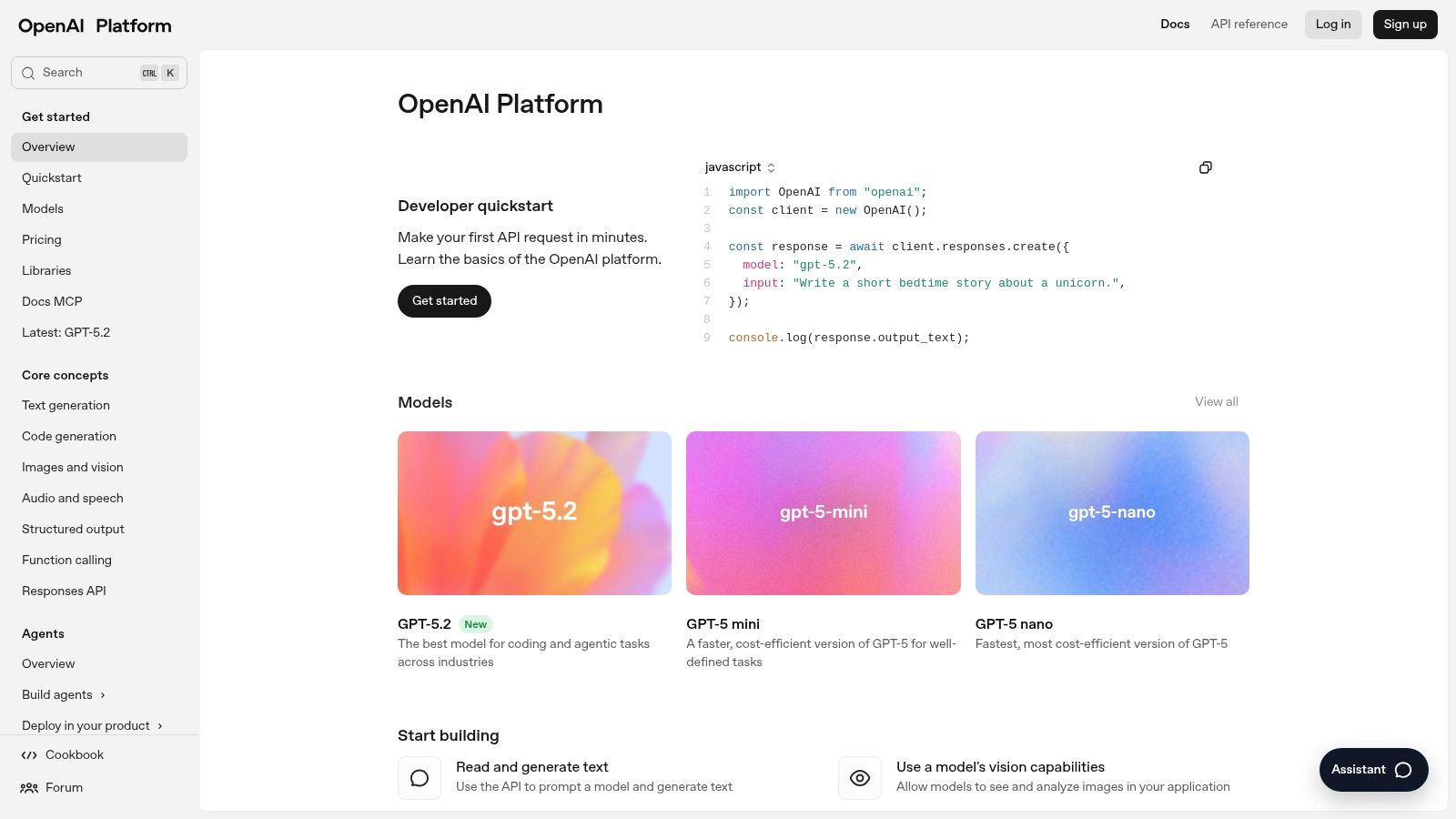
OpenAI represents the frontier of possibility, offering direct API access to some of the most advanced AI systems ever created, including the GPT-4 family and the latest multimodal GPT-4o. When we first started building at Thareja AI, OpenAI’s platform was our go-to for its sheer power and reliability, allowing us to build production-ready applications with complex reasoning, tool usage, and real-time interaction capabilities. Their well-documented API and robust ecosystem made it possible to move from concept to a functioning prototype in days, not months.
Core Strengths & Use Cases
This platform is a powerhouse for anyone looking to build state-of-the-art AI applications. We’ve found its models excel at creating sophisticated customer service agents, generating nuanced marketing copy, and powering internal tools that can analyze complex documents. For a detailed performance and versatility comparison of two leading models, including OpenAI's offerings against Anthropic's Claude, you can read more in Claude vs ChatGPT: The Ultimate AI Showdown.
Pros: Top-tier performance from its frontier models and a mature, well-supported ecosystem. The documentation is clear, making implementation straightforward even for complex projects.
Cons: The premium pricing for its most powerful models can be a significant cost factor. Additionally, navigating data residency requirements can be complex without leveraging cloud partners.
Our Takeaway
OpenAI remains the benchmark for raw model capability. It’s the platform we turn to when we need uncompromising performance for mission-critical tasks where state-of-the-art reasoning is non-negotiable. Learn more about how we integrate these powerful tools into user-centric platforms.
2. Anthropic (Claude family)
Anthropic’s Claude family of models, including Opus, Sonnet, and Haiku, represents a powerful alternative focused on safety, reliability, and sophisticated reasoning. When we needed to process and analyze massive documents, Claude’s impressive context window (up to 200K tokens) was a game-changer. This allowed us to feed entire codebases or extensive financial reports into the model for analysis without truncation, a task that was previously impractical. The platform's commitment to constitutional AI also provides an added layer of trust, which is critical when deploying models in enterprise environments.
Core Strengths & Use Cases
This platform excels in scenarios requiring deep comprehension of large, complex documents and a high degree of reliability. We’ve successfully used Claude for contract analysis, in-depth technical Q&A over extensive documentation, and generating reliable code. Its ability to maintain coherence across a vast context makes it one of the best LLM models for tasks where the entire history of an interaction is crucial. The tiered model system (Opus for power, Sonnet for balance, Haiku for speed) provides excellent flexibility for balancing cost and performance.
Pros: Exceptional long-context capabilities, strong reasoning and coding reliability, and a tiered pricing model that offers flexibility. Enterprise-grade guardrails and governance options are a significant plus.
Cons: The most powerful Opus tier can be costly for high-volume tasks. Additionally, some models are deprecated over time, requiring maintenance, and accessing top-tier models may necessitate using cloud partners like AWS or Google Cloud.
Our Takeaway
Anthropic is our go-to for tasks demanding deep analysis of extensive documents and a high level of safety and reliability. It’s the platform we trust when building systems that must understand complex context without fail. Learn more about how we focus on building trust through smart design in our applications.
3. Google AI Studio (Gemini)
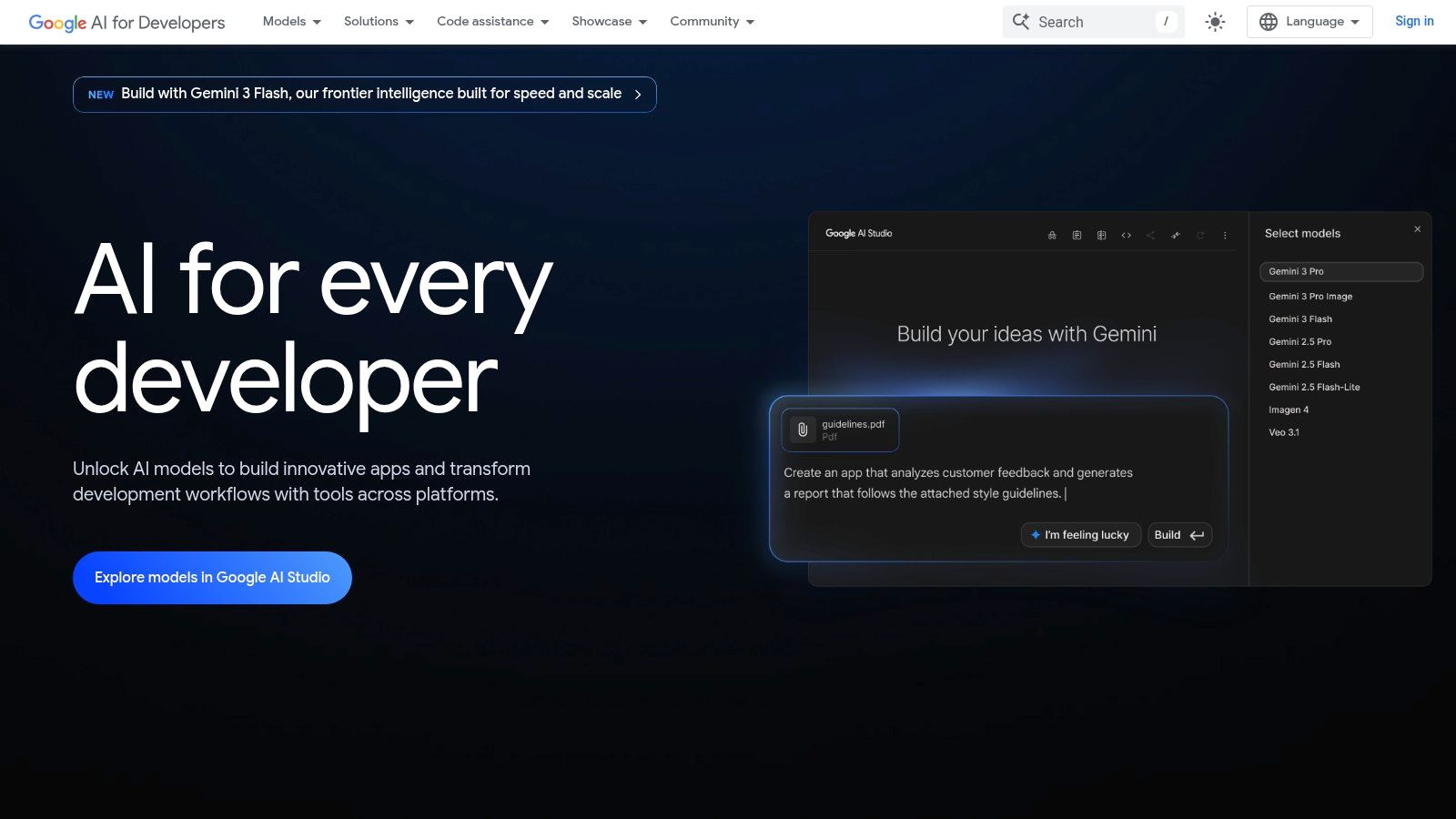
Google AI Studio provides an incredibly accessible entry point to the powerful Gemini family of models, bridging the gap between rapid prototyping and enterprise-grade deployment. When we needed to explore applications requiring massive context windows and real-world data grounding, Google’s platform was a natural choice. Its self-serve environment allowed us to quickly test concepts using Gemini 1.5 Flash’s impressive one million token context, a feature that unlocks entirely new possibilities for long-document analysis and complex, multi-turn conversations without losing track of the initial prompt.
Core Strengths & Use Cases
This platform excels at building applications that need to be deeply connected to real-world, real-time information. We've used its native grounding features, which integrate with Google Search, to build agents that can provide up-to-the-minute answers, a critical advantage for market research or news summarization tools. The seamless path from a working prototype in AI Studio to a scalable solution on Vertex AI is a huge benefit, reducing the friction that often stalls projects as they move from experimentation to production.
Pros: Generous context windows, competitive pricing on models like Gemini 1.5 Flash, and powerful, built-in grounding capabilities. The transition to Vertex AI for enterprise needs is well-defined.
Cons: The model landscape can change quickly with frequent updates and deprecations, requiring some agility to manage. Enterprise-level data compliance and residency are best handled through Vertex AI, adding a layer of complexity.
Our Takeaway
Google AI Studio is our go-to for prototyping next-generation applications that depend on vast context or grounded, real-time data. It's the ideal sandbox for pushing the boundaries of what one of the best LLM models can do before scaling it for serious business impact.
4. Microsoft Azure OpenAI Service
For many of our enterprise clients at Thareja AI, Microsoft Azure OpenAI Service is the bridge between OpenAI’s powerful models and the stringent security, compliance, and governance requirements of a large organization. It provides managed access to models like GPT-4o within the trusted Azure ecosystem, which was a non-negotiable for a financial services client concerned with data residency and network security. This allowed us to build solutions using the best LLM models while ensuring all data processing adhered to their strict internal policies and regional regulations.
Core Strengths & Use Cases
This platform excels where enterprise-grade controls are paramount. We leverage it to deploy solutions that require private networking, integration with Azure Active Directory for identity management, and guaranteed performance through Provisioned Throughput Units (PTUs). This predictability is crucial for applications with defined SLAs, such as an internal knowledge base for a global consulting firm we developed, where consistent response times were critical for user adoption. The service offers a secure, compliant path to adopting cutting-edge AI.
Pros: Top-tier enterprise security, data privacy, and compliance. The provisioned throughput option offers predictable performance and cost management for high-usage applications.
Cons: Access to the latest models can sometimes lag behind OpenAI's direct API. Navigating the regional availability and the approval process can add initial setup complexity.
Our Takeaway
Azure OpenAI is the definitive choice for enterprises that need to run powerful AI workloads within a secure, managed cloud environment. It’s the platform we recommend when a client’s security and compliance posture is just as important as the model's performance itself.
5. AWS Bedrock
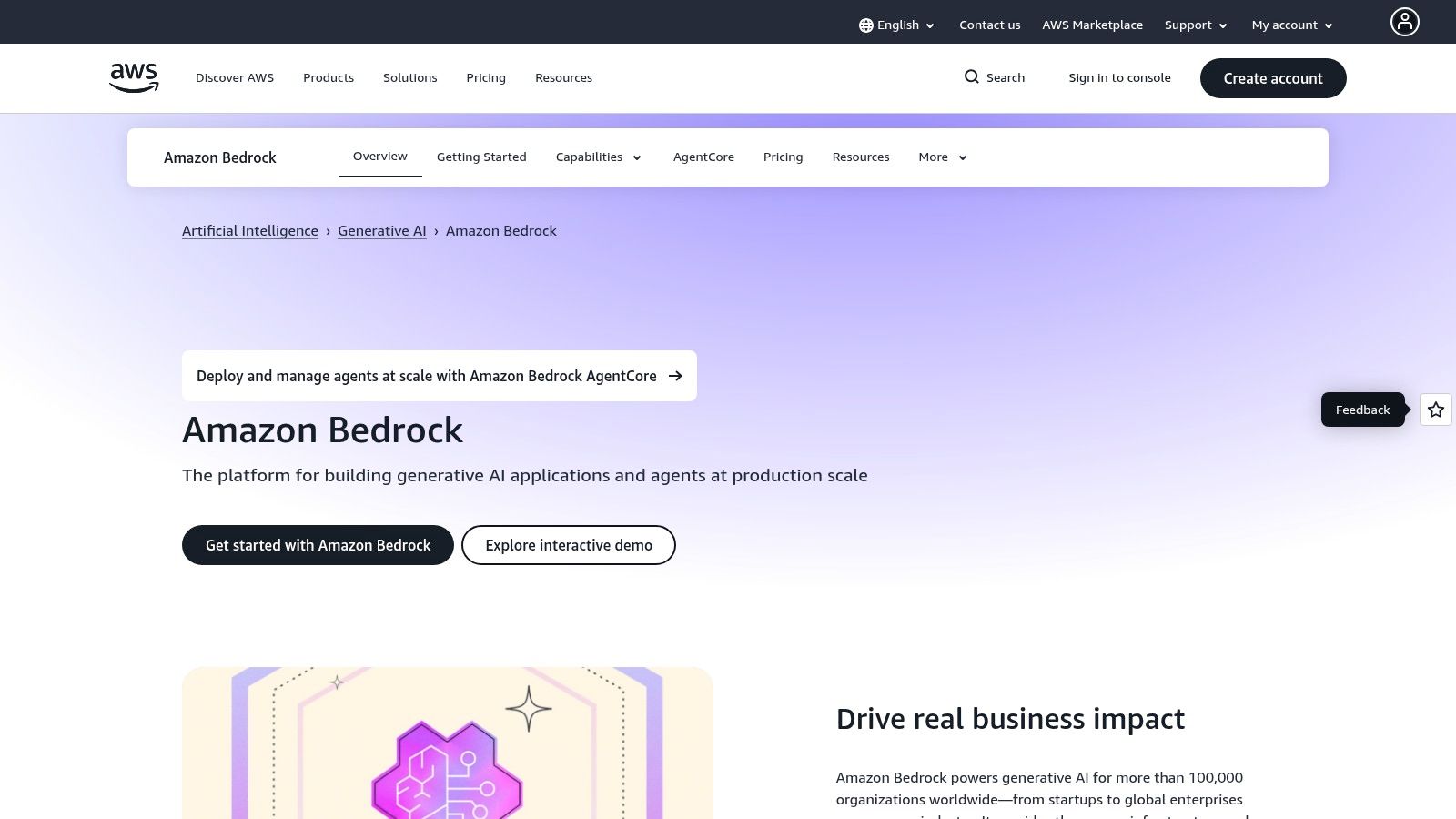
AWS Bedrock is the pragmatic choice for enterprises looking to leverage the power of the best LLM models within a secure, scalable, and familiar cloud environment. When we explored options for a client deeply integrated with AWS, Bedrock was the obvious path. It provides unified API access to a diverse catalog of foundation models from Anthropic, Meta, and Mistral, all managed under the AWS umbrella. This eliminates the need to manage multiple API keys and billing relationships, streamlining development and operations significantly.
Core Strengths & Use Cases
This platform excels at integrating AI into existing enterprise workflows with robust governance and cost controls. We found its Guardrails feature invaluable for enforcing brand safety and filtering PII in a customer-facing chatbot, reducing compliance risk. The various inference service tiers (Priority, Standard, Flex) allow for a sophisticated cost-performance strategy. For example, we use Priority for real-time user interactions and schedule high-volume, non-urgent tasks like document summarization using the discounted batch inference, saving over 40% on processing costs.
Pros: The broadest catalog of providers within a single cloud console, coupled with powerful enterprise controls, cost visibility, and native autoscaling.
Cons: Pricing can be complex, varying per model and across the different capacity tiers. Effective cost management requires careful capacity and reservation planning.
Our Takeaway
AWS Bedrock is the ultimate enabler for businesses already invested in the AWS ecosystem. It abstracts away vendor management complexity and provides the tools to build, deploy, and scale generative AI applications with confidence and control. Discover why we believe that performance and accessibility are key to user adoption.
6. Meta Llama (official access and downloads)
Meta’s Llama family of models represents the pinnacle of open-source AI, offering a powerful alternative for teams that prioritize control, customization, and cost-efficiency. When we needed to build highly specialized, domain-specific applications at Thareja AI, self-hosting Llama 3 was a game-changer. The official portal provides direct access to the model weights after a straightforward approval process, empowering us to deploy some of the best LLM models on our own infrastructure. This level of control is crucial for managing data privacy and fine-tuning models for niche tasks where off-the-shelf solutions fall short.
Core Strengths & Use Cases
This platform is the gateway to building bespoke AI systems without being locked into a specific vendor's ecosystem. We’ve leveraged Llama models to create internal knowledge bases that operate on sensitive company data and to power analytics tools that would be prohibitively expensive to run on a per-token basis. The vibrant community support through platforms like Hugging Face provides a wealth of pre-built tools and fine-tuning scripts, accelerating development significantly.
Pros: Complete control over deployment and data, eliminating per-token inference fees. The strong community provides excellent tooling like
vLLMandllama.cppfor optimized performance.Cons: Access requires an approved license request. Running models at scale demands significant infrastructure planning and MLOps expertise to manage GPU resources effectively.
Our Takeaway
Meta Llama is the ideal choice for teams with the technical capability to manage their own infrastructure who need maximum customization and cost predictability. It’s our go-to when we want to build a deeply integrated, proprietary AI asset that we can scale and adapt without external dependencies.
7. Mistral AI
Mistral AI burst onto the scene with a refreshing focus on efficient, high-performance models that challenge the status quo. We were immediately drawn to their approach, especially for use cases where throughput and cost-effectiveness are critical. By integrating Mistral's Mixtral models, we developed internal tools that could process thousands of support tickets per hour, categorizing and routing them with impressive accuracy without incurring the high costs of larger frontier models. Their API is lean, fast, and built for scale, making it a powerful choice for businesses that need to balance performance with budget.
Core Strengths & Use Cases
Mistral excels where speed and efficiency are paramount. We leverage their models for tasks like high-volume content summarization, semantic search indexing, and routing logic within complex workflows. The platform's emphasis on both open-weight models and optimized proprietary offerings provides a unique flexibility. Their models deliver a fantastic price-to-performance ratio, making them one of the best LLM models for startups aiming to scale AI features responsibly. You can explore their offerings and API access at mistral.ai.
Pros: Competitive price/performance, especially for throughput-heavy tasks. Their active release cadence and strong participation in the open-model ecosystem drive constant innovation.
Cons: The highest-end frontier performance can lag top proprietary tiers for extremely complex reasoning. Website plan pages and public rates can change, so we always verify current API rates before a new deployment.
Our Takeaway
Mistral is our go-to for building cost-efficient, high-throughput AI systems. It’s the pragmatic choice when you need 95% of the performance of a top-tier model at a fraction of the cost, enabling us to deliver powerful features that remain economically viable at scale.
8. Cohere
Cohere immediately stood out to us for its enterprise-first approach, offering LLMs designed for real-world business challenges like privacy, data governance, and deployment flexibility. When we explored solutions for a client in a highly regulated industry, Cohere's Command models and their options for private cloud or on-premise deployment were a game-changer. This focus on security and control, combined with tools for retrieval-augmented generation (RAG), allowed us to prototype systems that could securely query internal knowledge bases without exposing sensitive data.
Core Strengths & Use Cases
This platform is engineered for businesses that need more than just a powerful model; they need a production-ready, governable AI solution. We found Cohere's models particularly effective for building sophisticated internal search tools, customer support chatbots that pull from private documentation, and automating data extraction from confidential reports. Their managed connectors and retrieval tooling simplify the process of building advanced RAG systems, which is a critical component for many enterprise AI applications that require high accuracy and verifiability.
Pros: Strong enterprise posture with private deployment and on-premise options. The platform offers a clear migration path from development to production with robust billing and governance controls.
Cons: Many enterprise-tier prices are only available through direct sales conversations rather than public rate cards, which can slow down initial budget planning. Its focus is less consumer-oriented compared to some peers.
Our Takeaway
Cohere is our go-to recommendation for enterprises where data security, privacy, and deployment flexibility are paramount. It’s one of the best LLM models for businesses that need to ground AI in their private data while maintaining strict governance and control over their AI infrastructure. Learn more at https://cohere.com.
9. Hugging Face (Model Hub + Inference Endpoints)
Hugging Face stands as the vibrant, open-source heart of the AI community. It's not just a platform; it's an ecosystem where developers can discover, experiment with, and deploy a massive catalog of open and gated models. When a project at Thareja AI requires a specialized open-source solution or we need to quickly test a newly released model, Hugging Face is our first stop. The ability to deploy models from its extensive hub directly to managed Inference Endpoints with a few clicks dramatically accelerates our R&D cycle, saving us valuable engineering time and infrastructure setup costs.
Core Strengths & Use Cases
This platform is indispensable for teams wanting to leverage the breadth of the open-source community. We use it to find specialized models for tasks like sentiment analysis in niche industries or to deploy smaller, more efficient models for cost-sensitive applications. The Inference Endpoints provide a managed environment that bridges the gap between research and production, allowing us to deploy models from various providers on dedicated instances with features like autoscaling. The rich model cards and community discussions offer invaluable insights into a model's performance and limitations.
Pros: Unparalleled access to a vast and diverse library of models with strong community support. The flexible deployment options on dedicated infrastructure make it a powerful tool for custom AI solutions.
Cons: You are responsible for managing the endpoint scaling and compute costs, which can become significant. Production service level objectives (SLOs) and overall costs depend heavily on the instance and cloud provider you select.
Our Takeaway
Hugging Face is the ultimate sandbox and deployment launchpad for leveraging the open-source AI revolution. It's our go-to for rapid prototyping with a wide array of the best llm models and for deploying custom solutions where control over the infrastructure is key. The platform empowers us to stand on the shoulders of a global community.
10. NVIDIA AI Foundation Models and NIM
NVIDIA has transformed the hardware landscape for AI, and now it’s tackling the software layer with its AI Foundation Models and NVIDIA Inference Microservices (NIM). For us at Thareja AI, this platform represents the key to unlocking maximum performance when self-hosting. When we needed to squeeze every ounce of throughput from our on-premise GPUs for a high-volume data processing task, NIM provided the optimized, containerized environment that significantly reduced latency and operating costs. It’s about taking powerful open-source models and making them enterprise-ready and blazingly fast.
Core Strengths & Use Cases
This is the platform for teams that need to run the best LLM models on their own infrastructure without sacrificing speed or scalability. NVIDIA’s performance optimizations, like TensorRT-LLM, are not just theoretical; they deliver tangible improvements in inference speed. We've used NIM to deploy fine-tuned models for internal analytics, where data privacy is paramount and the model must handle thousands of daily queries from our team. The portability is a major plus, allowing a consistent deployment workflow whether you're on a local RTX-powered machine, a DGX server, or in the cloud.
Pros: Unmatched inference performance on NVIDIA hardware, providing significant throughput and latency gains. Enterprise-grade portability with deployment blueprints simplifies moving from development to production.
Cons: Production deployment often requires an NVIDIA AI Enterprise license, adding to the cost. You are also responsible for provisioning and managing the underlying GPU infrastructure.
Our Takeaway
NVIDIA is the essential choice for performance-critical, self-hosted AI. When you need to maximize your hardware investment and achieve the lowest possible latency for high-throughput applications, NIM offers a production-ready path that commodity API providers cannot match.
11. Together AI
Together AI is our go-to platform for harnessing the power of the open-source community at scale. When we need to experiment with a variety of specialized open models like Llama 3 or DeepSeek for cost-sensitive applications, their serverless inference platform offers unparalleled speed and aggressive pricing. The ability to spin up dedicated endpoints or run massive batch inference jobs on demand has been a game-changer, saving us significant infrastructure overhead while providing access to some of the best LLM models from the open ecosystem.
Core Strengths & Use Cases
This platform excels at making open-source models production-ready without the traditional complexities of self-hosting. We've used Together AI to deploy fine-tuned models for specific content generation tasks and data classification projects where a specialized, cost-effective model outperforms a generalist one. Their comprehensive fine-tuning options and on-demand GPU clusters allow for deep customization, while transparent, per-model pricing makes it easy to forecast and manage operational costs for high-volume workloads.
Pros: Highly competitive pricing for leading open models and significant discounts for batch inference. The platform offers a robust menu of fine-tuning capabilities and powerful GPU options.
Cons: The catalog is almost exclusively focused on open-source models, so access to proprietary frontier models is limited. Pricing can also vary significantly between models, requiring careful monitoring.
Our Takeaway
Together AI is the ideal choice for developers and businesses looking to leverage the innovation of the open-source AI community with the reliability of a managed cloud platform. It's where we turn for performance-per-dollar optimization, especially when a project demands a highly specialized or custom-tuned model.
12. OpenRouter
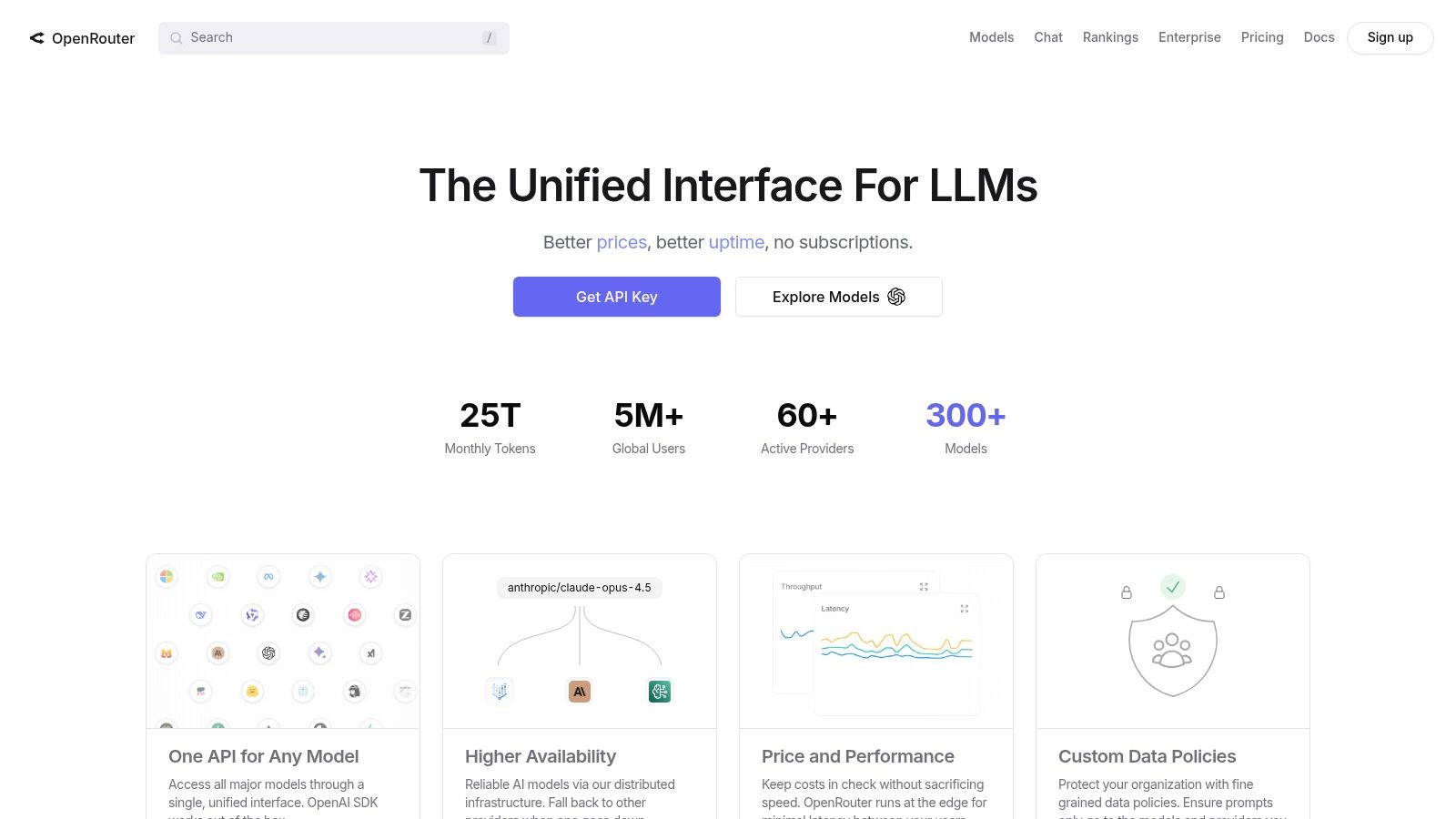
OpenRouter is an LLM aggregator that completely changed how we approach prototyping and model selection at Thareja AI. Instead of integrating multiple provider APIs, we use OpenRouter’s unified, OpenAI-compatible API to access over 400 different models. This was a game-changer early on, as it let us experiment with a vast range of options, from niche open-source models to frontier offerings, without rewriting our codebase for each one. The ability to swap models with a single line of code saved us countless development hours.
Core Strengths & Use Cases
This platform is ideal for rapid experimentation and cost optimization. We leverage its Auto-Router feature to dynamically select the best-fit model for a given task, balancing performance and cost automatically. It's perfect for building applications with variable complexity, such as a multi-layered content generation tool where a smaller, faster model handles simple summaries while a more powerful one tackles creative ideation. This approach helps manage operational expenses without sacrificing quality.
Pros: Access to an enormous catalog of the best LLM models through a single API simplifies development. The routing capability is excellent for cost-performance optimization.
Cons: The platform operates on a prepaid credit system, which requires careful monitoring. It also introduces another layer of abstraction, which can add latency or become a point of failure.
Our Takeaway
OpenRouter is the ultimate sandbox for model discovery and a powerful tool for intelligent routing in production. It’s our first stop for testing new and emerging models or when building cost-sensitive applications that need to dynamically choose the right tool for the job. You can learn more at https://openrouter.ai.
Top 12 LLM Providers — Quick Comparison
Provider | Core features ✨ | Quality ★ | Pricing 💰 | Target 👥 | Standout 🏆 |
|---|---|---|---|---|---|
OpenAI | Frontier multimodal models; tool/function calling | ★★★★★ | 💰 Premium (top-tier) | 👥 Prod apps, agents, real‑time multimodal | 🏆 SOTA models & robust ecosystem |
Anthropic (Claude) | Long‑context reasoning; guardrails & governance | ★★★★☆ | 💰 Tiered token pricing | 👥 Safety/governance‑focused enterprises | 🏆 Long context + strong guardrails |
Google AI Studio (Gemini) | Very large context; grounding (Search/Maps) | ★★★★☆ | 💰 Competitive for Flash; GCP billing | 👥 GCP teams & grounding‑heavy apps | 🏆 Massive context + Google grounding |
Microsoft Azure OpenAI Service | Managed OpenAI models with Azure security & PTUs | ★★★★☆ | 💰 Enterprise/cloud pricing (region vary) | 👥 Azure‑native enterprises | 🏆 Azure‑grade compliance & predictable capacity |
AWS Bedrock | Multi‑provider model catalog; inference tiers & guardrails | ★★★★☆ | 💰 Varies by model & capacity tier | 👥 AWS customers needing multi‑vendor access | 🏆 Broad provider access inside AWS |
Meta Llama | Official model weights for self‑hosting & fine‑tuning | ★★★★☆ | 💰 Self‑host = infra cost (no per‑token) | 👥 Researchers, self‑hosters, custom infra | 🏆 Direct weight access for full control |
Mistral AI | Compact, high‑throughput models; fine‑tuning options | ★★★★☆ | 💰 Competitive price/perf | 👥 Throughput‑heavy, cost‑sensitive teams | 🏆 Cost‑effective throughput models |
Cohere | Enterprise LLMs with private/on‑prem and retrieval tools | ★★★★☆ | 💰 Enterprise sales pricing | 👥 Privacy‑first enterprises | 🏆 Private deployments & retrieval tooling |
Hugging Face | Largest model hub + one‑click inference endpoints | ★★★★☆ | 💰 Flexible instance‑based billing | 👥 Developers, researchers, ML teams | 🏆 Model discovery & community ecosystem |
NVIDIA (Foundation Models & NIM) | TensorRT‑LLM optimizations; NIM microservices | ★★★★☆ | 💰 GPU infra + licensing costs | 👥 High‑throughput GPU deployments | 🏆 Best‑in‑class inference performance |
Together AI | Serverless + dedicated endpoints for open models; fine‑tuning | ★★★★☆ | 💰 Aggressive for open models; batch discounts | 👥 Teams using open models at scale | 🏆 Transparent token pricing & GPU on‑demand |
OpenRouter | Unified API to 400+ models; Auto‑Router & central billing | ★★★☆☆ | 💰 Prepaid credits; adds vendor layer | 👥 Quick model testing & cost/perf routing | 🏆 Fast multi‑model experimentation & routing |
The Takeaway: Stop Searching for the 'Best' Model, Start Building a Smart System
After diving deep into the expansive universe of LLMs, from the refined power of GPT-4o to the open-source spirit of Llama 3, the most critical takeaway isn't which model is definitively number one. The real revelation is that the quest for a single "best LLM model" is a flawed premise. When I first started integrating these technologies, I was obsessed with this question, losing weeks trying to crown a winner. That was a costly mistake, not just in time but in missed opportunities.
The true strategic advantage lies not in finding a lone champion but in architecting an intelligent, multi-model system. The goal isn't to pick a favorite; it's to build a flexible, resilient, and cost-effective AI stack that leverages the unique strengths of different models for specific tasks. This is the mental model shift that separates hobbyists from builders who achieve real business impact.
From Model Worship to Systemic Wisdom
The most powerful lesson I've learned is that an LLM is a component, not a complete solution. Just as you wouldn't use a single screwdriver for every task in a workshop, you shouldn't rely on one LLM for every business need. A multi-model approach allows you to optimize for three critical business levers: cost, performance, and speed.
For instance, at Thareja AI, we learned this the hard way. We initially used a powerful, expensive model for everything, from summarizing internal meeting notes to powering complex customer-facing analytics. Our monthly bill skyrocketed. The turning point came when we implemented a simple routing system:
Low-Stakes Summarization: We switched to a faster, cheaper model like Mistral's 7B. This saved us an estimated 80% on costs for internal tasks without any noticeable drop in quality for that specific use case.
Creative Content Generation: For drafting nuanced marketing copy, we still route to a highly capable model like Claude 3 Opus, where its sophisticated tone and creativity justify the higher cost.
Customer Support Triage: We use a function-calling specialist like Gemini 1.5 Pro to accurately categorize incoming tickets, which then triggers a workflow.
This component-based thinking is the future. It’s about creating a "council of models" where each one contributes its best work, managed by a smart routing layer that makes the optimal choice for every single API call. This isn’t just theory; it's a practical strategy for building a competitive moat around your AI-powered products (Jurafsky & Martin, 2023).
Your Actionable Next Steps
The age of generative AI isn't about sitting on the sidelines; it's about building. Forget endless analysis and start experimenting.
Identify Your Top 3 Use Cases: Don't try to boil the ocean. What are the three most immediate, high-impact tasks you could automate or enhance with an LLM? Be specific: "drafting weekly email newsletters," "analyzing customer feedback for sentiment," or "generating SQL queries from natural language."
Benchmark Two Models: Pick two contrasting models from our list, perhaps one premium (like GPT-4o) and one open-source or cost-effective option (like Llama 3 or a Mistral model). Run a small, real-world test for one of your use cases. Measure the results not just on quality but also on cost per task and processing speed. The goal is to build your own internal benchmark, not rely on generic industry ones (Vaswani et al., 2017).
Think in Systems, Not Silos: As you build, consider how these models will interact with your existing data and workflows. A model's value multiplies when it's integrated, not isolated. Furthermore, as LLMs become integral to how information is found and consumed, understanding their impact on discoverability is crucial. To effectively leverage LLMs and adapt to the evolving search landscape, consult this definitive guide to AI Search Engine Optimization.
This journey from a single-model mindset to a dynamic, multi-model system is the defining step toward creating truly intelligent and efficient applications. The "best LLM models" aren't the ones that top the leaderboards; they are the ones that work in concert, seamlessly and cost-effectively, to solve your specific business problems. It's a fundamental shift from seeking a silver bullet to becoming a master architect of your own intelligent systems (Kaplan et al., 2020; Brown et al., 2020).
Building a multi-model routing system from scratch can be complex and time-consuming. At Thareja Technologies Inc., we've done the heavy lifting for you, creating an intelligent AI gateway that automatically routes your requests to the best model for the job based on performance, cost, and latency. Start building smarter, not harder, by visiting Thareja Technologies Inc. to see how our unified API can save you time and money.