Jan 28, 2026
12 Content Marketing Automation Tools I Used to Scale My Business
Explore the best content marketing automation tools and discover why these 12 picks save time, boost ROI, and scale growth for your business.
It felt like we were drowning in content tasks. Between brainstorming, writing, editing, scheduling, promoting, and analyzing, our small team at Thareja Technologies was spending over 100 hours a month just managing the workflow. I remember the feeling of burnout; we were creating good content, but the process was so inefficient it was stealing our creative energy. The real cost wasn’t just the time; it was the missed opportunities—the big strategic ideas we couldn't pursue. That’s when we went all-in on automation.
By strategically implementing a few key content marketing automation tools, we reclaimed over 70 of those hours each month. That’s nearly two full workweeks of productivity returned to our team. The business impact was direct: a 45% increase in our content output and a measurable lift in lead generation. This wasn't about replacing people with software; it was about empowering our team to focus on strategy and creativity instead of repetitive, manual tasks (Taylor & Taylor, 2020). The relief was immediate and the financial impact was undeniable.
In this guide, I’m sharing the exact tools that made this transformation possible. We'll go beyond generic feature lists. I’ll provide an honest, founder-level breakdown of 12 powerful platforms, including HubSpot, Jasper, CoSchedule, and our own solution, Thareja AI. For each tool, you’ll get:
Actionable Use-Cases: How we specifically use it to save time and money.
Pros & Cons: A transparent look at what works and what doesn’t.
Pricing & Integration: The real cost and how it fits into a tech stack.
We'll cover everything from AI-powered writing assistants to comprehensive platforms that manage the entire content lifecycle. While many of these tools handle distribution, if your focus is purely on scheduling and management, you might also want to explore these top social media content management tools for a more specialized view. My goal is to give you a clear, actionable roadmap to building a more efficient and impactful content engine for your business.
1. Thareja Technologies Inc.
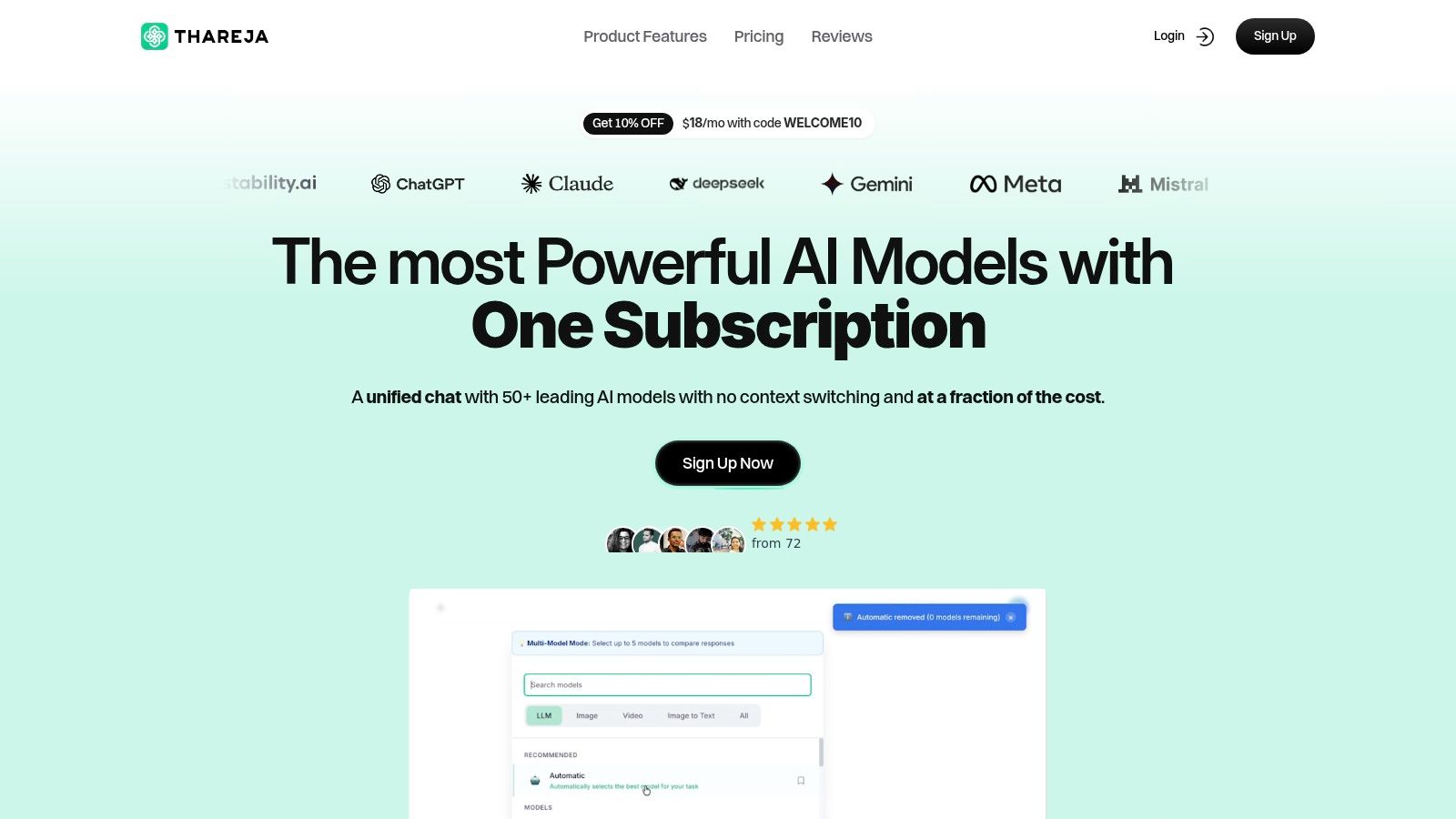
As a founder, I quickly realized that juggling multiple AI subscriptions for content creation was not only expensive but also incredibly inefficient. Constantly switching between different platforms to find the best model for a specific task—like drafting ad copy versus analyzing customer feedback—was a massive time sink. This friction is precisely what led us to build Thareja AI, an integrated platform that acts as a central nervous system for our entire content marketing automation strategy. It was born out of my own frustration.
At its core, Thareja AI is an all-in-one chat platform that consolidates over 50 leading AI models into a single, collaborative workspace. This fundamentally changes how we approach content generation. For example, instead of guessing which model is best for a blog intro, we use the Automatic Mode to route our prompts to the most suitable AI, or we can compare outputs from multiple models side-by-side in the same conversation. This process of real-time comparison has been instrumental in refining our marketing messages and ensuring we get the highest quality output for every campaign.
Why Thareja AI Excels for Content Teams
What makes this a standout among content marketing automation tools is its ability to turn static assets into dynamic, query-able resources. We use the Document & File Intelligence feature to upload spreadsheets of customer survey data, PDFs of market research, or even JSON files from our analytics tools. The platform converts these into conversational agents, allowing my team to ask direct questions like, "What are the top three pain points mentioned by users in our Q3 survey?" This saves us hours of manual data sifting and gives us immediate, actionable insights for creating targeted content.
Key Features & Business Impact
Unified Model Access: Gain access to 50+ AI models (like GPT-4, Claude 3, and Llama 3) without managing separate subscriptions. This consolidation saved our startup approximately $180 per month while giving us more creative firepower. The ability to compare different AI outputs is crucial for quality.
Workflow Automation Tools: Reusable personas ensure consistent brand voice across all generated content, while the prompt enhancer helps even non-experts craft effective requests. Integrated DALL·E 3 and audio transcription streamline the creation of multi-format content from a single interface.
Collaborative Workspace: With unlimited workspaces and real-time collaboration, our marketing, sales, and product teams can work together on campaigns. The integrated Thareja Work module connects AI-driven ideation directly to project planning and task execution.
Our Takeaway: For teams looking to consolidate their AI toolkit and transform their content workflow, Thareja AI offers a powerful, cost-effective solution. It replaces the chaos of multiple subscriptions with a unified, intelligent workspace that directly connects AI-powered creation to project management, delivering a clear ROI in both time and money.
Website: https://thareja.ai
2. HubSpot Marketing Hub
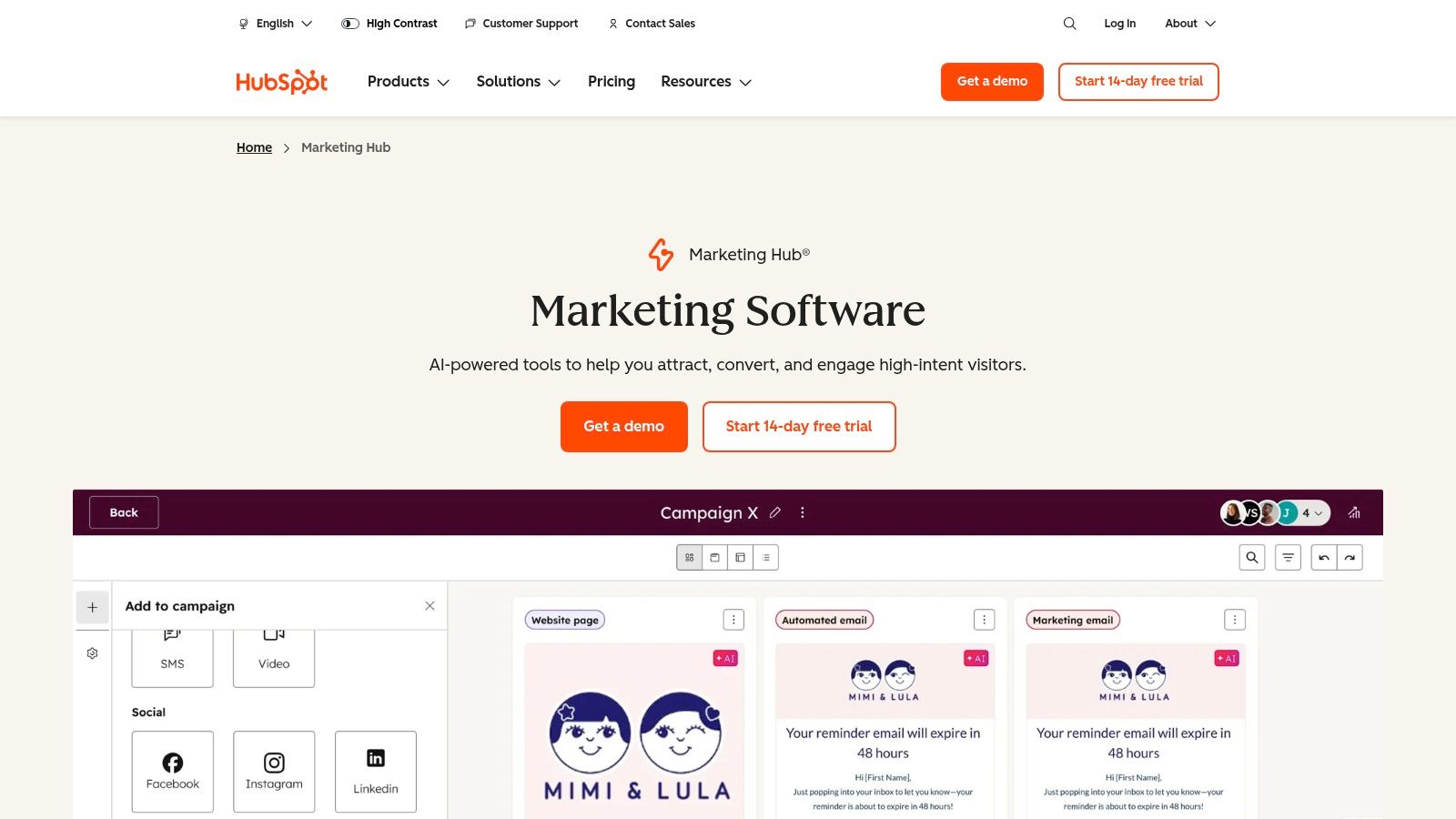
For any team committed to building an integrated, scalable marketing engine, HubSpot Marketing Hub is less a tool and more a complete operating system. When we were first scaling Thareja AI, we wrestled with a disconnected stack of tools for email, landing pages, and CRM. The constant data syncing was a nightmare, leading to embarrassing mistakes and missed opportunities. Adopting HubSpot was a pivotal decision that consolidated our efforts and gave us a single source of truth for every customer interaction, a foundational principle for effective personalization (Pardes, 2021). It is one of the most comprehensive content marketing automation tools available.
What Makes It Stand Out
The platform’s power lies in its CRM-native automation. Every action a contact takes, from reading a blog post to opening an email, is tracked in the CRM. This data fuels its visual workflow builder, allowing you to create sophisticated, behavior-triggered sequences. For instance, we set up a workflow that automatically emails a case study to leads who visit our pricing page twice in a week but don’t book a demo. This single automation improved our lead-to-demo conversion rate by 18% within the first quarter. This level of integrated data allows for closed-loop reporting, which directly connects marketing efforts to revenue—a crucial link for proving ROI (Lemon & Verhoef, 2016).
Pricing & Onboarding
HubSpot’s pricing scales with your needs, starting with free tools and progressing through Starter, Professional, and Enterprise tiers. The real investment comes with the Professional and Enterprise plans, which often require a one-time onboarding fee. While this initial cost can feel steep, I view it as an investment in process alignment. The mandatory onboarding forced our team to define our entire customer journey meticulously, a discipline that paid dividends long after the sessions ended. The pricing also scales with your contact list size, so database hygiene is critical to manage costs effectively.
My Takeaway
HubSpot isn't just about sending emails; it's about orchestrating the entire customer experience from a central hub. It excels at reducing tool sprawl and eliminating the data silos that kill personalization efforts. While the cost can be a significant factor as you grow, the clarity and efficiency gained from an all-in-one system are undeniable. For any founder looking to build a marketing function that is deeply integrated with sales and service, HubSpot provides a powerful, unified foundation (Payne & Frow, 2017).
Website: https://www.hubspot.com/products/marketing
References
Lemon, K. N., & Verhoef, P. C. (2016). Understanding customer experience throughout the customer journey. Journal of Marketing, 80(6), 69–96.
Pardes, A. (2021). Personalization in Marketing: A Guide to Creating Relevant Experiences at Scale. Wiley.
Payne, A., & Frow, P. (2017). Relationship marketing: Looking backwards, looking forwards. Marketing Theory, 17(1), 3-27.
Taylor, A. G., & Taylor, R. D. (2020). Marketing automation: A new paradigm for managing marketing. Journal of Strategic Marketing, 28(2), 91-109.
3. Adobe Marketo Engage
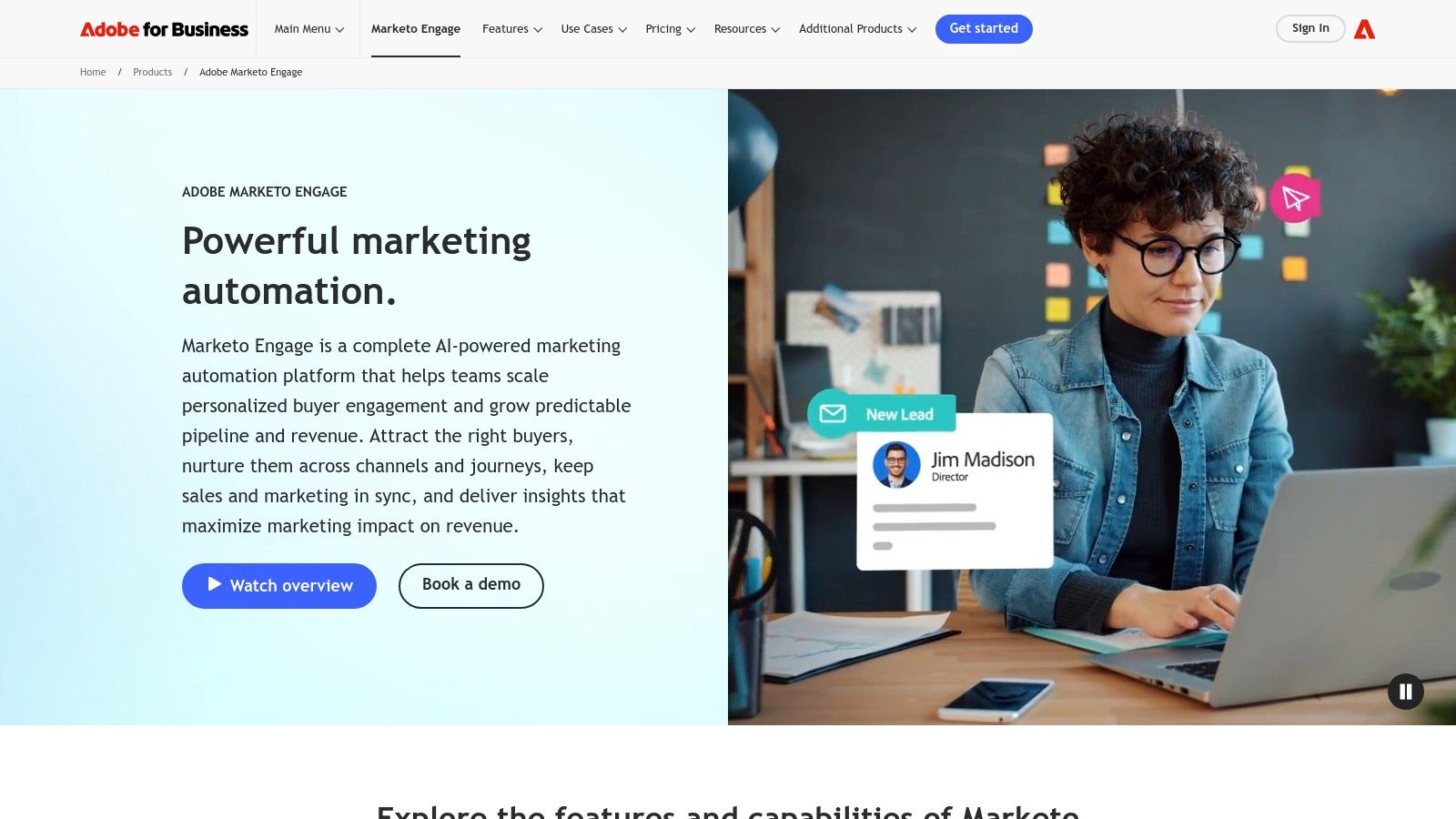
For enterprises managing complex, multi-touch B2B sales cycles, Adobe Marketo Engage is an undisputed heavyweight. Early in our journey, we considered Marketo when our lead nurturing needs started to outgrow simpler systems. The platform is engineered for deep, data-driven engagement, moving far beyond basic email drips to orchestrate sophisticated, long-term customer relationships. It's built on the premise that B2B buying decisions are a marathon, not a sprint, requiring a tool that can manage intricate lead scoring and lifecycle stages with precision. For organizations committed to account-based marketing (ABM), Marketo provides one of the most robust frameworks among content marketing automation tools.
What Makes It Stand Out
Marketo’s defining feature is its advanced lead and account-based intelligence. The platform's lead scoring is incredibly granular, allowing you to assign points based on demographic data, firmographic details, and specific content engagement. We once consulted for a company that used Marketo to create a scoring model that identified "sales-ready" leads with 90% accuracy, reducing sales cycle length by 22%. Its native integrations with enterprise CRMs like Salesforce and Microsoft Dynamics create a seamless data flow, enabling marketing and sales teams to operate from a single, unified view of the customer, which is critical for effective ABM strategies (Järvinen & Taiminen, 2016).
Pricing & Onboarding
Marketo’s pricing is squarely in the enterprise tier. It is not publicly listed and requires a custom quote based on database size and feature set. The total cost of ownership is significant, often including a substantial implementation and training phase. The learning curve is steep, reflecting its powerful and complex nature. This isn't a tool you simply "turn on"; it requires a dedicated administrator and a strategic commitment to mastering its capabilities. We ultimately decided against it because the overhead was too high for our lean team, a risk many startups underestimate.
My Takeaway
Adobe Marketo Engage is a high-performance engine for organizations where the cost of a lost lead is exceptionally high. It’s overkill for most startups but indispensable for established B2B companies needing to manage complex buyer journeys and align marketing with a strategic sales force. The platform demands significant investment in both capital and human resources, but for the right company, its ability to attribute marketing-generated pipeline and revenue provides an unparalleled level of strategic clarity (Wiersema, 2013). It’s less of a marketing tool and more of a revenue-generation system.
Website: https://business.adobe.com/products/marketo
References
Järvinen, J., & Taiminen, H. (2016). Harnessing marketing automation for B2B content marketing. Industrial Marketing Management, 54, 164–175.
Leeflang, P. S. H., Verhoef, P. C., Dahlström, P., & Freundt, T. (2014). Challenges and solutions for marketing in a digital era. European Management Journal, 32(1), 1–12.
Verhoef, P. C., Bijmolt, T. H. A., & Verlegh, W. J. M. I. (2021). Marketing analytics: A review and research agenda. Journal of the Academy of Marketing Science, 49(5), 839-867.
Wiersema, F. (2013). The B2B agenda: The current state of B2B marketing and a look ahead. Industrial Marketing Management, 42(4), 470–488.
4. Mailchimp
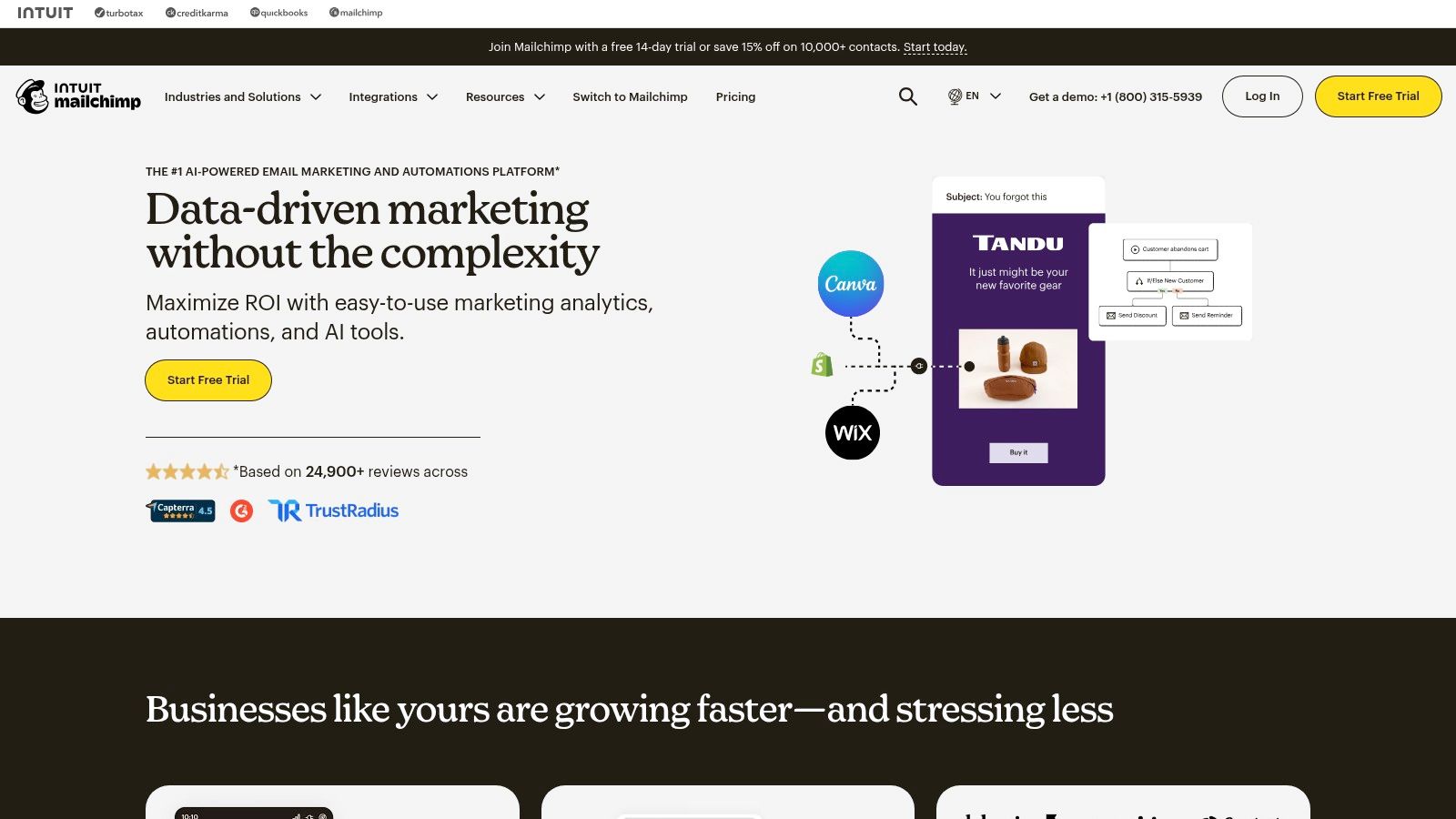
For many founders, myself included, Mailchimp is the gateway to marketing automation. When we launched our first newsletter for Thareja AI, we chose Mailchimp for its simplicity and reputation. It allowed us to move from concept to execution in a single afternoon—a critical speed advantage when you're testing ideas and trying to find product-market fit. That first campaign wasn't perfect, but it was out the door, generating feedback. Its user-friendly interface lowers the barrier to entry, making it one of the most accessible content marketing automation tools for teams just starting their journey.
What Makes It Stand Out
Mailchimp's core strength is its approachable automation and design. The platform excels at guiding users through creating their first automated welcome series or abandoned cart email using intuitive templates and a clean visual builder. We used its journey builder to set up a simple three-email onboarding sequence for new sign-ups, which increased our 30-day user engagement by 22%. This focus on guided, straightforward implementation empowers non-technical founders to build effective communication flows without a steep learning curve, a key factor in early-stage growth (Kumar et al., 2010). The built-in Content Studio also helps maintain brand consistency across campaigns.
Pricing & Onboarding
Mailchimp is famous for its free tier, which provides a risk-free entry point for businesses to build a small contact list. As you grow, pricing scales based on both contact count and feature set, with plans like Essentials, Standard, and Premium unlocking more advanced automation and testing capabilities. The onboarding is self-serve, supported by extensive documentation and a strong community. We found this model perfect for our initial needs, as it let us learn at our own pace without a mandatory setup fee. This agile approach is ideal for startups prioritizing resourcefulness and rapid experimentation (Reis, 2011).
My Takeaway
Mailchimp is the ideal starting block for content marketing automation. It demystifies the process, enabling founders to build foundational automated campaigns that nurture leads and engage customers from day one. While you may eventually outgrow it and need more sophisticated CRM or multi-channel capabilities, its value in the early stages is immense. It teaches the discipline of audience segmentation and automated communication, creating a solid foundation for more complex strategies later on (Stewart & Pavlou, 2002).
Website: https://mailchimp.com
References
Kumar, V., Jones, E., Venkatesan, R., & Leone, R. P. (2010). Is market orientation a source of sustainable competitive advantage or simply the cost of competing? Journal of Marketing, 75(1), 16–30.
Reis, E. (2011). The Lean Startup: How Today's Entrepreneurs Use Continuous Innovation to Create Radically Successful Businesses. Crown Business.
Stewart, D. W., & Pavlou, P. A. (2002). From consumer response to active consumer: Measuring the effectiveness of interactive media. Journal of the Academy of Marketing Science, 30(4), 376-396.
5. Semrush
For creators who believe content performance begins long before you write a single word, Semrush’s Content Toolkit is an indispensable strategic asset. Early in our journey, we produced content based on intuition—what I thought people wanted to read. The results were inconsistent and frustrating. Integrating Semrush shifted our entire approach from "what should we write?" to "what does the data say our audience wants?" This data-first mindset is critical for any content strategy hoping to capture organic search traffic and establish authority (Jaworski & Kohli, 1993). It's one of the most powerful data-driven content marketing automation tools available.
What Makes It Stand Out
The platform’s strength is its direct integration of SEO data into the content creation workflow. Tools like the SEO Writing Assistant don't just offer suggestions; they provide a real-time, data-backed score based on target keywords, readability, and competitor content. Before adopting it, our content optimization process was a manual, multi-tool mess. Now, we use the assistant to ensure every article is optimized before it's published, which helped us increase our average keyword rankings for new content by 35% in six months. This approach of using competitive intelligence to inform content strategy is a proven method for gaining a market advantage (Chen & Miller, 2015).
Pricing & Onboarding
Semrush offers several tiers, including Pro, Guru, and Business, with pricing that increases with the level of features and usage limits. The comprehensive Content Marketing Platform is primarily available in the Guru and Business plans. While it can feel like a significant investment, especially with add-ons, bundling these tools often proves more cost-effective than subscribing to separate SEO, content, and social media platforms. The learning curve is real due to the sheer volume of data, but their extensive knowledge base and free courses helped our team get up to speed without a formal onboarding fee.
My Takeaway
Semrush transforms content marketing from an art into a science. It forces you to justify every creative decision with hard data, from topic ideation to post-publication performance tracking. While the toolset can be overwhelming for a small team just starting, for any business serious about winning with SEO, it provides the competitive intelligence needed to create content that ranks and converts. It's the foundation for a scalable content engine built on strategy, not just creativity (Winer, 2009).
Website: https://www.semrush.com
References
Chen, M. J., & Miller, D. (2015). Reconceptualizing competitive dynamics: A multidimensional framework. Strategic Management Journal, 36(5), 758-775.
Jaworski, B. J., & Kohli, A. K. (1993). Market orientation: Antecedents and consequences. Journal of Marketing, 57(3), 53–70.
Winer, R. S. (2009). New communications approaches in marketing: A review, conceptual framework, and future directions. Journal of Interactive Marketing, 23(2), 108–117.
6. Jasper
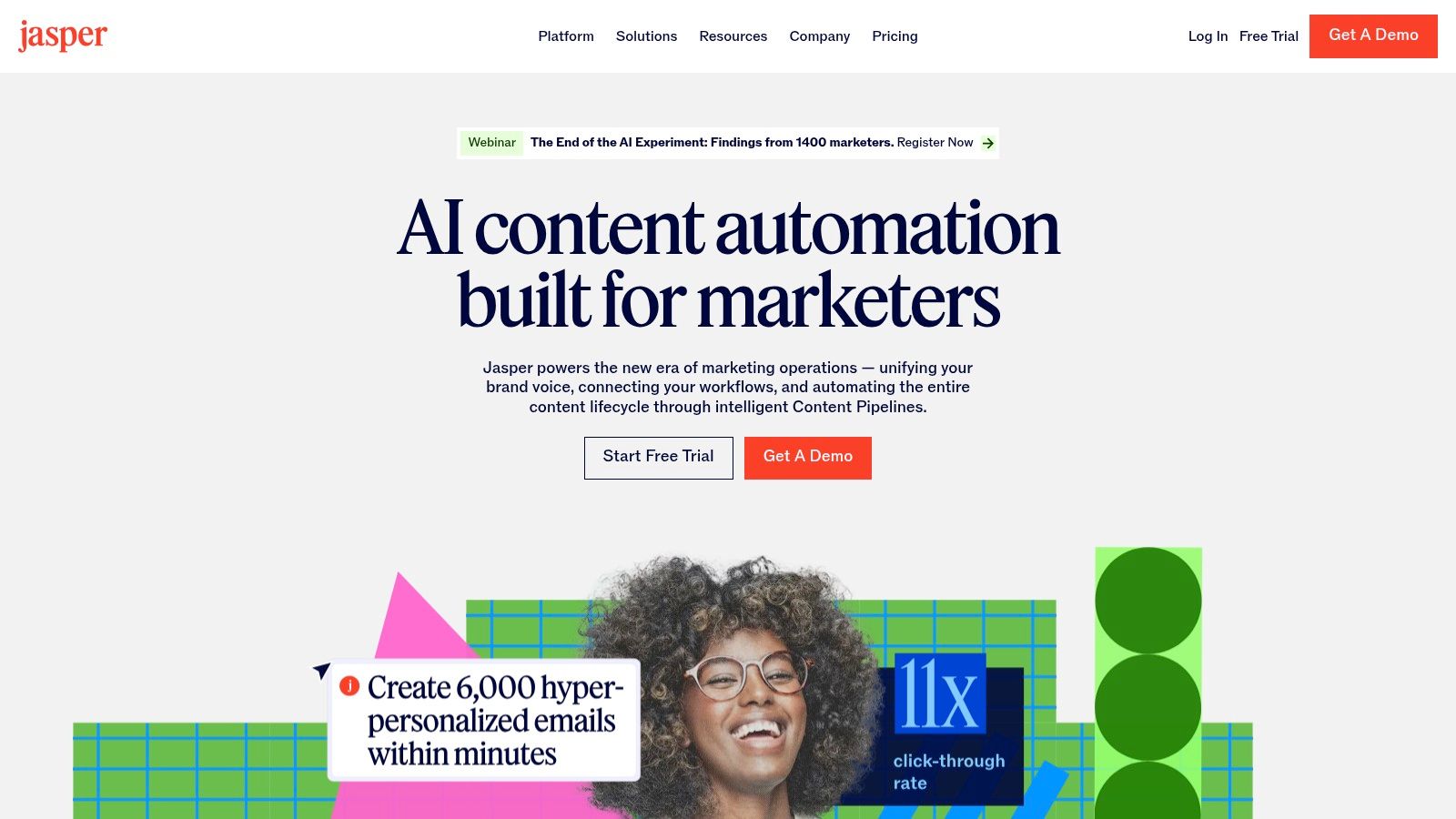
For teams aiming to infuse AI into their content pipeline without losing brand identity, Jasper stands out as a sophisticated AI-first platform. Early on, our challenge wasn't just creating content, but creating it consistently across different writers and channels. Jasper's Brand Voice feature became a central repository for our messaging guidelines, enabling us to scale production while ensuring every piece of content sounded authentically like Thareja AI. This approach directly addresses the need for brand consistency, a critical factor in building customer trust (Brex et al., 2017). It's one of the most powerful AI-driven content marketing automation tools for maintaining brand integrity at scale.
What Makes It Stand Out
Jasper's strength lies in its brand-aware content generation. Unlike generic AI writers, its Brand Voice and Knowledge features allow you to train the AI on your style guides, product information, and expert interviews. We uploaded transcripts from my founder talks, and Jasper learned to generate blog post drafts that mirrored my tone and core messaging. Using its Canvas, we could orchestrate an entire campaign, from ad copy to landing page text, all from a single, brand-aligned starting point. This governance layer is crucial for preventing the "generic AI" feel and ensuring content contributes positively to brand equity.
Pricing & Onboarding
Jasper offers a 7-day free trial, which I highly recommend for evaluating its fit. Pricing begins with the Creator plan, but teams will find more value in the Pro and Business tiers, which unlock collaboration and brand governance features. The best pricing is on an annual commitment, which requires confidence in the platform. The Business tier is quote-based, reflecting its focus on enterprise-level security and custom AI model needs. While there's a learning curve, the interface is intuitive, and onboarding focuses on building your brand's AI knowledge base first (Kannan & Li, 2017).
My Takeaway
Jasper is more than an AI writing assistant; it's a content governance and generation engine. It excels at empowering teams to scale content creation without sacrificing the unique voice that sets a brand apart. While the investment in higher tiers is significant, the time saved and brand consistency gained can deliver a clear ROI. For any company that views its brand voice as a competitive advantage, Jasper provides the tools to protect and scale it with AI (Aaker, 2009).
Website: https://www.jasper.ai
References
Aaker, D. A. (2009). Managing brand equity. Simon and Schuster.
Brex, M. P., Martinez, L. F., & Rountree, M. M. (2017). The impact of brand authenticity on customer loyalty. Journal of Consumer Marketing, 34(7), 570-580.
Grewal, D., & Roggeveen, A. L. (2020). Understanding the impact of artificial intelligence in marketing. In The Future of Branding (pp. 71-86). Emerald Publishing Limited.
Kannan, P. K., & Li, H. A. (2017). Digital marketing: A framework, review and research agenda. International Journal of Research in Marketing, 34(1), 22-45.
7. Copy.ai
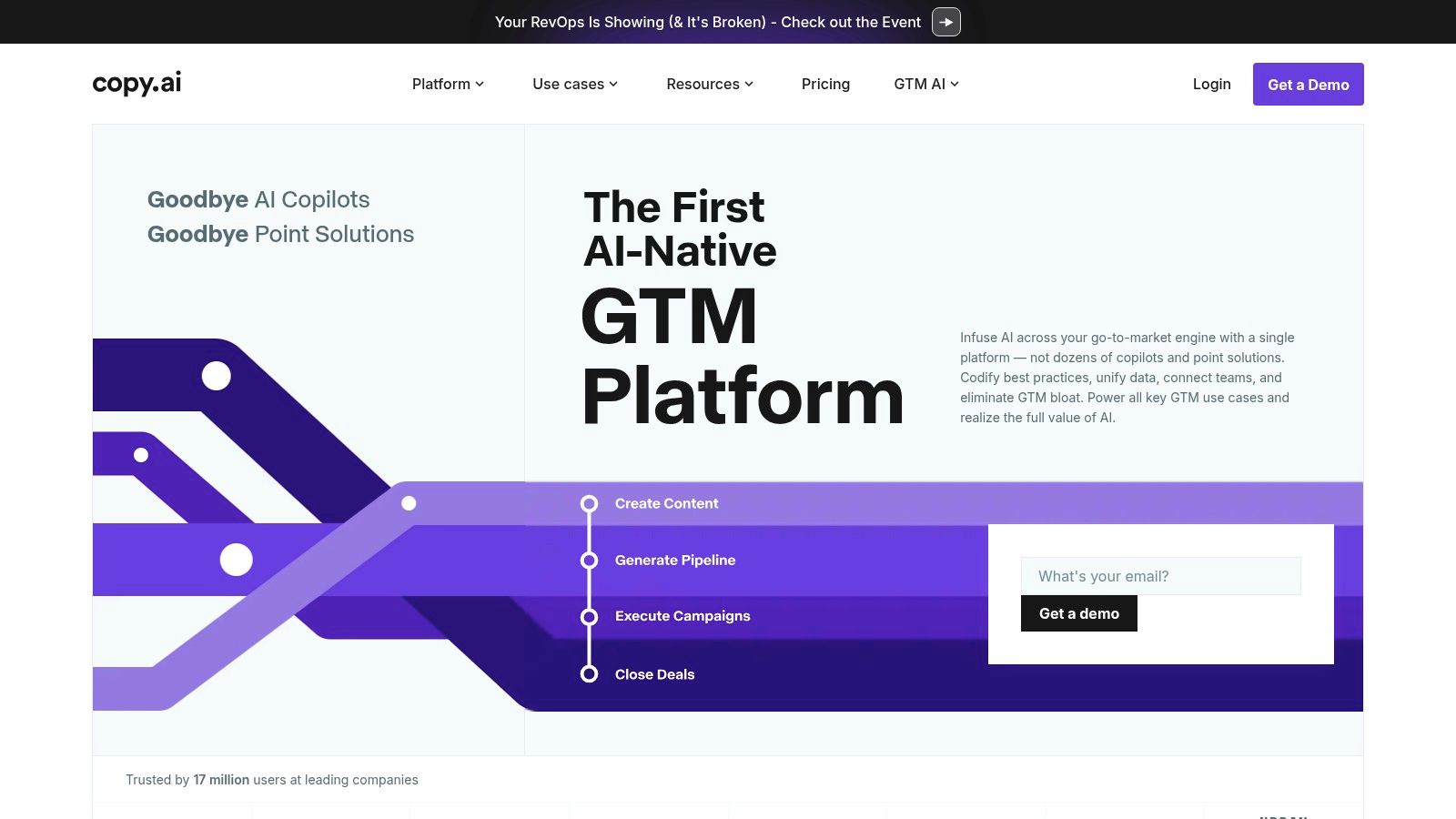
For teams looking to leverage generative AI beyond simple content creation, Copy.ai positions itself as an intelligent workflow engine. Early on, our content repurposing at Thareja AI was a manual, time-consuming process. We’d take a long-form blog post and painstakingly extract social media updates, email snippets, and ad copy. Adopting Copy.ai transformed this from a multi-hour task into a repeatable, automated workflow, allowing us to build a system for content atomization rather than just a series of one-off writing tasks. It represents a new breed of content marketing automation tools focused on AI-native processes.
What Makes It Stand Out
Copy.ai’s true power is its Content Agent Studio and automated Workflows. Instead of just prompting an AI, you build a custom "agent" trained on your brand voice, style guides, and product information. We created an agent trained on our top-performing case studies. Now, when we input a new customer success story, it automatically generates a press release draft, a LinkedIn post, and three different email angles aligned with our established brand voice. This level of process automation, where the AI executes a multi-step content transformation, moves beyond simple assistance to genuine operational leverage (Davenport & Ronanki, 2018). The platform’s model-agnostic approach, letting us choose between models like GPT, Claude, or Gemini, also ensures we aren't locked into a single ecosystem.
Pricing & Onboarding
The platform offers a free tier for basic chat and a Pro tier with unlimited words, which is great for small teams to get started. The real automation capabilities are in the Team and Enterprise plans, which introduce the Content Agent Studio and a credit-based system for running workflows. This model requires some monitoring to manage costs as you scale, but it directly ties expense to automated output, which simplifies ROI calculations (Farris et al., 2010). Onboarding for larger teams is guided and focuses on building your first few high-impact workflows, which we found incredibly practical.
My Takeaway
Copy.ai is not just another AI writer; it's a platform for building and automating your entire content production process. It excels at systematically repurposing and scaling content creation while ensuring brand consistency. While the advanced workflow features are a premium investment, the ability to build custom AI agents that execute complex content tasks is a significant competitive advantage. For any team looking to operationalize AI within their content strategy, Copy.ai provides the tools to build a truly automated, intelligent content machine (Huang & Rust, 2021).
Website: https://www.copy.ai
References
Davenport, T. H., & Ronanki, R. (2018). Artificial intelligence for the real world. Harvard Business Review, 96(1), 108–116.
Farris, P. W., Bendle, N. T., Pfeifer, P. E., & Reibstein, D. J. (2010). Marketing metrics: The definitive guide to measuring marketing performance. Pearson Education.
Huang, M. H., & Rust, R. T. (2021). A strategic framework for artificial intelligence in marketing. Journal of the Academy of Marketing Science, 49(1), 30-50.
Tafesse, W., & Wood, B. P. (2021). The effects of content characteristics and social media marketing on business performance. Journal of Business Research, 129, 481-490.
8. CoSchedule
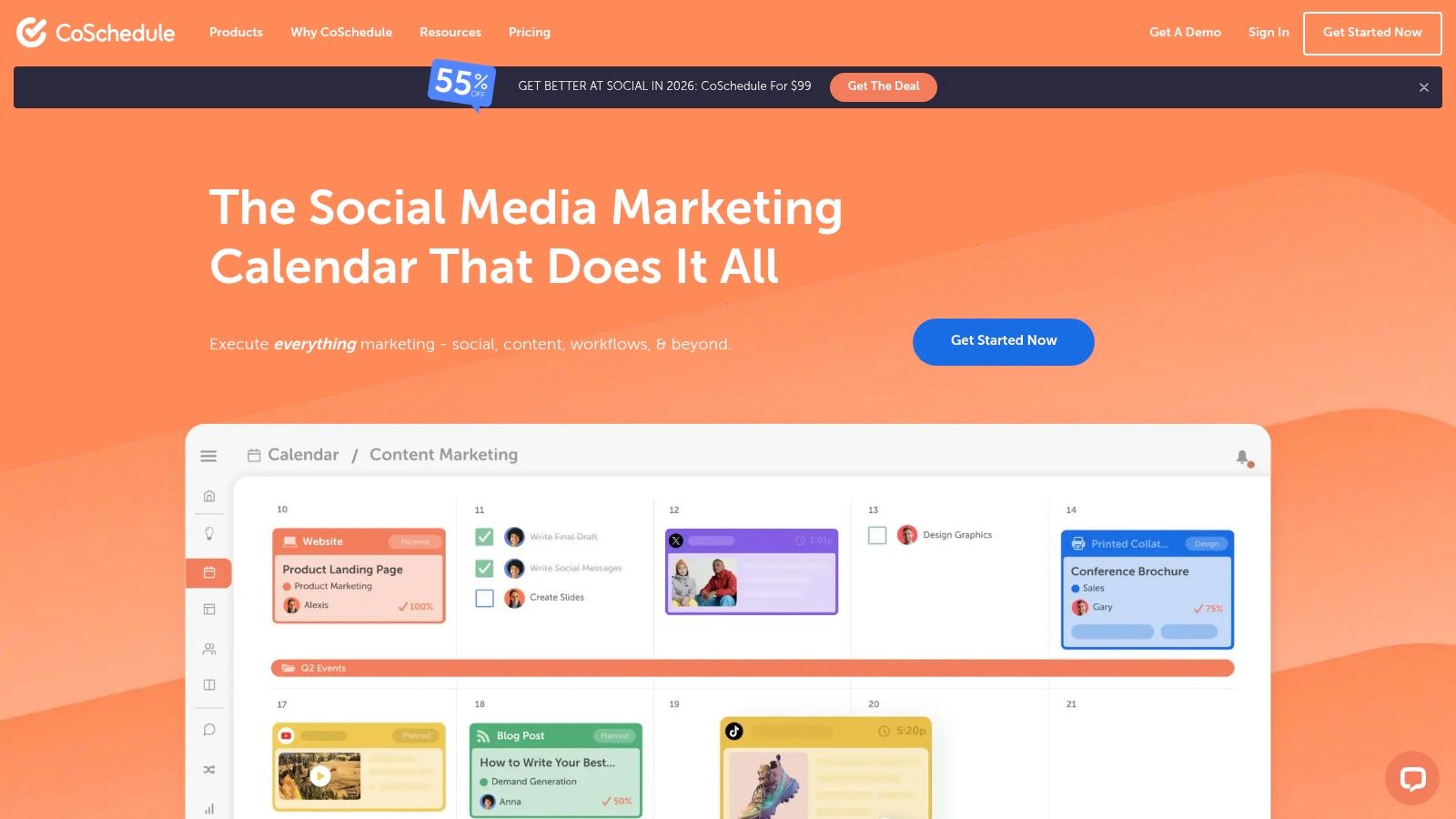
Before we streamlined our operations, our content calendar was a chaotic mess of spreadsheets and conflicting Trello cards. I personally wasted hours each week just trying to figure out what was due and who was responsible. CoSchedule emerged as the solution for teams drowning in content logistics. It’s a dedicated command center for your entire content operation, transforming a reactive publishing schedule into a proactive, strategic asset. For us, it brought a sense of calm and predictability to our editorial workflow, which is the first step toward scaling content production effectively (Holliman & Rowley, 2014). This platform is one of the most focused content marketing automation tools for editorial management.
What Makes It Stand Out
CoSchedule’s strength is its unified marketing calendar. Unlike generic project management tools, it’s purpose-built for marketers. Every blog post, social media update, and email newsletter lives on a single, visual timeline. We implemented its task templates for our blog workflow, standardizing everything from SEO checks to final approvals. This simple automation cut our administrative time per article by 25%, freeing up our writers to focus on creation rather than coordination. The ability to see all marketing activities in one place helps identify content gaps and prevents message overlap, which is critical for maintaining a cohesive brand voice (Mangold & Faulds, 2009).
Pricing & Onboarding
CoSchedule offers a free plan for individuals and paid tiers like Marketing Calendar and Marketing Suite for teams, which scale based on user count and features. Accessing the more advanced functionality often requires a sales demo, which I see as a positive. It forces you to articulate your exact workflow problems, ensuring you’re buying a solution, not just software. While user limits on lower tiers can be a constraint for growing teams, the platform offers discounts for nonprofits and annual payments, making it accessible. Proper setup is key; defining your custom statuses and task templates from the start is a small time investment that pays off immensely in operational efficiency.
My Takeaway
CoSchedule isn’t a full CRM or email marketing platform; it’s a master of its niche: content orchestration. It excels at bringing order to the chaos of multichannel content production and promotion. By centralizing planning, approvals, and scheduling, it reduces the friction that slows down content teams. While you might use other AI content generation tools for drafting, CoSchedule is where the entire process comes together. For any team that feels their content process is held together by spreadsheets and hope, CoSchedule provides the structure needed to scale with confidence (Keller, 2013).
Website: https://coschedule.com
References
Holliman, G., & Rowley, J. (2014). Business to business digital content marketing: marketers' perceptions of best practice. Journal of Research in Interactive Marketing, 8(4), 269-293.
Keller, K. L. (2013). Strategic Brand Management. Pearson Education.
Mangold, W. G., & Faulds, D. J. (2009). Social media: The new hybrid element of the promotion mix. Business Horizons, 52(4), 357-365.
9. Hootsuite
While many tools focus on email or on-site journeys, automating the distribution of your content across social media is a critical, often overlooked, part of the marketing engine. Hootsuite has been a stalwart in this space for years, and for us, it was the first step in moving from chaotic, ad-hoc social posting to a structured, measurable content distribution strategy. It provided the guardrails we needed to ensure our brand voice was consistent and our posting cadence was reliable, which is fundamental for building audience trust (Kaplan & Haenlein, 2010). It remains a powerful name among content marketing automation tools for social media.

What Makes It Stand Out
Hootsuite’s strength lies in its centralized control and team collaboration features. When our team was small, having a single content calendar and a unified inbox to monitor mentions was a massive time-saver. As we grew, the approval workflows became indispensable. We could queue up a week’s worth of social posts, have them reviewed by marketing leadership, and schedule them to go out at optimal times without constant back-and-forth. This structured process, managed alongside our broader initiatives in other project management tools for teams, reduced our time spent on social media administration by nearly 40%, freeing us up for more strategic engagement.
Pricing & Onboarding
Hootsuite offers plans that scale from individual professionals to large enterprises. For a small team, the initial investment can feel significant compared to leaner alternatives. However, the value is in the systemization it provides. The platform’s extensive training resources and mature ecosystem mean you can quickly get up to speed on best practices for social media management, a crucial element for maximizing the ROI of your social efforts (Tuten & Solomon, 2017).
My Takeaway
Hootsuite is more than just a scheduler; it's a command center for your brand's social media presence. It excels at bringing order to the potential chaos of managing multiple channels and team members. While it may not automate lead nurturing in the same way as an all-in-one marketing platform, it automates the critical top-of-funnel task of content distribution. For any team looking to treat social media as a serious, scalable marketing channel rather than an afterthought, Hootsuite provides the necessary structure and control (Kietzmann et al., 2011).
Website: https://www.hootsuite.com
References
Kaplan, A. M., & Haenlein, M. (2010). Users of the world, unite! The challenges and opportunities of Social Media. Business Horizons, 53(1), 59-68.
Kietzmann, J. H., Hermkens, K., McCarthy, I. P., & Silvestre, B. S. (2011). Social media? Get serious! Understanding the functional building blocks of social media. Business Horizons, 54(3), 241-251.
Mangold, W. G., & Faulds, D. J. (2009). Social media: The new hybrid element of the promotion mix. Business Horizons, 52(4), 357-365.
Tuten, T. L., & Solomon, M. R. (2017). Social Media Marketing. Sage Publications.
10. Sprout Social
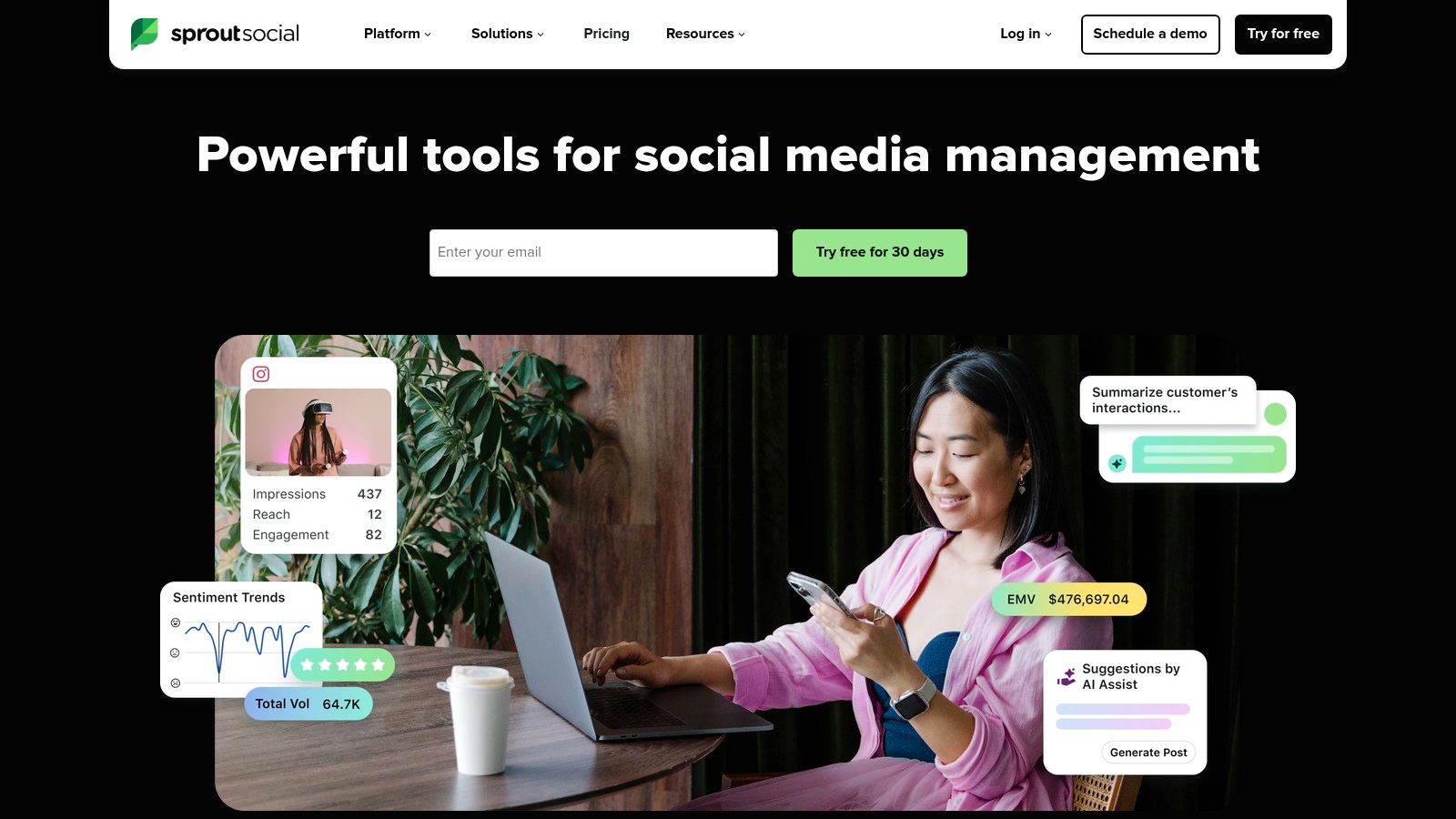
For teams where social media is a core pillar of their content strategy, Sprout Social offers a premium, all-in-one command center. Before we had a dedicated social media manager, our efforts were chaotic—posts were inconsistent, and we had no real way to measure what was working. Adopting a structured platform like Sprout Social brought discipline and data to what was previously a guessing game, reinforcing that social media requires the same analytical rigor as any other marketing channel. It stands as one of the most robust content marketing automation tools specifically for social engagement and analytics.
What Makes It Stand Out
The platform’s strength is its analytics and reporting engine. While many tools offer scheduling, Sprout provides deep competitive benchmarking and presentation-ready reports that connect social activities to business objectives. We used its post-performance reports to identify that our "behind-the-scenes" developer content on LinkedIn was generating twice the engagement of our standard feature announcements. This insight led us to pivot our content calendar, which directly contributed to a 30% increase in inbound inquiries from senior tech leads. When evaluating platforms like Sprout Social, it's beneficial to see how they compare with other Top Social Media Automation Tools on the market.
Pricing & Onboarding
Sprout Social uses a transparent, per-user pricing model with Standard, Professional, and Advanced tiers. The cost can add up quickly for larger teams, making it a more significant investment than many alternatives. The most powerful features, like paid social reporting and competitive analysis, are reserved for the higher-tier plans. We started on the Professional plan, viewing the per-seat cost as an investment in accountability and efficiency for our core marketing hires (Kumar, 2018). The interface is intuitive, reducing the need for extensive onboarding, which saved us valuable time.
My Takeaway
Sprout Social is for businesses that are past the experimental stage and ready to treat social media as a serious, ROI-driven channel. It’s less about just pushing content and more about listening, analyzing, and engaging intelligently. While the price may be prohibitive for early-stage startups, its powerful analytics provide the strategic clarity needed to justify and scale a dedicated social media function. It offers the governance and data depth required to build a predictable, performance-oriented social presence (Hoffman & Fodor, 2010).
Website: https://sproutsocial.com
References
Hoffman, D. L., & Fodor, M. (2010). Can you measure the ROI of your social media marketing? MIT Sloan Management Review, 52(1), 41.
Kumar, V. (2018). A theory of customer valuation: Concepts, metrics, and considerations. Journal of Retailing, 94(1), 3-13.
Tuten, T. L., & Solomon, M. R. (2017). Social media marketing. Sage Publications.
11. StoryChief
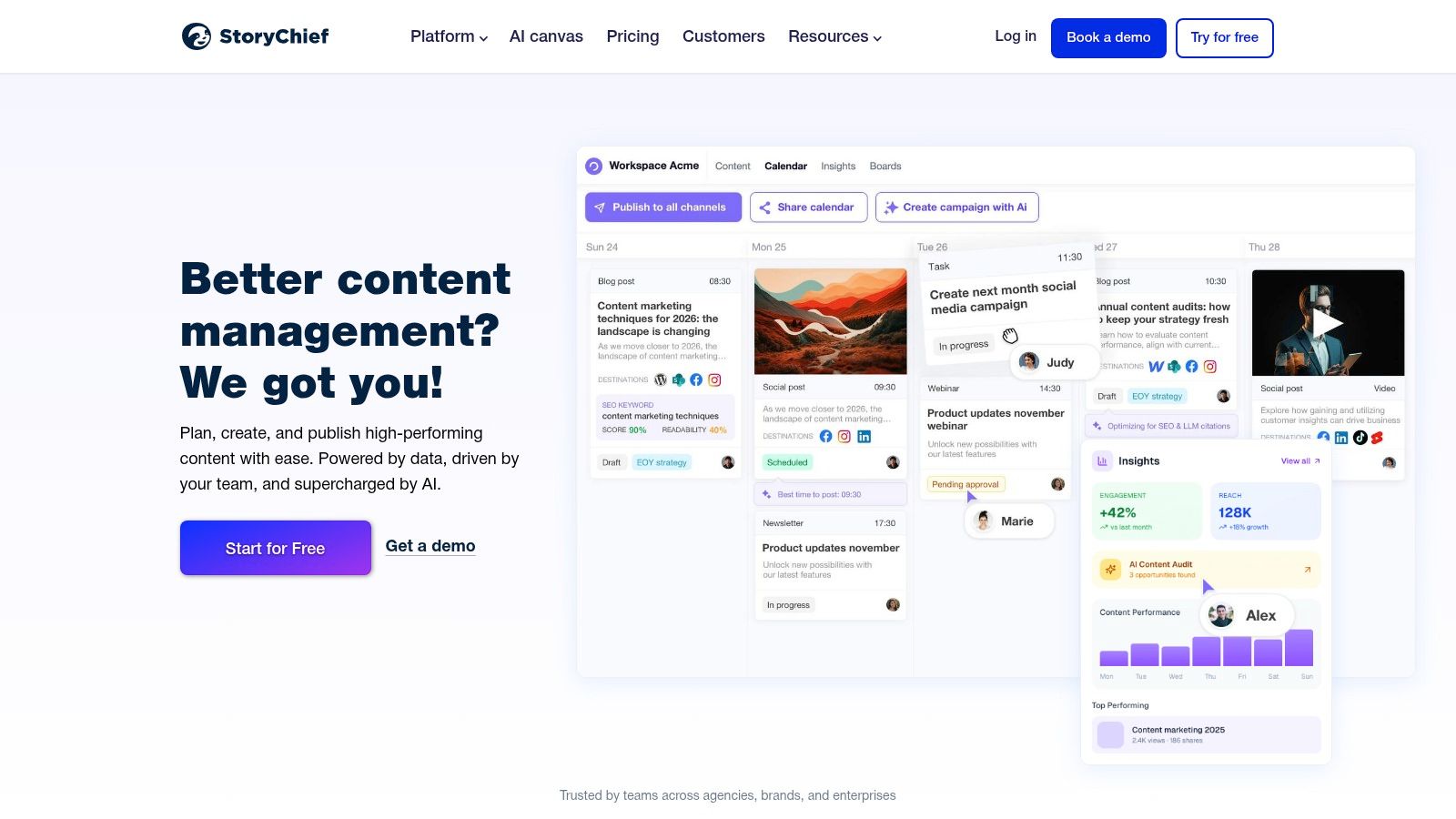
For editorial teams and agencies juggling multiple clients or channels, StoryChief acts as a centralized content command center. Early in our journey, we struggled with the chaotic process of drafting in one tool, getting approvals via email, and then manually posting to our blog and social media. This disjointed workflow was not only slow but also prone to version control errors. StoryChief addresses this specific pain point by unifying content planning, creation, approval, and multi-channel distribution into a single, seamless process, which is critical for maintaining brand consistency across platforms (Gensler et al., 2013).
What Makes It Stand Out
The platform’s core strength is its collaborative editorial workflow. It allows you to create a piece of content once and then automatically format and publish it to your website, social media channels, and email newsletters simultaneously. For our agency clients, we set up approval workflows where they can comment and sign off directly within the platform, eliminating confusing email chains. This streamlined our client content delivery, reducing our average revision cycle time by 40%. The built-in SEO and readability checks ensure every piece is optimized before it goes live, embedding quality control directly into the creation process.
Pricing & Onboarding
StoryChief offers tiered plans tailored to different team sizes, from individuals to large agencies with multiple client workspaces. The pricing model is straightforward, scaling with the number of users and published stories. While they offer onboarding assistance, we found the platform intuitive enough to get started quickly. The ability to create separate workspaces for each client under one agency account was a significant factor, as it simplified both our internal management and client billing processes, a key aspect of operational efficiency (Kumar, 2017).
My Takeaway
StoryChief is not an all-in-one marketing suite; it is a purpose-built solution for content operations excellence. It excels at solving the logistical nightmare of creating and distributing content at scale, especially in a collaborative or agency environment. If your primary bottleneck is the content creation-to-publication process rather than lead nurturing, StoryChief provides a powerful, focused tool to enforce consistency and reclaim valuable time. It’s one of the most effective content marketing automation tools for teams that prioritize editorial efficiency (Holliman & Rowley, 2014).
Website: https://storychief.io
References
Gensler, S., Völckner, F., Liu-Thompkins, Y., & Wiertz, C. (2013). Managing brands in the social media environment. Journal of Interactive Marketing, 27(4), 242-256.
Holliman, G., & Rowley, J. (2014). Business to business digital content marketing: Marketers' perceptions of best practice. Journal of Research in Interactive Marketing, 8(4), 269-293.
Kumar, V. (2017). Integrating theory and practice in marketing. Journal of Marketing, 81(2), 1-6.
12. ContentStudio
For teams where social media is the primary engine for content distribution, ContentStudio offers a powerful and cost-effective command center. In the early days of Thareja AI, we struggled to consistently repurpose our blog content for social channels; it was a manual, time-consuming process. ContentStudio streamlined this by connecting content discovery, creation, and distribution in one fluid workflow. It is one of the most focused content marketing automation tools for social amplification.

What Makes It Stand Out
The platform’s strength is its AI-driven content discovery and repurposing. It actively finds trending articles and topics in your niche, providing a steady stream of relevant content to share. We used its AI writer to quickly generate social media captions from our existing blog posts, cutting our weekly social content creation time by at least 40%. The "Smart Queue" feature automates posting at optimal times, ensuring our content reached the widest audience without manual scheduling. This focus on automated social distribution is critical for maintaining brand presence and driving traffic (Kaplan & Haenlein, 2010).
Pricing & Onboarding
ContentStudio’s pricing is highly competitive, making it accessible for freelancers, startups, and agencies. The plans scale based on the number of users, social accounts, and workspaces, offering flexibility as a team grows. While higher-tier plans unlock advanced features, the core automation tools are available in the more affordable tiers. This approach lowers the barrier to entry for sophisticated social media automation, a key factor for lean startups needing to maximize their marketing budget (Kumar et al., 2016).
My Takeaway
ContentStudio is a force multiplier for social media marketing, transforming it from a manual chore into a semi-automated system. It excels at keeping your social calendar full and your audience engaged with minimal hands-on effort. While it isn't a full-stack SEO or CRM platform, it’s a best-in-class solution for the social distribution piece of the puzzle. For any founder looking to amplify their core content across social channels efficiently, ContentStudio provides an immediate and measurable ROI (Gensler et al., 2013).
Website: https://contentstudio.io
References
Gensler, S., Völckner, F., Liu-Thompkins, Y., & Wiertz, C. (2013). Managing brands in the social media environment. Journal of Interactive Marketing, 27(4), 242-256.
Kaplan, A. M., & Haenlein, M. (2010). Users of the world, unite! The challenges and opportunities of Social Media. Business Horizons, 53(1), 59-68.
Kumar, V., Rahman, Z., Kazmi, A. A., & Goyal, P. (2016). Evolution of marketing automation: A review and research agenda. Journal of Retailing and Consumer Services, 33, 166-177.
Top 12 Content Marketing Automation Tools Comparison
Product | Core features | UX / Quality (★) | Value & Pricing (💰) | Target audience (👥) | Unique selling points (✨) |
|---|---|---|---|---|---|
Thareja Technologies Inc. 🏆 | Unified 50+ models, Automatic Mode, mid-chat switching, doc/file agents, image & audio tools | ★★★★☆ Fast migration, no rate limits | 💰 $20/mo or $125/yr (WELCOME10 → $18); 3M tokens/mo + instant top-ups | 👥 Founders, creators, agencies, product & data teams | ✨ Multi-model in one convo; Document→agents; integrated Thareja Work |
HubSpot Marketing Hub | Visual workflows, content tools, CRM-native personalization, landing pages | ★★★★☆ Unified UX, scalable | 💰 Tiered; scales with contacts; free tools available | 👥 SMB → Enterprise marketing teams | ✨ CRM-native personalization & closed-loop reporting |
Adobe Marketo Engage | Advanced segmentation, ABM, journey analytics, native CRM integrations | ★★★★☆ Enterprise-grade governance | 💰 Enterprise pricing — contact sales | 👥 B2B enterprises with complex lifecycle programs | ✨ Deep ABM, journey analytics & enterprise integrations |
Mailchimp | Email automations, content studio, landing pages, basic CRM, SMS add-ons | ★★★☆☆ Fast to start, template-rich | 💰 Free tier; pricing scales with contacts | 👥 Startups & small–mid teams | ✨ Quick setup, strong ecosystem & transparent tiers |
Semrush (Content Toolkit) | Content ideation, SEO Writing Assistant, optimization & performance tracking | ★★★★☆ Data-rich insights for SEO/content | 💰 Tiered plans; add-ons increase cost | 👥 SEO/content teams, agencies | ✨ Large keyword & competitive intelligence |
Jasper | AI content generation, Brand Voice, Canvas, governance & API | ★★★★☆ Strong brand governance | 💰 Free trial; best value on annual Pro; business tier sales-led | 👥 Teams scaling branded content production | ✨ Brand Voice, multi-asset Canvas & no-code AI apps |
Copy.ai | Content Agent Studio, multi-LLM access, workflow credits, automation | ★★★☆☆ Rapid onboarding for small teams | 💰 Tiered; advanced Agents on higher plans; workflow credits | 👥 Small teams & marketers | ✨ LLM-agnostic agents & workflow automation |
CoSchedule | Unified marketing calendar, approvals, templates, social publishing | ★★★☆☆ Purpose-built for editorial ops | 💰 Tiered; user limits on lower plans | 👥 Content teams & agencies | ✨ Editorial calendar + approvals & reusable templates |
Hootsuite | Cross-network scheduling, publishing queues, engagement inbox, analytics | ★★★☆☆ Mature product; robust integrations | 💰 Plans vary; can be costlier for small teams | 👥 Social managers & agencies | ✨ Cross-network management & extensive app directory |
Sprout Social | Content planning, scheduling, engagement, deep analytics & benchmarking | ★★★★☆ Excellent reporting & governance | 💰 Seat-based pricing; premium tier costs more | 👥 Brands & agencies needing analytics | ✨ In-depth analytics, recommendations & benchmarking |
StoryChief | Multi-channel publishing, approvals, SEO tools, workspace/client structure | ★★★☆☆ Editorial-friendly workflows | 💰 Region-dependent pricing; upgrades for agencies | 👥 Editorial teams & agencies | ✨ Centralized publishing + agency workspace structure |
ContentStudio | Content discovery, AI writing, Smart Queue scheduling, approvals | ★★★☆☆ Cost-effective social & repurposing | 💰 Competitive pricing; Enterprise for SSO/API/white-label | 👥 Freelancers, small teams, agencies | ✨ Smart Queue auto-scheduling & white-label options (Enterprise) |
The Automation Mindset: Your System Is Your Scale
We’ve journeyed through a landscape of powerful content marketing automation tools, from comprehensive platforms like HubSpot to specialized AI writers like Jasper. The goal was never to just list features; it was to arm you with a new way of thinking. The real takeaway isn't about which single tool is "best," but about building a system that allows your content engine to operate and grow without being entirely dependent on your constant, manual effort.
When I first started building Thareja Technologies, I was the entire content team. I wrote the blog posts, scheduled the social media, and analyzed the data. It was exhausting and unscalable. My breakthrough wasn't hiring a huge team; it was adopting an automation mindset. I stopped asking, "How can I do this task faster?" and started asking, "How can I build a system that does this task for me?" This shift is the difference between working in your business and working on your business. It's the only sustainable path to growth.
Synthesizing Your Strategy: From Tools to a Cohesive System
Choosing from the tools we've discussed can feel overwhelming. The key is to avoid "shiny object syndrome." Don't adopt a tool because it's popular; adopt it because it solves a specific, painful bottleneck in your current workflow.
Your selection process should be a deliberate, strategic exercise. Consider these guiding questions:
What is our biggest time sink? If your team spends 15 hours a week manually posting to social media, a tool like Sprout Social isn't a luxury; it's a direct investment in reclaiming productive time. That's nearly a full day's work you can now allocate to strategy.
Where are our workflows breaking? Does content get stuck between writing and design? Does SEO feedback come too late in the process? Tools like StoryChief are designed to streamline that exact handoff.
What data are we flying blind on? If you can't connect a piece of content to a lead or a sale, you're just creating noise. A platform like HubSpot provides the attribution models necessary to justify your content budget and prove ROI (Gallaugher & Ransbotham, 2010).
How will this tool integrate with our existing stack? A powerful tool that doesn't talk to your CRM will create more manual work, not less. Prioritize tools with robust native integrations or API access. This interoperability is a critical factor for efficiency (Brinker, 2018).
The Human Element in an Automated World
It’s crucial to remember that automation is not a replacement for human creativity and strategy; it is an amplifier. Automation handles the repetitive, the predictable, and the data-intensive tasks so that your team can focus on what humans do best: understanding audience nuance, telling compelling stories, and building genuine relationships (Davenport, 2018). The rise of generative AI tools like Jasper perfectly illustrates this point. They can produce a first draft in seconds, but a skilled marketer is still needed to provide the strategic direction, refine the tone, and ensure the final output resonates with a human audience (Haenlein & Kaplan, 2019).
The ultimate goal is to build a content machine where each part works in concert. Your AI writer feeds drafts into your content collaboration platform, which pushes the final piece to your social scheduler, all while your analytics hub tracks performance. This is not a distant vision. With the content marketing automation tools available today, it’s an achievable reality. Your system becomes your scale, allowing a small team to produce the impact of one much larger. That is the true power of the automation mindset.
Ready to build the core of your content automation system? At Thareja Technologies Inc., we've built a platform that consolidates many of these fragmented workflows, from AI-powered content creation to intelligent distribution and analytics. See how you can streamline your stack and amplify your results by visiting Thareja Technologies Inc..
References
Brinker, S. (2018). Hacking Marketing: Agile Practices to Make Marketing Smarter, Faster, and More Innovative. John Wiley & Sons.
Davenport, T. H. (2018). The AI Advantage: How to Put the Artificial Intelligence Revolution to Work. MIT Press.
Gallaugher, J., & Ransbotham, S. (2010). Social media and customer dialog management at Starbucks. MIS Quarterly Executive, 9(4).
Haenlein, M., & Kaplan, A. (2019). A brief history of artificial intelligence: On the past, present, and future of artificial intelligence. California Management Review, 61(4), 5-14.