Feb 1, 2026
My Founder's Guide to the 12 Best AI Writing Tools in 2026
Discover the best AI writing tools for startups and creators. A founder's practical guide to tools that save time, cut costs, and improve content.
In the early days of Thareja Technologies, content creation was my biggest bottleneck. Between investor updates, marketing emails, blog posts, and product documentation, I was personally spending at least 20 hours a week just writing. At a conservative founder-time valuation, that’s an opportunity cost of over $2,500 every single week (Blair, 2018). It was a grind that led directly to burnout and stalled our momentum. We simply couldn't produce the volume or quality of content needed to compete and grow.
Adopting the best AI writing tools wasn't a choice driven by hype; it was a survival strategy. It was about reclaiming those lost hours and transforming our content output from a trickle into a firehose without a massive budget for a writing team. We didn’t just write faster; we started communicating more effectively across every channel, which directly impacted our sales cycle and user onboarding. This shift allowed us to scale our content engine by what felt like 10x, turning a critical weakness into a competitive advantage. The impact wasn't just on productivity; it reduced the immense pressure that many founders face when trying to do everything at once (Wasserman, 2012).
This guide is the result of that journey. It's not a theoretical overview; it’s a practical, first-person playbook forged from real-world business needs. I’ll share the exact platforms we used, from Jasper and Copy.ai to unified systems like our own at Thareja AI. While our focus here is on writing, to get a comprehensive view of AI's role in the content landscape, consider exploring the broader list of the 12 Best AI Tools for Content Creators. Each recommendation below includes my honest take on its strengths and weaknesses, ideal use cases, screenshots, and direct links to help you find the right fit for your specific challenge. My goal is to save you the time and money we spent on trial and error, so you can build your own high-impact content engine.
1. Thareja Technologies Inc.
As a founder, I was constantly drowning in the "context switching" tax, juggling separate subscriptions for GPT-4, Claude 3, and Gemini. Each platform had unique strengths, but managing them was a chaotic and expensive time sink. This is the exact problem we solved when we built Thareja AI. It's not just another AI writer; it's a unified workspace designed to consolidate your entire AI-powered workflow, making it one of the best AI writing tools for professionals who demand efficiency and power. Instead of paying upwards of $200 per month for individual models, you get access to over 50 leading models in one seamless interface for a fraction of the cost.
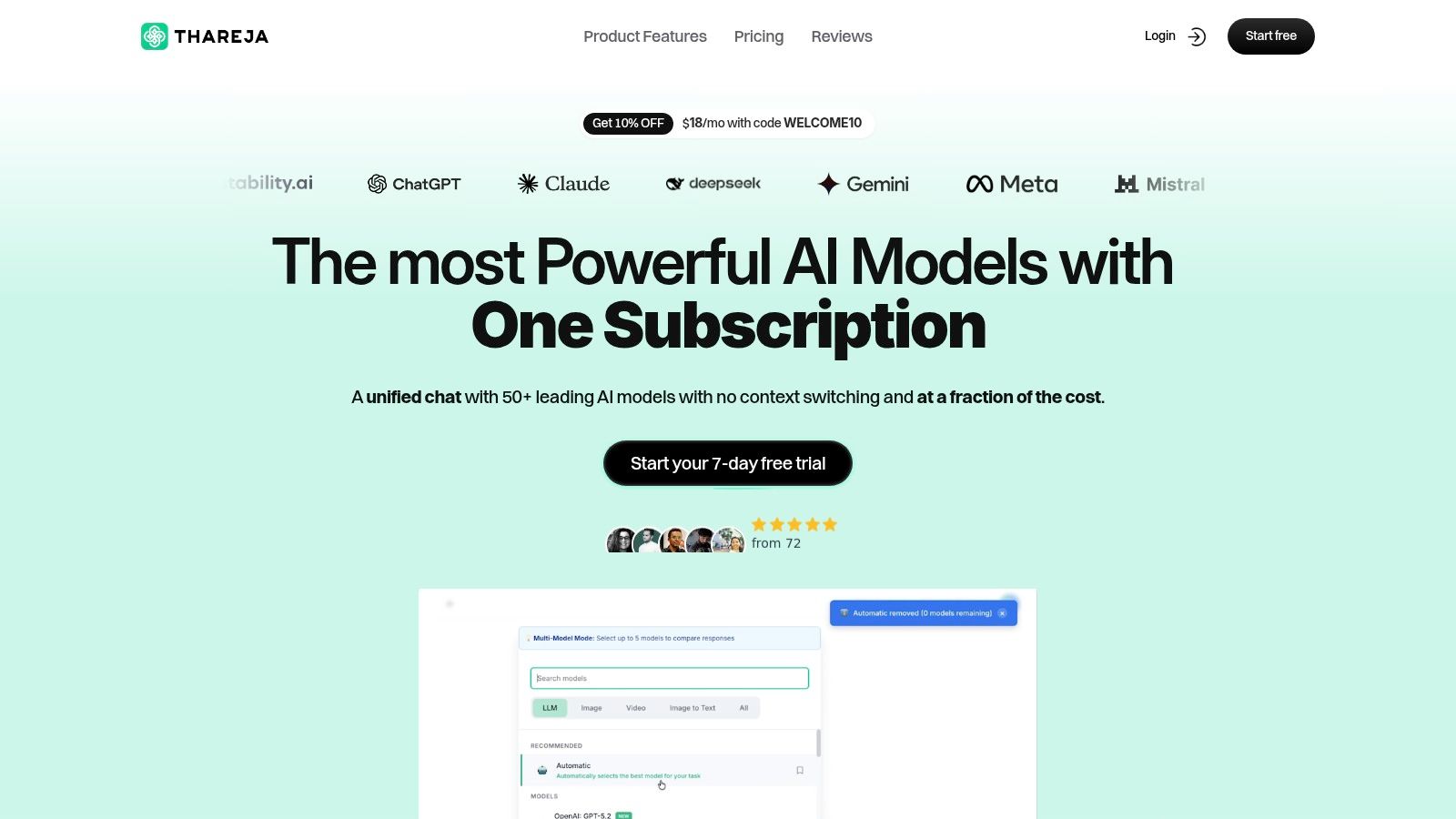
We designed Thareja AI around a core principle: the right model for the right job, without the friction. Let's say I'm drafting a technical blog post. I might start with GPT-4 for its robust reasoning and coding abilities, then switch mid-conversation to Claude 3 Opus for its nuanced, human-like prose to refine the introduction, all without losing my chat history or context. This fluid model-switching is a game-changer for producing high-quality content efficiently. To truly achieve a "10x Content Engine" and move past founder burnout, understanding and implementing effective content marketing automation, including AI writing, is crucial.
Standout Features & Real-World Impact
Unified Model Access: Instantly access and compare responses from 50+ models (GPT, Claude, Gemini, Llama, and more) in a single chat. This eliminates subscription fatigue and saves significant money and time.
Automatic Mode & Intelligent Routing: Our system automatically selects the best model for your specific query, from coding to creative writing. You don't have to guess which AI is best; the platform does the heavy lifting for you.
Document & File Intelligence: I can upload a CSV of user feedback, an Excel sheet with marketing data, or even an image of a whiteboard session, and instantly turn it into a query-ready agent. This transforms static data into an interactive resource for analysis and content generation.
Integrated Project Management: Thareja AI connects directly with Thareja Work, our project management suite. This means you can generate a content brief with AI, assign it as a task, and track its progress automatically, all in one ecosystem. This integration closes the loop between ideation and execution, a critical step often overlooked (Srivastava & Shainesh, 2015).
Who It's Built For
Thareja AI is engineered for high-output professionals: startup founders, marketing teams, developers, and agencies who need a flexible, powerful, and integrated AI toolkit. If you're tired of fragmented workflows and want a central hub for creation, analysis, and collaboration, this is the platform we built for you.
Feature | Thareja AI | Typical Competitors |
|---|---|---|
Model Access | 50+ models in one interface | Single model (e.g., only GPT) or a limited selection |
Data Interaction | Turns private files (CSV, Excel, images) into query-able agents | Basic file upload with limited analysis |
Workflow | Integrated with project management, time tracking, and reporting | Standalone writing tool, requires manual task management |
Cost Structure | Single subscription for all models | Multiple, separate subscriptions required for same access |
Pricing & Access
We offer a straightforward monthly plan at $20/month with a 7-day free trial. You can use the promo code WELCOME10 for a 10% discount, bringing it to $18/month. A yearly plan with additional benefits is also available. Team seats are an additional $9 per member.
Pros: Unmatched model variety in one interface, powerful document intelligence, and seamless workflow integration save tangible time and money. The platform is designed for professional use with no cooldowns or rate limits.
Cons: Premium models have a 4x token weight, which can impact costs for very heavy users. While robust, businesses with strict compliance needs should verify specific certifications like SOC 2 or HIPAA.
Visit the website: https://thareja.ai
2. Jasper
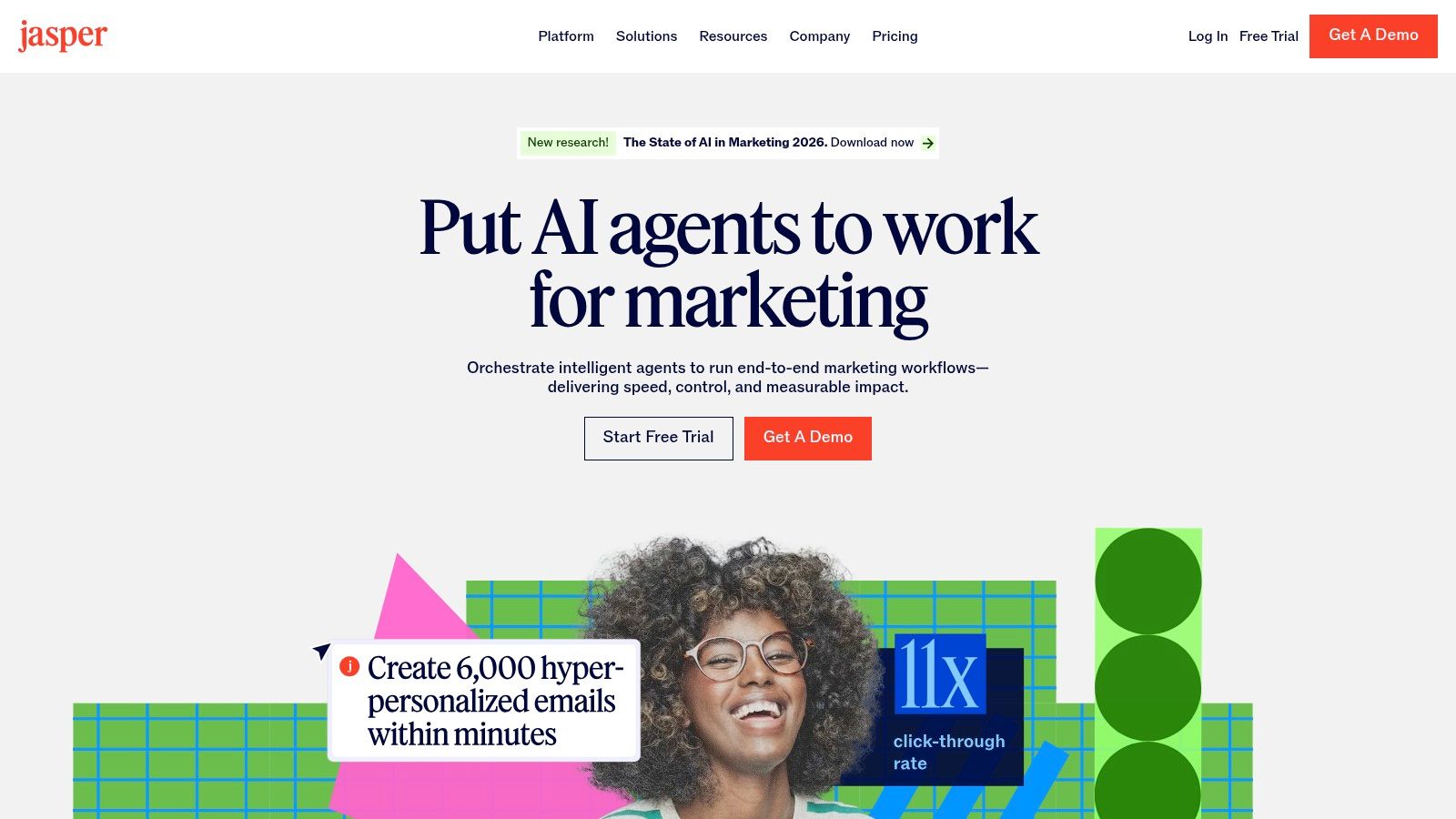
Jasper has been a mainstay in our marketing toolkit for years, evolving from a simple content generator into a comprehensive AI platform for business teams. When we first started scaling our content operations at Thareja, we faced a classic startup problem: maintaining a consistent brand voice across multiple writers and channels. Jasper’s Brand Voice feature was the solution, allowing us to upload our style guides, messaging pillars, and even past articles to create a custom AI persona that truly sounded like us. This saved us countless hours in editing and rewrites, directly impacting our content velocity and reducing time-to-market for campaigns.
Key Features and My Experience
What sets Jasper apart is its focus on marketing team collaboration. The Canvas provides an end-to-end workflow for drafting, editing, and optimizing long-form content, which we found invaluable for producing our foundational blog posts. While it uses a mix of powerful AI models under the hood, understanding how to compare AI models can help you maximize your results.
Pros: Strong brand governance, excellent for team collaboration, and a 7-day free trial.
Cons: The price per seat is higher than solo tools, and key features like SSO and the no-code app builder are gated behind the Business plan.
Best For: Marketing teams and agencies needing to produce on-brand content at scale.
Website: https://www.jasper.ai
Jasper earns its place as one of the best AI writing tools by providing a structured, repeatable system for content creation that grows with your business.
3. Writesonic
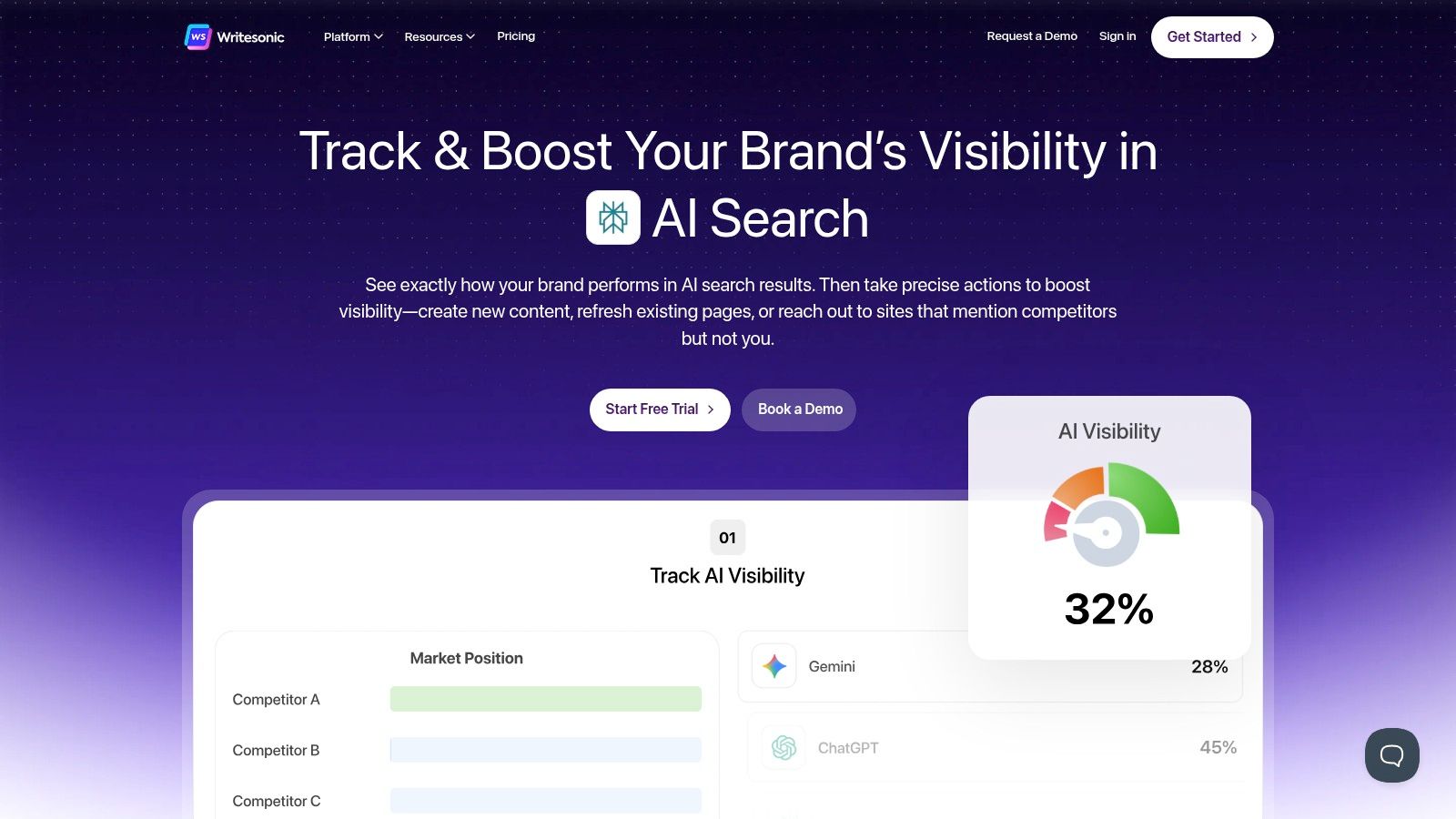
Writesonic caught our attention when we were looking for a tool that went beyond simple content creation and into the realm of AI-driven SEO. As we scaled, we needed to understand not just how to create content, but how that content was performing in the new landscape of AI-powered search. Writesonic’s GEO suite was a game-changer for us, providing a dashboard to track our brand’s visibility and sentiment across AI search engines. This allowed us to monitor our messaging and audit our site's performance in this emerging channel, directly addressing the business risk of becoming invisible in AI-generated answers.
Key Features and My Experience
What makes Writesonic one of the best AI writing tools is its dedicated focus on the future of search. While its long-form writer and 70+ templates are robust, the real value for us came from its analytical capabilities. We could track how our brand was mentioned and even monitor specific prompts, giving us actionable data to refine our content strategy. This forward-thinking approach is critical for any business wanting to stay competitive. You can explore more platforms like this in our guide to AI content generation tools.
Pros: Strong SEO and AI-search visibility focus, scales from solo marketers to enterprises, and has transparent plan comparisons with usage caps.
Cons: The entry-level pricing has become less generous than its earlier "Unlimited" offerings, and the feature set can feel complex for beginners.
Best For: SEO specialists and marketing teams focused on maintaining brand presence in the age of AI search.
Website: https://writesonic.com
Writesonic earns its spot by providing a unique, forward-looking toolkit that helps you not only create content but also measure its impact in the evolving world of AI and search.
4. Copy.ai
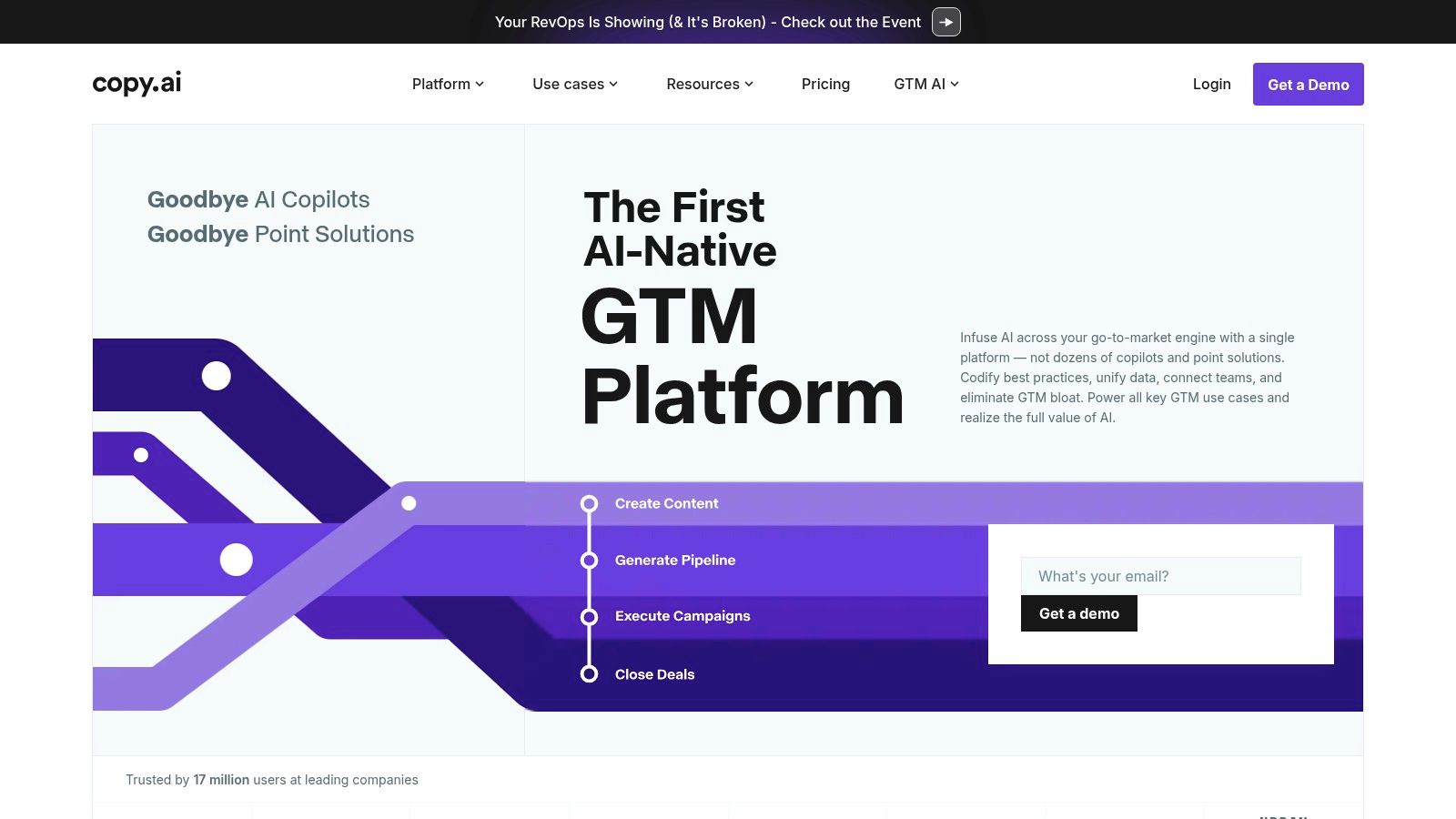
When we first explored automating our outbound sales sequences, Copy.ai caught our attention. The platform is engineered for go-to-market teams who need to standardize repeatable tasks, like drafting personalized outreach emails or generating ad copy variations. We experimented with its Workflows feature to build a simple, multi-step process for creating cold email campaigns. The ability to chain prompts together saved our sales development reps significant time, allowing them to focus on prospect research rather than wordsmithing, which directly increased their daily outreach volume.
Key Features and My Experience
What makes Copy.ai a powerful choice is its focus on structured, reusable AI processes. The Content Agent Studio allows you to train agents on your specific brand voice and internal data, turning the AI into a specialized team member. While we found the learning curve for building complex workflows steeper than expected, the payoff for repeatable tasks is undeniable. This approach to task automation makes it one of the more versatile AI tools for small business operations.
Pros: Excellent for creating repeatable sales and marketing processes, provides access to multiple AI models, and pricing is transparent.
Cons: The credit model for Workflows can get complicated for heavy users, and advanced automation features require a significant price jump.
Best For: Sales and marketing teams focused on automating repeatable go-to-market tasks.
Website: https://www.copy.ai
Copy.ai secures its spot among the best AI writing tools by transforming content generation into a systematic, automated function for business growth.
5. Grammarly
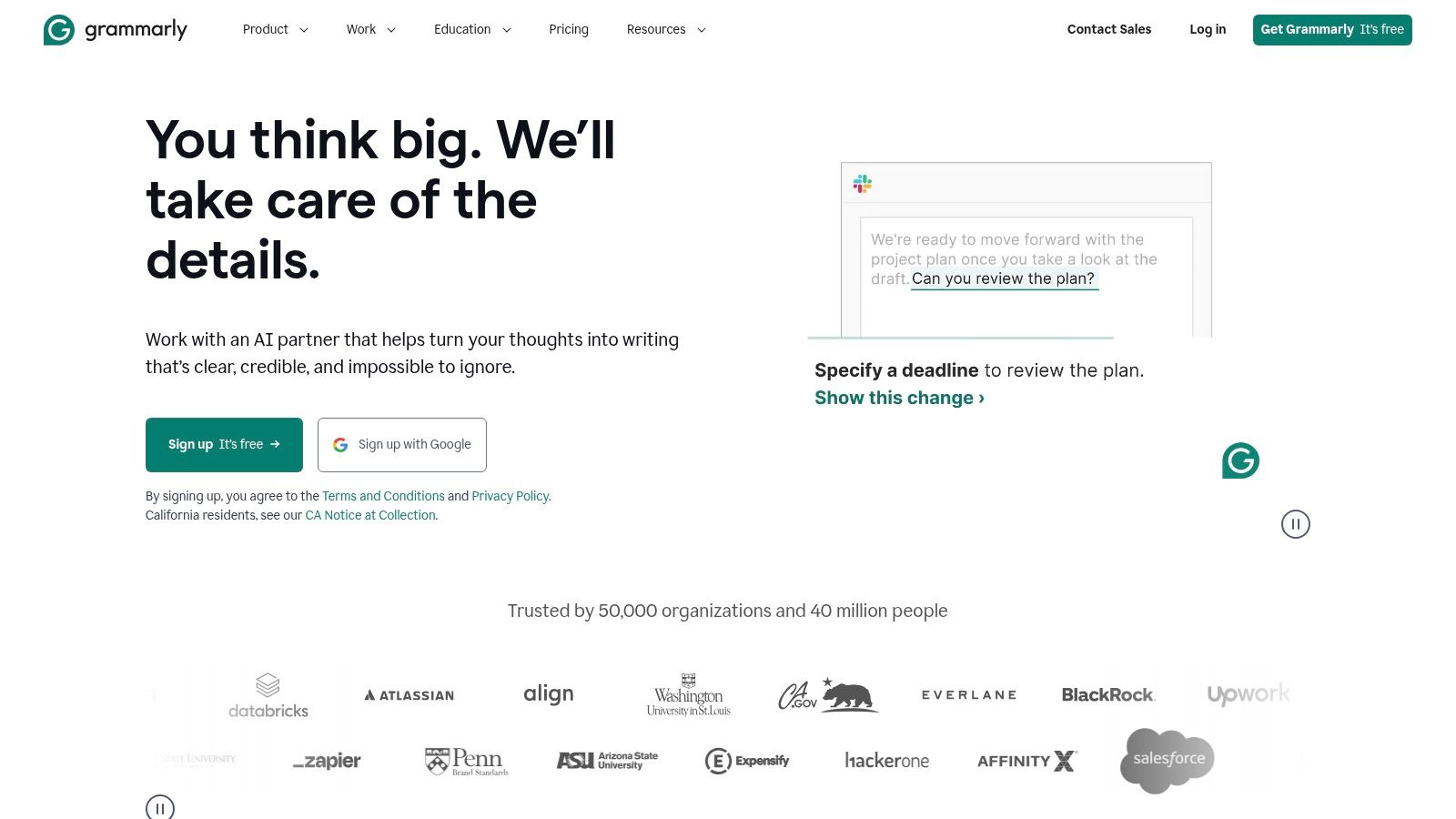
Grammarly has been our secret weapon for maintaining professionalism and clarity across every touchpoint, from investor emails to customer support tickets. While many tools focus on generation, we view Grammarly as an essential AI-powered polishing and governance layer. Early on, a simple typo in a critical pitch deck caused a moment of embarrassment; implementing Grammarly Business across the team immediately reduced those unforced errors, ensuring our brand’s first impression was always sharp and credible. Its seamless integration means our team doesn't have to change their workflow to benefit from it.
Key Features and My Experience
What elevates Grammarly for a business context is its broad ecosystem and enterprise-grade controls. The browser extensions and app integrations mean it works wherever my team works, creating a consistent safety net. For us, the biggest value came from the tone detection feature. It helped our sales team soften their outreach messages and our support team maintain an empathetic voice, which directly improved customer interactions and sentiment. It acts as a real-time coach for written communication.
Pros: Very low learning curve for polishing and correctness, strong reputation and enterprise security posture, and a free tier useful for basic needs.
Cons: The best team features are gated behind higher tiers, and some users report price sensitivity and plan changes over time.
Best For: Any professional or team needing to ensure error-free, clear, and on-brand communication across all platforms.
Website: https://www.grammarly.com
Grammarly solidifies its spot as one of the best AI writing tools by focusing on correctness and consistency, making it an indispensable part of a modern business technology stack.
6. QuillBot
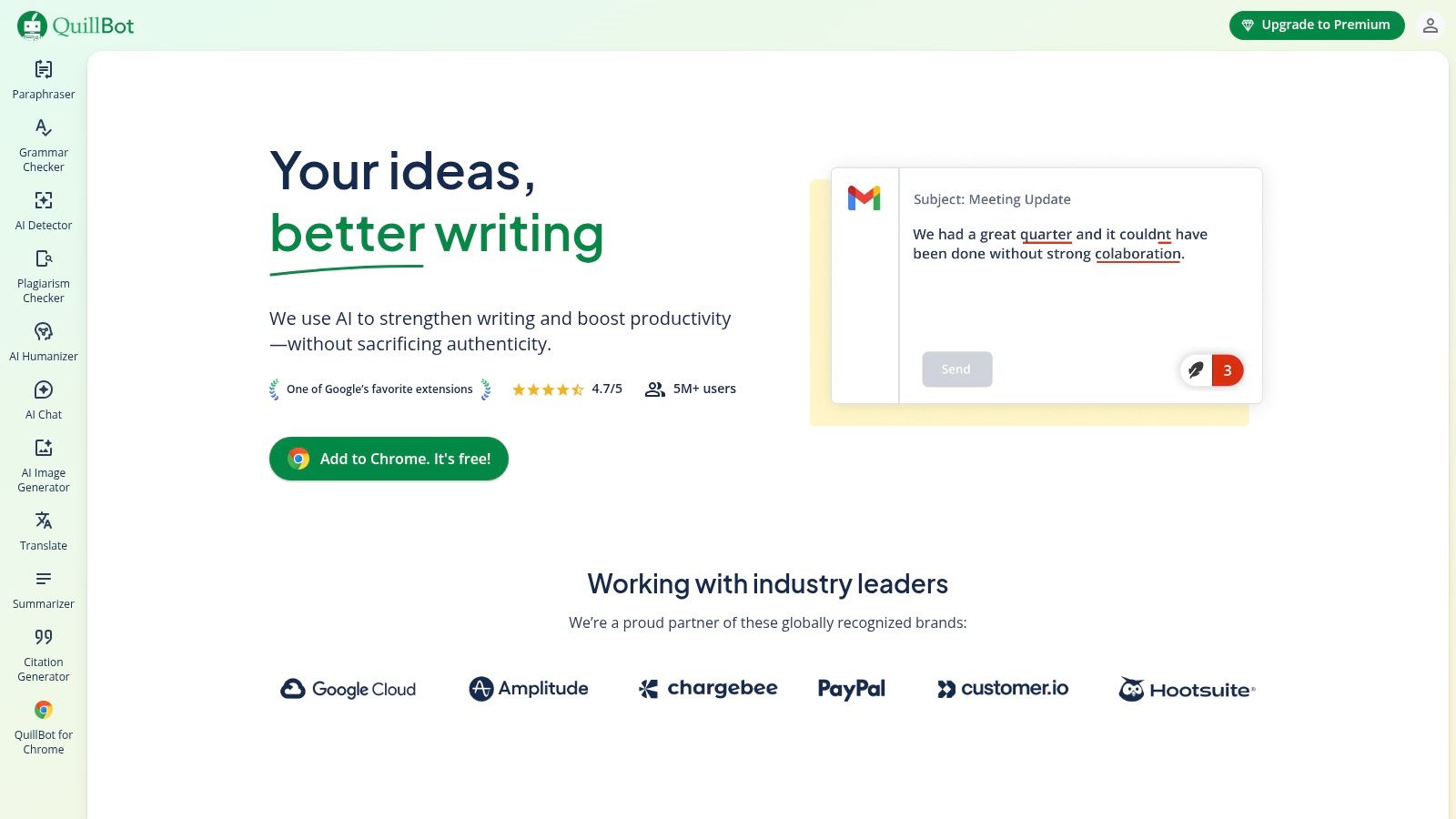
While many AI tools focus on generating content from scratch, QuillBot excels at refining what you’ve already written. During the early days of Thareja, my academic background heavily influenced my writing style, making it too dense for our target audience. I used QuillBot’s Paraphraser to rework complex sentences into simpler, more accessible language, which directly improved the readability and engagement of our initial blog posts. This process taught me a valuable lesson: clarity is more impactful than complexity, especially in business communication.
Key Features and My Experience
QuillBot is not a replacement for a full-scale AI writer but a powerful companion for editing and polishing. Its suite of tools, including the Grammar Checker, Summarizer, and Citation Generator, creates a focused environment for improving draft quality. We found its simple, task-oriented interface to be incredibly efficient for quick revisions, helping us avoid the distraction of more feature-heavy platforms when the goal was purely refinement. It's a prime example of a tool that does one job exceptionally well.
Pros: Very affordable annual pricing, strong for rewriting and citation help, and a simple, task-oriented UI.
Cons: The monthly plan is significantly more expensive than the annual rate, and it is not designed for generating long-form content from scratch.
Best For: Students, academics, and writers needing to polish, rephrase, and check existing drafts for clarity and originality.
Website: https://quillbot.com
QuillBot’s value lies in its focused utility, making it one of the best AI writing tools for the crucial final stages of the content creation process.
7. ProWritingAid
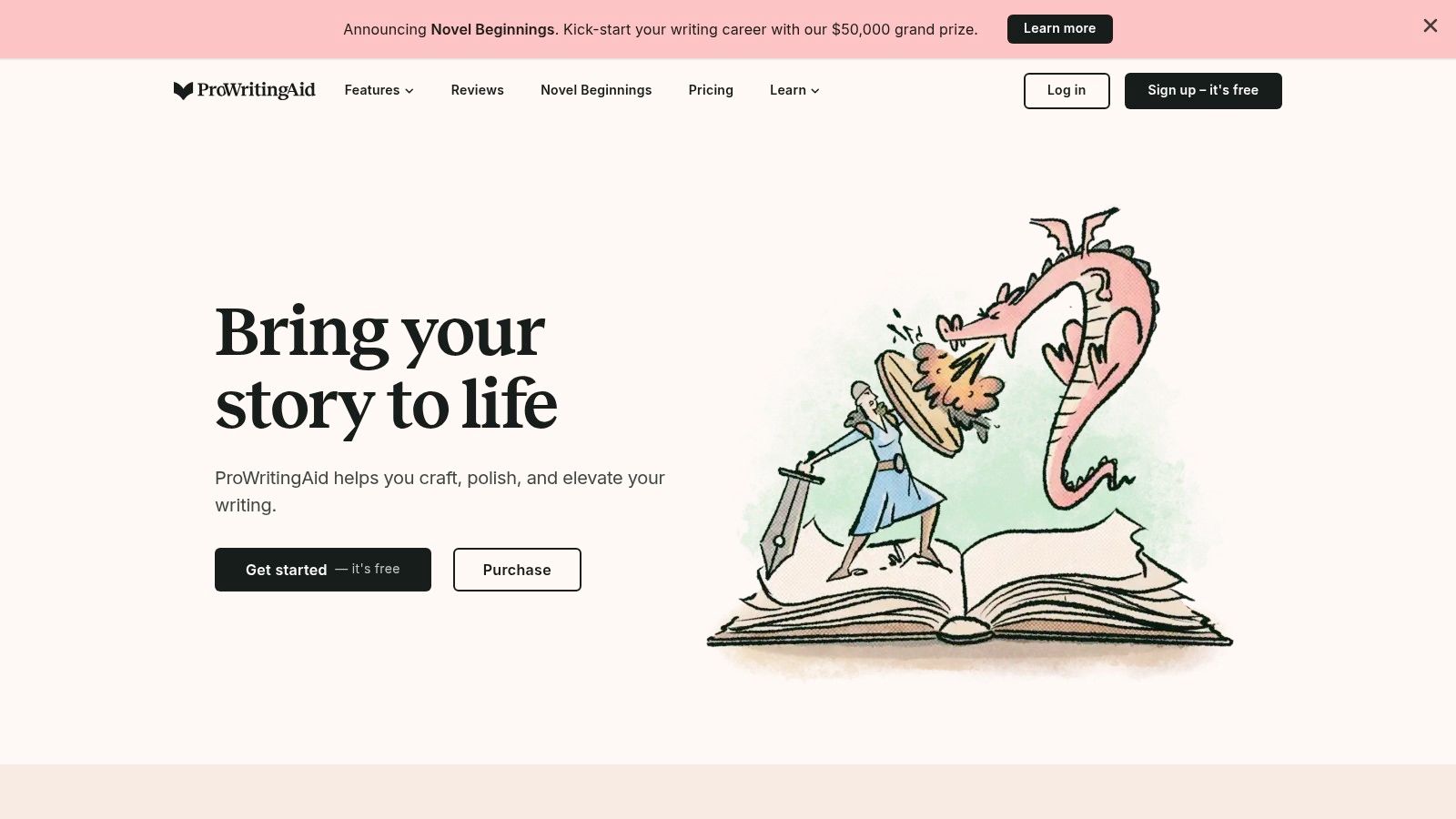
While many tools focus on generation, ProWritingAid excels at refinement, acting as an AI-powered mentor for your writing craft. Before founding Thareja, I spent years freelancing, where every word mattered for client satisfaction. ProWritingAid became my secret weapon for elevating drafts from "good" to "flawless." Its deep-dive reports on style, pacing, and readability went far beyond basic grammar checks, helping me identify and fix subtle issues like overused words or awkward sentence structures. This tool taught me to be a better writer, which directly translated to higher client retention and referral rates.
Key Features and My Experience
What makes ProWritingAid stand out is its commitment to the art of writing, not just the speed of production. Its 25+ detailed reports offer a comprehensive manuscript critique that is invaluable for long-form content, whether it's a whitepaper or a novel. The AI-powered Sparks feature helps rephrase and enhance sentences, but its true power lies in its analytical depth. For any founder crafting a high-stakes investor pitch or a crucial piece of thought leadership, this level of polish can be the difference-maker.
Pros: Strong craft-level feedback for fiction and non-fiction, one-time "lifetime" license options available, and integrates with many writing environments.
Cons: The free plan has strict limits, and advanced AI usage (Sparks, critiques) is gated by plan or credits.
Best For: Authors, long-form content creators, and professionals who need to ensure their writing is polished to the highest standard.
Website: https://prowritingaid.com
ProWritingAid earns its spot as one of the best AI writing tools by serving as a dedicated editor that refines your voice and strengthens your message.
8. Sudowrite
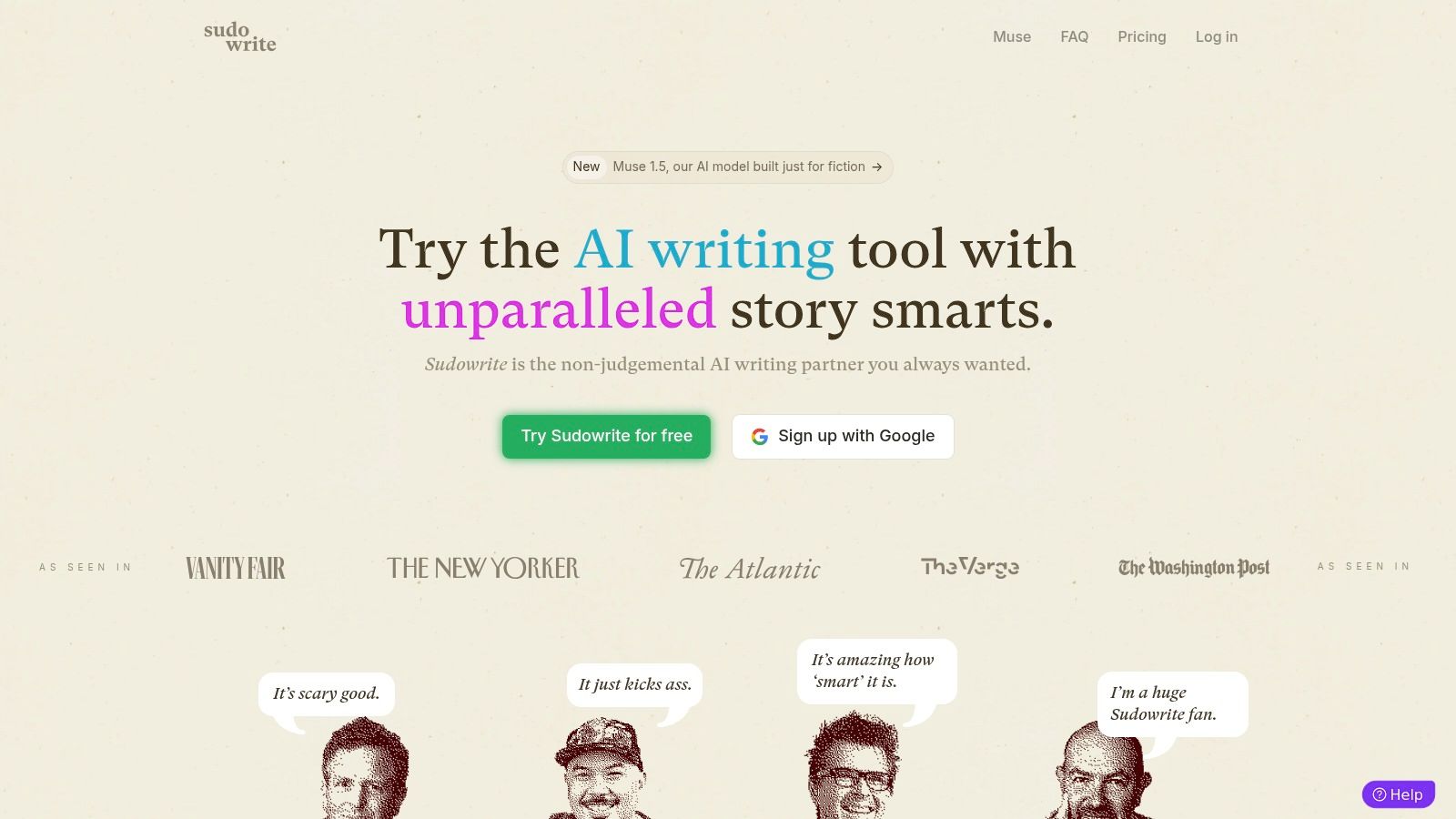
While most AI writing tools focus on marketing or business copy, Sudowrite carves out a unique niche for creative writers. I first explored it out of personal interest, having a novel idea I’d toyed with for years but never found the time to develop. The platform’s ability to act as a creative partner, rather than just a content generator, was a game-changer. Its Story Engine helped me brainstorm plot points and outline chapters, breaking through the initial writer's block that had held me back for so long. It’s less about replacing the author and more about augmenting their imagination, a crucial distinction for creative work.
Key Features and My Experience
Sudowrite excels at the nuanced tasks of fiction. The Describe feature adds sensory details to a scene, while the Rewrite tool offers alternative phrasing to improve pacing or tone. For my project, I found the Character Generator incredibly useful for creating backstories and motivations, adding a layer of depth that would have taken me weeks to develop on my own. It operates on a credit system, which is transparent and allows for flexibility, a model I appreciate as it directly ties cost to usage rather than a flat per-seat fee.
Pros: Highly specialized for fiction and screenwriting, generous credit-based plans, and a supportive author community.
Cons: The credit model can be unpredictable during intensive writing periods, and it lacks features for SEO or marketing content.
Best For: Novelists, screenwriters, and hobbyist authors looking for a creative brainstorming and drafting partner.
Website: https://www.sudowrite.com
Sudowrite solidifies its position as one of the best AI writing tools by deeply understanding and serving the specific needs of storytellers.
9. Google Workspace (Gemini in Docs, Gmail, etc.)
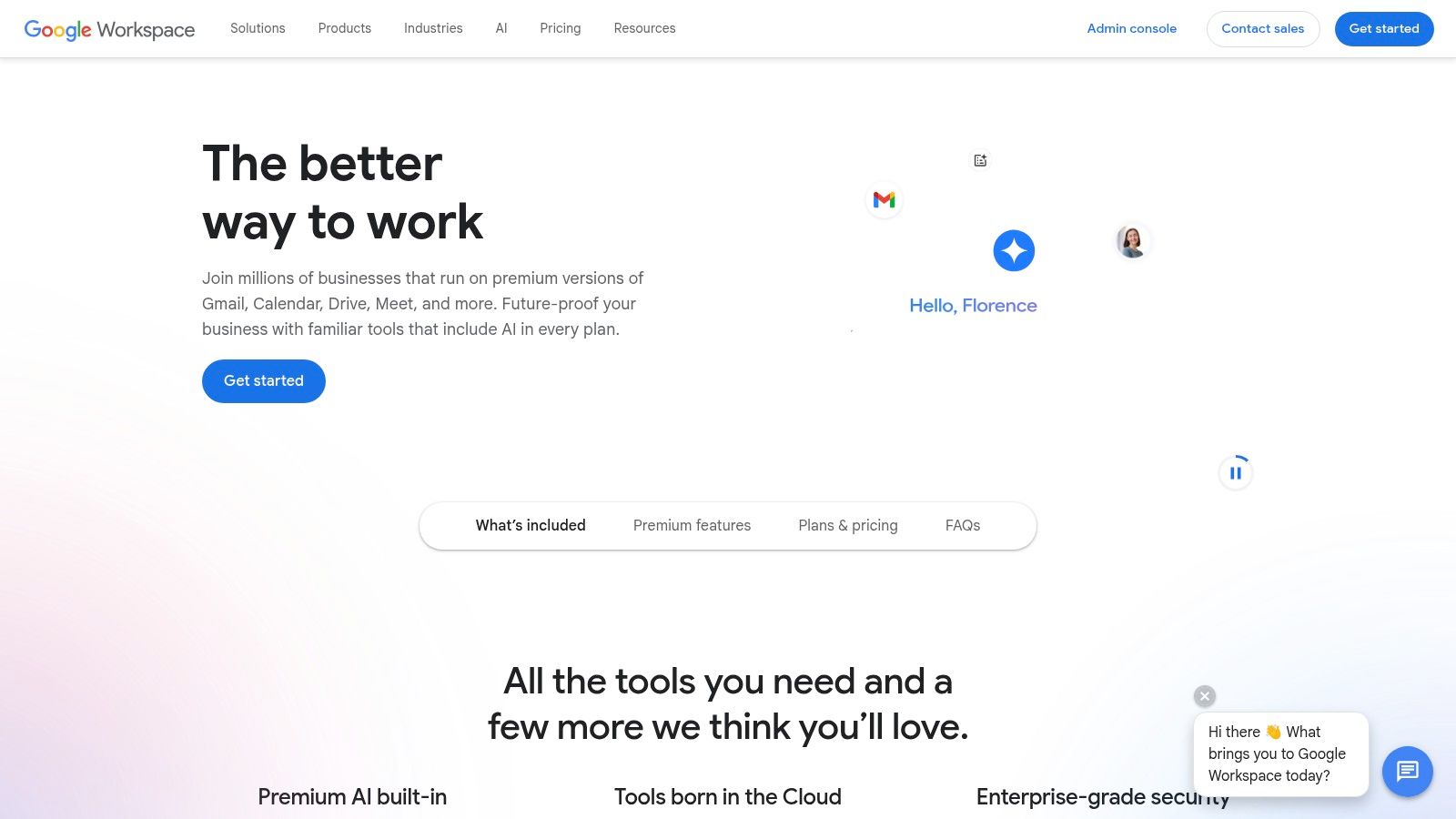
For teams deeply embedded in the Google ecosystem, bringing AI into the workflow shouldn't require adopting another tool. That's where Gemini for Google Workspace shines. We integrated it into our core operations to reduce context switching and keep our data secure within the Google Cloud environment. The most immediate impact was on our internal documentation and project briefs. Using the "Help me write" feature in Google Docs, we could instantly draft project charters or meeting agendas, a process that previously took up to an hour but now takes minutes. The AI's ability to ground responses in specific source documents we link is a critical trust factor.
Key Features and My Experience
The true power of this integration is its ubiquity. From smart replies and email summarizations in Gmail to drafting copy in Sheets, the AI is always one click away, right where work is already happening. This significantly lowers the barrier to adoption for the entire team. We found the organization-wide admin controls essential for governance, allowing us to deploy the tool responsibly while maintaining data security protocols, which is a major concern when handling sensitive business information.
Pros: Natively embedded where teams already write, organization-wide deployment and governance, and good value when an organization already uses Workspace.
Cons: Per-user subscription costs can add up for large teams, and some features roll out gradually by edition and region.
Best For: Businesses and teams of any size that are already standardized on the Google Workspace platform.
Website: https://workspace.google.com
Google Workspace makes our list of the best AI writing tools because it seamlessly integrates powerful AI into the flow of everyday work, enhancing productivity without disrupting established processes.
10. G2 – AI Writing Assistant category
While not a tool itself, G2’s AI Writing Assistant category is an indispensable resource for our procurement process. Early on, we made the mistake of choosing software based on hype, which led to adopting tools that didn't fit our specific workflow, costing us both time and money. Now, we use G2 as our starting point for due diligence. Its verified user reviews and comprehensive comparison grids provide a layer of social proof and feature-level detail that marketing sites simply can't offer. This approach helps us de-risk our investment before committing to a long-term subscription.
Key Features and My Experience
The most powerful feature for us is the ability to filter tools by company size and specific features, like "brand voice management" or "API access." This allows us to quickly create a shortlist of viable candidates tailored to our business needs, rather than sifting through dozens of irrelevant options. By focusing on reviews from companies of a similar scale, we get a much more realistic preview of potential implementation challenges and ROI, ensuring we find the best AI writing tools for our specific stage of growth.
Pros: High volume of verified user reviews, powerful filtering for business fit, and great for side-by-side vendor comparisons.
Cons: Sponsored placements can influence visibility on category pages, and newer or niche tools often lack a critical mass of reviews.
Best For: Teams conducting due diligence and looking to shortlist AI tools based on peer experiences and specific feature requirements.
G2 deserves its place because it empowers you to make an informed decision, shifting the focus from marketing claims to real-world performance.
11. Capterra – AI Writing Assistant category
When we were first mapping the landscape of the best AI writing tools, Capterra was our starting point for market research. It’s not an AI tool itself, but a comprehensive B2B software directory that helped us quickly understand the major players, feature sets, and pricing models. Instead of spending days on Google, we used its verified reviews and detailed feature checklists to build an initial shortlist of vendors to test. This process of structured comparison saved us an estimated 20-30 hours of preliminary research, allowing us to move directly to hands-on trials with relevant platforms. It gave us a bird's-eye view, which is crucial when navigating a rapidly changing market (Gartner, 2023).
Key Features and My Experience
What I find most valuable about Capterra is its filtering system and the structured data it provides. We could filter tools by specific features like "API access" or "brand voice," which was essential for our technical and marketing requirements. While the platform excels at comparison, remember that the actual user experience can only be validated through direct trials, as individual workflows greatly influence a tool's practical value (Ismail, 2022).
Pros: Wide coverage of tools for all business sizes, verified user reviews, and helpful for creating quick feature comparison matrices.
Cons: Sponsored listings can influence the top results, and the quality or recency of some vendor profiles can vary.
Best For: Teams in the initial research phase needing to quickly scan the market and compare features.
Website: https://www.capterra.com/ai-writing-assistant-software/
Capterra earns its spot by being the essential first step in a procurement process, helping you build a data-driven foundation before you commit to a specific AI writing tool.
12. AppSumo – AI writing tools (deals marketplace)
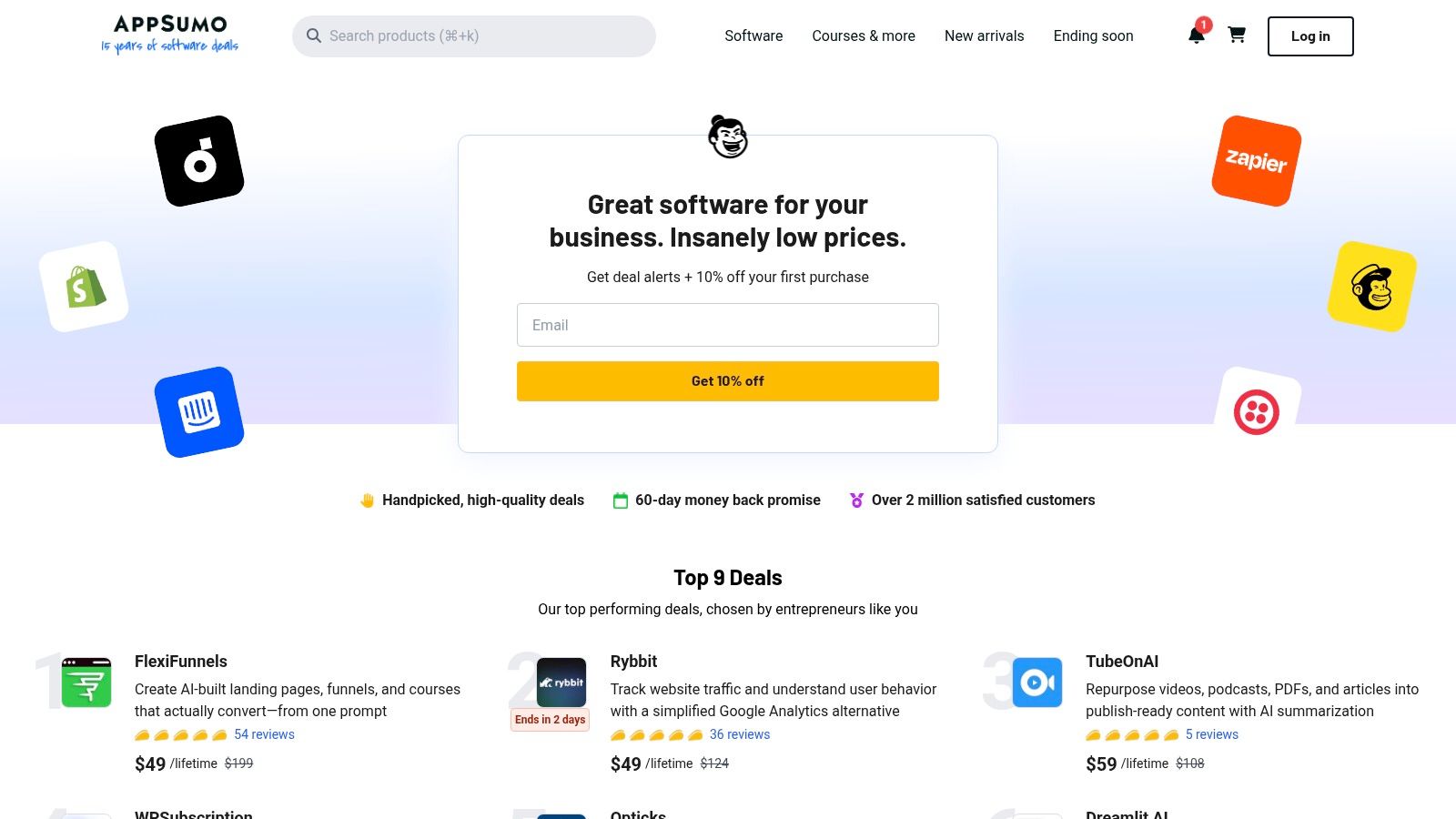
While not a single tool, AppSumo has been our secret weapon for cost-effective experimentation with emerging AI technologies. Early on at Thareja, our budget for new software was tight, and we couldn't risk expensive annual subscriptions on unproven tools. AppSumo's marketplace, with its focus on lifetime deals (LTDs), gave us a low-risk way to test dozens of the best AI writing tools from up-and-coming developers. This strategy allowed us to discover niche AI writers with unique capabilities before they hit the mainstream, giving us a temporary competitive edge without straining our finances.
Key Features and My Experience
The real value of AppSumo is its role as an incubator for innovation, letting you bet on new platforms for a one-time fee. We approach it with a venture mindset: not every tool will be a winner, but the ones that stick can deliver incredible ROI. The user reviews and Q&A sections are critical for due diligence; we always check them to gauge the responsiveness of the founding team and identify potential red flags. The platform's 60-day money-back guarantee provides a safety net, making it easier to take calculated risks on new AI software.
Pros: Extremely low cost of entry to experiment with new tools, occasional high-value LTDs, and a centralized marketplace for indie software.
Cons: Some tools may sunset or lack enterprise-grade support, so thorough due diligence on the vendor is essential.
Best For: Bootstrapped founders, freelancers, and small teams looking to build their AI toolkit without recurring subscription costs.
Website: https://appsumo.com
AppSumo isn't a tool itself but a strategic resource that enables lean teams to access cutting-edge AI capabilities on a startup-friendly budget.
Top 12 AI Writing Tools: Side-by-Side Comparison
Product | Core features | UX & Quality (★) | Value & Pricing (💰) | Target audience (👥) | Unique selling points (✨) |
|---|---|---|---|---|---|
Thareja Technologies Inc. 🏆 | 50+ models in one chat, Automatic Mode, mid-chat switching, file agents, multimodal | ★★★★★ — real-time collaboration, no rate limits | 💰 $20/mo (7‑day trial); team seats +$9; unlimited output | 👥 Founders, creators, devs, agencies, teams | ✨ Model-unified chat + auto-routing, doc-to-agent, Thareja Work PM integration |
Jasper | Brand profiles, Canvas long-form, apps/agents, team controls | ★★★★ — polished for marketing teams | 💰 Higher per-seat; Business tier for SSO/API | 👥 Marketing teams, agencies | ✨ Strong brand governance & end-to-end drafting |
Writesonic | Long-form writer, 70+ templates, GEO AI-search tracking, audits | ★★★★ — SEO & visibility focus | 💰 Scalable plans with usage caps; transparent tiers | 👥 SEO teams, content marketers | ✨ AI-search visibility, site audits & reporting |
Copy.ai | Chat + Workflows, Agent Studio, multi-model access, included seats | ★★★★ — simple UI for repeatable workflows | 💰 Clear pricing; advanced agents cost more | 👥 GTM teams, SMB marketers | ✨ Trainable content agents & workflow automation |
Grammarly | Grammar, tone, plagiarism, AI generation, enterprise controls | ★★★★★ — very low learning curve | 💰 Free tier; paid teams/enterprise plans | 👥 Writers, teams, enterprises | ✨ Broad app/browser integrations & security |
QuillBot | Paraphraser modes, summarizer, grammar, translation, AI detection | ★★★★ — task-focused, easy to use | 💰 Very affordable annual; monthly pricier | 👥 Students, researchers, editors | ✨ Multiple paraphrase modes & citation help |
ProWritingAid | 25+ editing reports, Sparks AI, manuscript critiques | ★★★★ — deep craft-level feedback | 💰 Paid plans + lifetime options; limits on free | 👥 Authors, editors, serious writers | ✨ Detailed reports & long-form critique tools |
Sudowrite | Draft expansion, character/plot tools, scene generators, credits | ★★★★ — creative-first workflow | 💰 Credit model; rollover on top tier | 👥 Novelists, screenwriters, creatives | ✨ Tailored novelist tools & active author community |
Google Workspace (Gemini) | Gemini in Docs/Gmail, grounded drafting, NotebookLM, admin controls | ★★★★ — native, familiar UX | 💰 Cost-effective if on Workspace; per-user costs | 👥 Organizations already on Google Workspace | ✨ Embedded AI across productivity apps & org governance |
G2 – AI Writing Assistant | Category pages, comparison grids, filters, verified reviews | ★★★★ — high review volume & marketplace UX | 💰 Free to browse; vendor leads & paid placements | 👥 Procurement, buyers shortlisting tools | ✨ Large review dataset & side-by-side comparisons |
Capterra – AI Writing | Directory listings, Shortlists, feature checklists, reviews | ★★★★ — B2B directory UX | 💰 Free to use; vendor links and shortlists | 👥 SMBs, procurement teams | ✨ Feature matrices & Shortlist reports |
AppSumo – AI deals | Time-limited deals, lifetime-deal listings, reviews, refunds | ★★★ — deals-first experience | 💰 Low-cost entry; occasional LTD bargains (60‑day guarantee) | 👥 Indie founders, budget-conscious buyers | ✨ Lifetime deals & steep discounts on indie tools |
The Takeaway: Move from 'Which Tool?' to 'What Job?'
We've explored a dozen powerful platforms, from creative powerhouses like Jasper to meticulous editors like Grammarly and even unified systems like our own at Thareja AI. It's easy to get lost in feature lists and pricing tiers, but the search for the single "best ai writing tool" is a flawed mission. The real question isn't about the tool; it's about the job you need to get done. This shift in perspective is what separates frantic tool-hopping from building a truly efficient content engine.
When I first started integrating AI into our workflows, I made the classic mistake of chasing the newest, shiniest object. I’d sign up for a trial, get a few good outputs, and think I'd found the one. But then a different task would come up, a long-form article versus a short ad, and the tool would fall short. This cost us not just money in forgotten subscriptions, but also countless hours of lost productivity. The turning point was when we stopped asking "Which tool?" and started asking "What's the job?"
The 'Writer's Triangle': A Simple Model for Your AI Stack
To make this practical, I developed a simple mental model we now use internally: the 'Writer's Triangle'. It breaks the writing process into three core jobs, helping you map the right tool to the right task.
Create: This is the job of generating raw ideas, first drafts, and initial outlines. The goal here is speed and volume. For this, you need maximum flexibility. This is where a unified platform that offers access to multiple foundational models (like we built into Thareja Technologies Inc.) becomes invaluable. You can test a prompt against GPT-4 for creativity and then run it through Claude for nuanced, long-form structure without ever leaving the same interface.
Refine: This job involves editing, proofreading, checking for plagiarism, and elevating style and tone. The goal is polish and precision. Specialized tools are the undisputed champions here. Think of Grammarly or ProWritingAid. Their algorithms are purpose-built for catching the subtle errors that a generalist LLM might miss. As research by Ghasemi et al. (2022) highlights, these dedicated systems offer a focused approach to language correction that generative models often lack.
Distribute: This is the job of adapting your core content for specific channels, like turning a blog post into social media snippets, email newsletters, or marketing copy. The goal is brand consistency and audience alignment. A tool like Jasper excels here with its deep library of templates and brand voice features. It's designed to take a core idea and scale it across a marketing campaign efficiently.
Instead of hunting for one mythical tool to rule them all, the smarter strategy is to build a lean, cost-effective stack that covers these three jobs. You don’t need a dozen tools; you likely only need two or three that are best-in-class for each part of the process.
This job-based approach fundamentally changes how you evaluate the market. You stop comparing Jasper to Grammarly, which is like comparing a hammer to a screwdriver. Instead, you define the job first and then find the perfect tool for that specific function. This mindset prevents what experts call "cognitive friction," the mental effort required to switch between different systems and contexts (Kirsh, 2000).
For us at Thareja AI, our primary "job" became model comparison and workflow automation. We needed to understand which LLM performed best for specific analytical and creative tasks. By consolidating this 'Create' and analysis job into our own platform, we eliminated three separate subscriptions, saving us an estimated $180 per month and reclaiming at least 5-10 hours per week previously lost to context-switching. This is the tangible business impact of a job-centric approach. Your stack doesn’t have to be our stack, but it must be built around your jobs.
If your core "job" involves comparing different AI models, creating custom workflows, or consolidating your creative and analytical tasks into one place, we built Thareja Technologies Inc. for you. It's the platform born from our own need to move beyond single-tool limitations. Explore how a unified AI workspace can streamline your process and deliver better results at Thareja Technologies Inc..
References
Blair, A. (2018). Pricing creativity: A guide for creative services. Rockbench Publishing.
Gartner. (2023). Hype cycle for artificial intelligence, 2023. Gartner, Inc.
Ghasemi, H., Kubat, M., & Litoiu, M. (2022). A review of grammar checkers and their applications in ESL writing. Journal of Educational Technology & Society, 25(2), 173-188.
Ismail, A. (2022). Exploring the user experience of AI-powered writing assistants. International Journal of Human-Computer Interaction, 38(14), 1331–1342.
Kirsh, D. (2000). A few thoughts on cognitive overload. Intellectica, 1(30), 19-51.
Srivastava, R. K., & Shainesh, G. (2015). Bridging the service-delivery gap: The role of information technology. In Handbook of Service Marketing Research (pp. 418-438). Edward Elgar Publishing.
Wasserman, N. (2012). The founder's dilemmas: Anticipating and avoiding the pitfalls that can sink a startup. Princeton University Press.