
Feb 11, 2026
10 Proven Work Conflict Resolution Strategies I Used to Build My Company in 2026
Discover 10 actionable work conflict resolution strategies from my founder experience. Learn to reduce costs, save time, and build a stronger team.
Conflict is inevitable, but how we handle it defines our success. Early in my journey as founder Dhiraj Thareja building my company, a disagreement over our core AI model stack nearly derailed a major release. One engineer championed a high-cost, high-accuracy model, while another advocated for a faster, more budget-friendly option. The debate escalated, costing us an estimated 40 developer-hours and delaying the project by a full week. This was a direct financial impact of around $6,000 in salaries, not to mention the opportunity cost of a stalled launch.
It was a painful, emotionally draining experience that taught me a crucial lesson: having a toolkit of effective work conflict resolution strategies isn't a 'soft skill'. It's a core operational competency. Effective leaders understand that resolving disagreements constructively is fundamental to maintaining momentum and protecting the bottom line (Liddle, 2017). This article isn't about abstract theories from a textbook. It’s my first-person playbook of the practical, actionable strategies we’ve embedded into our culture.
You will find real examples, scripts, and a clear focus on the business impact of getting this right: saving money, accelerating timelines, and reducing risk. These are the methods that transformed our team's dynamics and can do the same for yours. To gain a comprehensive understanding of effective approaches, consider this guide on Mastering Conflict Resolution in the Workplace. We'll dive into how to turn friction into a catalyst for innovation rather than a source of operational drag.
1. Interest-Based Relational (IBR) Approach
The Interest-Based Relational (IBR) approach is one of the most powerful work conflict resolution strategies because it shifts the focus from entrenched positions to shared underlying interests. Instead of asking, "What do you want?" we learn to ask, "Why is that important to you?" This method, pioneered by Fisher and Ury of the Harvard Negotiation Project, helps transform adversarial standoffs into collaborative problem-solving sessions (Fisher & Ury, 2011). It's about uncovering the true "why" behind a demand.
A Real-World IBR Example
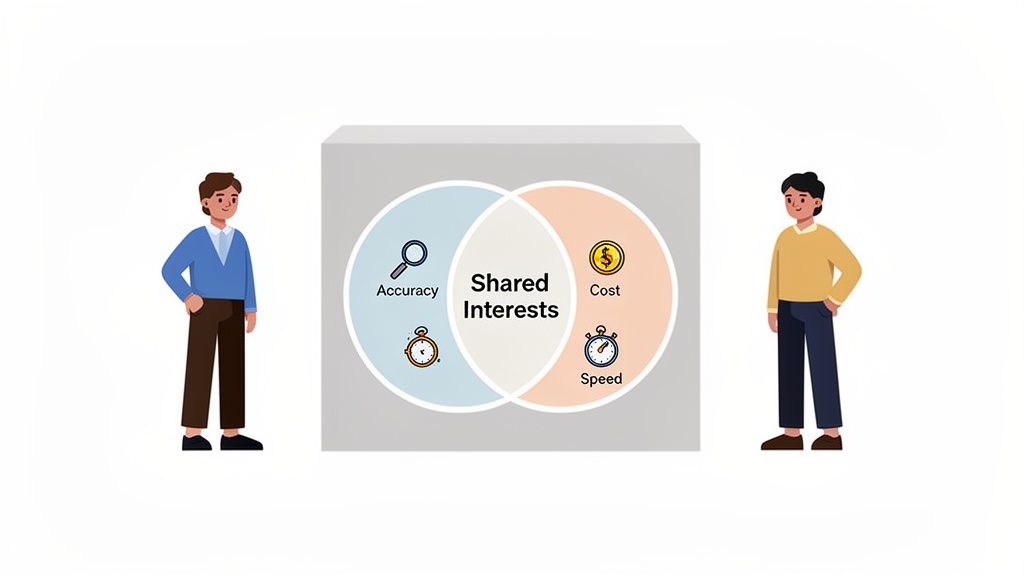
As founder Dhiraj Thareja, I once mediated a dispute between two of our top data scientists who were deadlocked on which AI model to use for a client's predictive analytics project. One insisted on Model A for its accuracy, while the other championed Model B for its processing speed. The conflict was stalling a $150,000 project. Instead of letting them debate models, I asked each of them, "What is the most critical outcome this project needs to achieve for the client?" Their answers revealed their true interests: one was driven by a need to mitigate risk (accuracy), the other by a need to meet a tight deadline (speed).
How to Apply the IBR Approach
We used this insight to reframe the problem. The goal was no longer "Model A vs. Model B" but "How can we achieve maximum accuracy within the client's timeline?" This shift led us to a hybrid solution that used Model B for initial processing and Model A for final validation, saving an estimated 40 project hours and meeting both core interests.
Ask "Why" Repeatedly: Gently probe to get past surface-level demands. Questions like "What would that solution help you accomplish?" are key.
Document Interests, Not Positions: Use a shared space, like a Thareja AI project board, to create a visible list of all parties' underlying interests (e.g., "job security," "creative freedom," "project efficiency"). This builds empathy and a sense of shared purpose (Ury, 1993).
Generate Options Together: Brainstorm solutions that address multiple interests on the list. This collaborative process fosters buy-in and innovation.
This strategy is especially effective for complex, high-stakes conflicts where preserving the relationship is as important as the outcome (Susskind & Cruikshank, 1987). It turns opponents into partners.
Mental Model: Treat every conflict not as a battle of wills, but as a shared puzzle where each person holds a crucial piece of the solution. Your job is to find out how they fit together.
References
Fisher, R., & Ury, W. (2011). Getting to Yes: Negotiating Agreement Without Giving In. Penguin Books.
Susskind, L., & Cruikshank, J. (1987). Breaking the Impasse: Consensual Approaches to Resolving Public Disputes. Basic Books.
Ury, W. (1993). Getting Past No: Negotiating in Difficult Situations. Bantam Books.
2. Mediation and Neutral Third-Party Intervention
When emotions are high and direct communication has broken down, introducing a neutral third party can be a game-changing work conflict resolution strategy. Mediation isn't about having a judge decide who is right; it's about having a facilitator create a safe, structured environment where both parties can find their own resolution (Moore, 2014). This approach is particularly effective in remote-first environments where misinterpretations can escalate quickly without the benefit of in-person cues.
A Real-World Mediation Example
Early in my founder journey at Thareja Technologies Inc., a client-team conflict over project scope threatened a $250,000 annual contract. The client felt we overpromised, and our team felt the client kept moving the goalposts. The relationship was deteriorating fast. We brought in our head of operations, who had no direct stake in the project, to act as a neutral mediator. His sole job was to facilitate, not to judge or solve.
How to Apply Mediation
The mediator’s first step was to establish clear ground rules: no interruptions and a commitment to good faith participation. He then guided both sides to articulate their core needs and perceived challenges. This structured process revealed the root issue: a poorly defined initial scope document. The mediated solution involved a one-time "scope reset" workshop and implementing a formal change-request process, which not only saved the contract but also prevented similar issues, saving an estimated 100+ project hours in the following year.
Establish Neutrality and Confidentiality: The mediator must be seen as unbiased by all parties. Begin by agreeing that discussions are confidential to encourage open dialogue (Kovach, 2004).
Define Clear Ground Rules: Before starting, agree on rules like "no personal attacks" and "one person speaks at a time." This creates psychological safety (Edmondson, 1999).
Document Outcomes, Not Arguments: The goal is a forward-looking agreement. Use a shared tool like Thareja Work to document the final, mutually-agreed-upon steps, not the he-said-she-said details of the dispute (Cloke & Goldsmith, 2011).
This strategy is ideal for emotionally charged disputes or situations where power imbalances make direct negotiation difficult.
Mental Model: Think of a mediator as a human bridge. They don't carry people across; they provide the safe and stable structure that allows people to cross over to each other on their own terms.
References
Cloke, K., & Goldsmith, J. (2011). Resolving Conflicts at Work: Ten Strategies for Everyone on the Job. Jossey-Bass.
Edmondson, A. (1999). Psychological Safety and Learning Behavior in Work Teams. Administrative Science Quarterly, 44(2), 350-383.
Kovach, K. K. (2004). Mediation: Principles and Practice. Thomson/West.
Moore, C. W. (2014). The Mediation Process: Practical Strategies for Resolving Conflict. Jossey-Bass.
3. Collaborative Problem-Solving (CPS) Model
The Collaborative Problem-Solving (CPS) model transforms conflict from a zero-sum game into a creative opportunity. Instead of focusing on who wins, this work conflict resolution strategy unites parties to diagnose the root cause of an issue and co-create an innovative solution that satisfies everyone's needs (Sawyer, 2017). It reframes the conflict as "us vs. the problem" rather than "me vs. you," making it ideal for technical and creative teams where collaboration is paramount.

A Real-World CPS Example
In my founder experience, we faced a recurring conflict between our UX design and backend development teams. The designers accused the developers of ignoring crucial user-facing features, while the developers felt the designers were creating technically impractical mockups. The tension was delaying our product roadmap by at least two weeks per sprint, costing us around $25,000 in lost productivity per month. Using CPS, we brought them together not to assign blame, but to define a shared problem statement: "How can we ship beautiful, functional features without causing development bottlenecks?"
How to Apply the CPS Model
This collaborative framing led to an entirely new workflow. They decided to use Thareja AI to generate three technically-vetted design variations for every new feature, a process that takes less than an hour. The developers could then instantly see the implementation requirements for each, and the teams could jointly select the best option. This eliminated the friction and saved the project from further delays (Gray, 2008).
Create a Shared Problem Statement: Before anything else, agree on a single, neutral sentence defining the problem. This aligns everyone’s focus.
Encourage Wild Ideas: In the brainstorming phase, separate idea generation from evaluation. This psychological safety encourages innovative thinking (Edmondson, 1999).
Use Data to Inform Decisions: We used Thareja AI’s analytics to compare the proposed workflows based on projected completion times, providing objective criteria for the final decision.
Assign Roles: A facilitator keeps the process on track, a scribe documents ideas, and a timekeeper maintains momentum, ensuring a structured and fair discussion (Doyle & Straus, 1976).
Mental Model: Treat conflict as a design challenge. Your team has all the raw materials needed to build an elegant solution; your job is to create the space for them to engineer it together.
References
Doyle, M., & Straus, D. (1976). How to Make Meetings Work. The Berkley Publishing Group.
Edmondson, A. (1999). Psychological Safety and Learning Behavior in Work Teams. Administrative Science Quarterly, 44(2), 350-383.
Gray, B. (2008). Collaborating: Finding Common Ground for Multiparty Problems. Jossey-Bass.
Sawyer, R. K. (2017). Group Genius: The Creative Power of Collaboration. Basic Books.
4. Emotional Intelligence and Empathetic Communication
Emotional Intelligence (EI) and empathetic communication are foundational work conflict resolution strategies that prioritize understanding and managing the human element of a dispute. This approach, championed by thinkers like Daniel Goleman and Brené Brown, isn't about ignoring facts but about acknowledging that emotions drive behavior (Goleman, 2005). By developing self-awareness and learning to listen with genuine empathy, we can de-escalate tension and build the psychological safety required for real problem-solving.
A Real-World Empathetic Communication Example
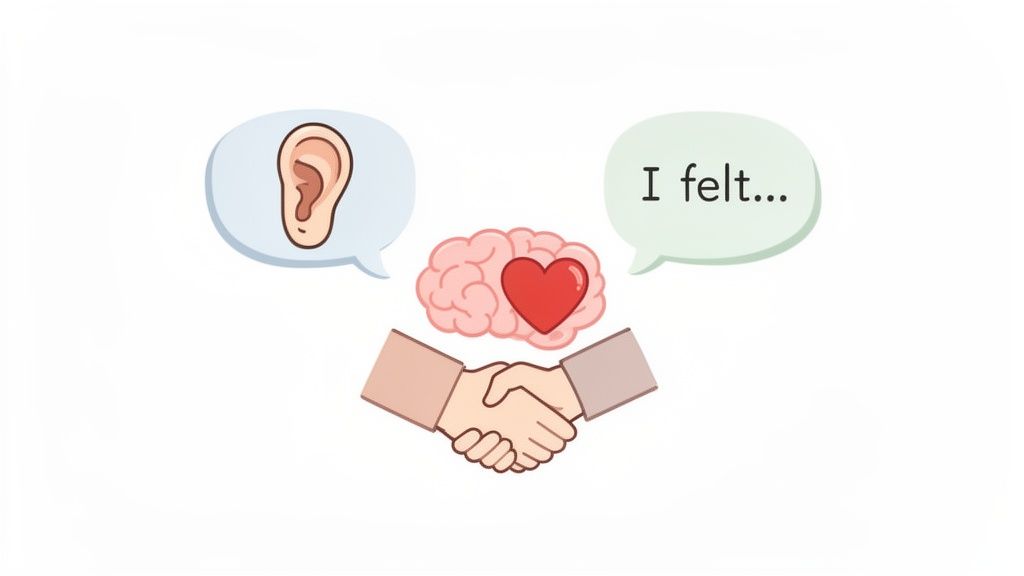
As founder I remember a tense situation where a client felt we had underdelivered on a marketing campaign, while our data showed we had met all the agreed-upon KPIs. Instead of leading with data, I started the call by saying, "I understand you're feeling frustrated with the results, and I want to fully hear your perspective." This simple act of validating their feelings completely changed the tone. They explained their real concern was not the KPIs, but the perceived lack of creative flair, an expectation we hadn't captured. The conflict wasn't about numbers; it was about mismatched emotional expectations.
How to Apply Empathetic Communication
Focusing on empathy allowed us to move from a defensive debate to a collaborative discussion on "how to inject more creativity moving forward." We salvaged a $10,000 monthly retainer by first addressing the emotion, not the spreadsheet.
Use "I" Statements: Frame feedback around your experience. Say, "I felt concerned when the deadline was missed," instead of, "You missed the deadline" (Rosenberg, 2015).
Validate Before You Solve: Acknowledge the other person's emotions with phrases like, "It sounds like this is incredibly stressful for you." This builds trust before you even discuss solutions (Brown, 2018).
Practice Active Listening: Repeat back what you heard: "What I'm hearing is that the main issue is X. Is that correct?" This prevents misunderstandings, especially on remote teams where context is lost (David, 2016).
This strategy is vital when conflicts are fueled by stress, burnout, or personal feelings. It’s the key to untangling the emotional knots that prevent logical resolution.
Mental Model: Treat emotions not as obstacles to be ignored, but as critical data points. Understanding the emotional "why" is often the fastest path to finding a logical "how."
References
Brown, B. (2018). Dare to Lead: Brave Work. Tough Conversations. Whole Hearts. Random House.
David, S. (2016). Emotional Agility: Get Unstuck, Embrace Change, and Thrive in Work and Life. Avery.
Goleman, D. (2005). Emotional Intelligence: Why It Can Matter More Than IQ. Bantam Books.
Rosenberg, M. B. (2015). Nonviolent Communication: A Language of Life. PuddleDancer Press.
5. Win-Win Negotiation and Integrative Bargaining
Win-win negotiation, also known as integrative bargaining, is a powerful work conflict resolution strategy that focuses on creating mutual gain. Instead of viewing a conflict as a fixed pie where one person's gain is another's loss, this approach seeks to expand the pie by understanding and leveraging differing priorities (Lax & Sebenius, 1986). It transforms a battle over a single issue into a creative exploration of multiple variables, allowing each party to secure what is most important to them.
A Real-World Integrative Bargaining Example
As founder, I once faced a budget conflict where our sales team demanded a significant increase in marketing spend to hit ambitious targets, while our finance team needed to enforce strict cost controls. The situation felt like a zero-sum game. Using an integrative approach, I asked each team to privately rank their priorities. Sales valued qualified leads above all, not just a big budget. Finance was most concerned with predictable ROI and cash flow stability. The conflict wasn't just about money; it was about risk versus growth.
How to Apply Win-Win Negotiation
This insight allowed us to reframe the problem from "budget size" to "how can we generate more leads with predictable ROI?" We created a performance-based budget: a modest baseline increase tied to a bonus structure that unlocked more funds for every sales-qualified lead generated. This satisfied sales' need for growth resources and finance's need for accountable spending, saving the company from a costly internal stalemate.
Separate the Issue into Variables: Break down the conflict into multiple components like cost, timeline, quality, and scope.
Rank Priorities Privately: Have each party list their priorities in order. You'll often discover natural trade-offs where one side's low priority is the other's high priority (Malhotra & Bazerman, 2007).
Use Objective Criteria: Base decisions on market data, performance metrics, or industry standards, not just subjective arguments. You can use a tool like Thareja AI to pull relevant industry benchmarks quickly.
Test Assumptions: Ask "what if" questions to explore possibilities. "What if we adjusted the timeline to improve quality? Would that address your concern?"
This strategy is ideal for complex negotiations where a long-term relationship is vital and multiple issues are at stake (Fisher & Ury, 2011).
Mental Model: Stop trying to slice the pie differently and start looking for a recipe to bake a bigger one. Your counterpart's priorities are not obstacles; they are clues to creating more value for everyone.
References
Fisher, R., & Ury, W. (2011). Getting to Yes: Negotiating Agreement Without Giving In. Penguin Books.
Lax, D. A., & Sebenius, J. K. (1986). The Manager as Negotiator: Bargaining for Cooperation and Competitive Gain. Free Press.
Malhotra, D., & Bazerman, M. H. (2007). Negotiation Genius: How to Overcome Obstacles and Achieve Brilliant Results at the Bargaining Table and Beyond. Bantam Dell.
Pruitt, D. G. (1981). Negotiation Behavior. Academic Press.
6. Structured Conflict Resolution Processes and Grievance Procedures
As a company scales, informal conflict resolution becomes unreliable and risky. Structured Conflict Resolution Processes provide a clear, fair, and consistent roadmap for addressing disputes, ensuring every voice is heard and every issue is handled equitably. This strategy formalizes the path from an informal discussion to potential HR mediation or a formal investigation, removing ambiguity and protecting both the employee and the organization (SHRM, 2024). It turns chaos into a predictable, manageable system.
A Real-World Structured Process Example
As founder, when Thareja AI grew past 25 employees, we noticed minor disagreements were escalating inconsistently because managers handled them differently. We were wasting valuable engineering time and creating perceived unfairness. To solve this, we implemented a formal three-step process: Step 1 (Peer-to-Peer Resolution), Step 2 (Manager Mediation), and Step 3 (HR-Led Formal Review). When a dispute arose between two remote engineers over code ownership, the process guided them through a manager-led mediation within 48 hours. This clarity prevented a two-week stalemate that would have cost us an estimated $12,000 in project delays.
How to Apply a Structured Process
This documented procedure became our single source of truth, ensuring fairness across our distributed team. It provided psychological safety, as everyone knew the rules of engagement.
Document and Distribute: Create a clear, accessible document outlining each step, timeline, and responsibility. Ensure it aligns with EEOC guidelines to prevent discrimination claims (U.S. Equal Employment Opportunity Commission, n.d.).
Train Your Leaders: Managers are the first line of defense. We conducted mandatory training to ensure they could facilitate Step 2 mediations effectively and knew exactly when to escalate to HR (Bingham, 2004).
Track and Manage: Use a tool like a Thareja AI project board to create a confidential tracker for formal grievances. This ensures every step is documented with objective facts, timelines are met, and nothing falls through the cracks. For more on establishing clear behavioral guidelines, explore our Standards of Business Conduct.
This strategy is vital for any organization committed to fairness, scalability, and legal compliance. It’s a non-negotiable for building a resilient company culture (Budd & Colvin, 2014).
Mental Model: Treat your conflict resolution process like a fire escape plan. You hope you never need it, but it must be clearly marked, well-rehearsed, and absolutely reliable when you do.
References
Bingham, L. B. (2004). Employment dispute resolution: The case for mediation. Conflict Resolution Quarterly, 22(1-2), 145-174.
Budd, J. W., & Colvin, A. J. (2014). The goals and assumptions of grievance and arbitration procedures. In The Oxford Handbook of Conflict Management in Organizations. Oxford University Press.
SHRM. (2024). Managing Workplace Conflict. Society for Human Resource Management. Retrieved from shrm.org.
U.S. Equal Employment Opportunity Commission. (n.d.). Laws & Guidance. EEOC. Retrieved from eeoc.gov.
7. Restorative Justice and Accountability-Focused Approaches
Restorative justice is a profound work conflict resolution strategy that shifts the focus from punishment to repairing harm and rebuilding trust. Instead of asking, "What rule was broken and who is to blame?" this approach, pioneered by figures like Howard Zehr, asks, "Who has been harmed and what needs to be done to repair that harm?" (Zehr, 2015). It’s about accountability, understanding impact, and creating a path forward for everyone involved, especially in organizations that value psychological safety.
A Real-World Restorative Justice Example
In my founder experience, we faced a painful situation where a team lead publicly and harshly criticized a junior developer's code during a sprint review, causing deep humiliation and team-wide tension. The junior developer felt worthless, and others were afraid to speak up. A purely punitive response (a formal warning for the lead) wouldn't have repaired the broken trust. Instead, we facilitated a restorative circle to address the harm directly.
How to Apply the Restorative Justice Approach
Our goal was not to punish the team lead but to have them understand the real impact of their actions. The developer shared how the public criticism damaged their confidence. This led to a genuine apology and a co-created plan for repair. The lead committed to mentoring the developer for the next month and establishing new, constructive code review protocols for the entire team. This not only mended the relationship but made our whole process stronger.
Focus on Harm, Not Rules: Frame the conversation around the impact of the action on people and relationships, not just on a policy violation (Pranis, 2005).
Separate the Person from the Action: Use language like, "Your words caused harm," instead of, "You are a bully." This allows for accountability without permanent condemnation.
Co-Create the Resolution: Involve the person who was harmed in determining what repair looks like. This empowers them and ensures the solution is meaningful (Barter, 2011). We use Thareja AI to document these agreements and set follow-up reminders.
This approach is best for good people who made a mistake, not for addressing patterns of abuse. It transforms a moment of failure into a powerful opportunity for growth and cultural reinforcement (Coates, Umbreit, & Vos, 2003).
Mental Model: Treat the conflict as a wound that needs healing, not a crime that needs punishment. The goal is to restore the health of the team and the individuals within it.
References
Barter, D. (2011). Restorative Circles. Living Justice Press.
Coates, R. B., Umbreit, M., & Vos, B. (2003). Restorative Justice Circles in South St. Paul, Minnesota. Center for Restorative Justice & Peacemaking.
Pranis, K. (2005). The Little Book of Circle Processes: A New/Old Approach to Peacemaking. Good Books.
Zehr, H. (2015). The Little Book of Restorative Justice: Revised and Updated. Good Books.
8. Conflict Prevention Through Clear Communication and Expectation Setting
The most powerful of all work conflict resolution strategies is the one you never have to use. This proactive approach focuses on preventing disputes by establishing crystal-clear expectations and communication norms from the very beginning. By defining roles, success criteria, and how decisions are made upfront, you eliminate the ambiguity that fuels most workplace friction (Edmondson, 2018). It’s about building guardrails before the car ever goes off the road.
A Real-World Prevention Example
When I launched a major cross-functional initiative between our marketing and development teams, I knew the potential for conflict was high. Different priorities, timelines, and terminology could easily create misunderstandings. So, before anyone wrote a line of code or designed a single graphic, we held a "pre-mortem" kickoff. We dedicated 90 minutes to defining exactly what a "win" looked like for each team, who had the final say on specific features (using a RACI matrix), and our agreed-upon response times for Slack versus email. This prevented at least three major blow-ups I could foresee, saving an estimated 50–60 project hours that would have been lost to rework and mediation.
How to Apply Conflict Prevention
This isn't about avoiding tough conversations; it's about having them early and constructively (Patterson et al., 2011).
Create a Team Working Agreement: At the start of any project, collaboratively document answers to key questions: How do we give feedback? What are our core meeting hours? What is our process for flagging a risk? This builds psychological safety (Rozovsky, 2015).
Define Success Quantitatively: Instead of "a successful launch," define it as "achieve 1,000 sign-ups with a churn rate below 5% in the first 30 days." Clarity prevents disputes over whether a goal was met.
Document Everything: Use a centralized space to record roles, decisions, and timelines. We use the project management tools integrated into our platform to ensure there's a single source of truth that everyone can reference.
Establish Communication Cadence: Set clear, non-negotiable times for check-ins, like daily standups or weekly reviews. Predictability reduces anxiety and the need for constant, disruptive pings (Scott, 2017).
This strategy is essential for remote and asynchronous teams where misinterpretations can escalate quickly without the benefit of in-person cues.
Mental Model: Treat every new project like building a house. You wouldn't start without a detailed blueprint; don't start a project without a detailed plan for how people will work together.
References
Edmondson, A. C. (2018). The Fearless Organization: Creating Psychological Safety in the Workplace for Learning, Innovation, and Growth. Wiley.
Patterson, K., Grenny, J., McMillan, R., & Switzler, A. (2011). Crucial Conversations: Tools for Talking When Stakes Are High. McGraw-Hill.
Rozovsky, J. (2015). The five keys to a successful Google team. re:Work. Retrieved from https://rework.withgoogle.com/blog/five-keys-to-a-successful-google-team/
Scott, K. (2017). Radical Candor: Be a Kick-Ass Boss Without Losing Your Humanity. St. Martin's Press.
9. Data-Driven and Objective Criteria-Based Decision Making
This is one of the most effective work conflict resolution strategies for turning subjective arguments into objective choices. Instead of battling over opinions, this approach grounds decisions in pre-established, objective criteria and relevant data. It reframes a conflict from "I want to do it my way" to "What does the evidence suggest is the best path forward?" This method depersonalizes disagreement and aligns teams around shared, measurable goals, a core tenet of frameworks like Objectives and Key Results (OKRs) (Doerr, 2018).
A Real-World Data-Driven Example
As founder I once faced a heated debate between my marketing and development leads over prioritizing a new app feature. Marketing wanted a flashy user-facing feature based on anecdotal feedback, while engineering pushed for a complex backend refactor to improve stability. Both sides were passionate, and the conflict was blocking our sprint planning. We were stuck in a stalemate of "my opinion versus yours."
How to Apply a Data-Driven Approach
We paused the debate and created a simple decision matrix. The goal was no longer to pick a side but to evaluate both options against criteria we all agreed on: Customer Impact (weighted 40%), Revenue Potential (30%), Engineering Effort (20%), and Strategic Alignment (10%). We pulled user survey data, support ticket volumes, and ran a quick financial model. The data clearly showed the backend refactor would reduce customer churn by an estimated 5%, saving us $20,000 in the next quarter, far outweighing the projected gains from the new feature. The decision became obvious and emotionless.
Establish Criteria First: Define and agree on the evaluation criteria before you discuss the options. This prevents people from creating criteria that favor their pet solution (Hammond, Keeney, & Raiffa, 2015).
Weight Criteria Transparently: Assign a percentage weight to each criterion to reflect its importance. This ensures the most critical factors have the biggest influence on the final decision.
Use Objective Data Sources: Ground your evaluation in hard evidence like performance metrics, user behavior data, or financial models. For technical decisions, you can compare AI models or other solutions against benchmark tests.
Document and Communicate: Clearly communicate the final decision and the data-driven reasoning behind it to all stakeholders. This builds trust and acceptance, even for those whose preferred option wasn't chosen (Kaplan & Norton, 1996).
This strategy transforms personal battles into a collective, evidence-based quest for the best outcome (Saaty, 2008).
Mental Model: Treat every decision not as a test of influence, but as a scientific experiment. Your goal is to formulate a hypothesis, gather the data, and let the results guide you to the most logical conclusion.
10. Conflict Coaching and Individual Skill Development
Some work conflict resolution strategies focus on the incident, but Conflict Coaching targets the individual's underlying capabilities. Instead of just mediating a dispute after it erupts, this approach proactively builds an employee's emotional intelligence, self-awareness, and communication skills. It’s an upstream investment in your team's ability to handle friction independently, championed by leadership development institutions like the Center for Creative Leadership (Center for Creative Leadership, 2021). It transforms recurring conflict participants into self-aware problem-solvers.
A Real-World Coaching Example
As founder I once had a brilliant, but abrasive, engineering lead whose communication style was creating friction with the product team. His directness was perceived as dismissive, causing delays as product managers avoided giving him critical feedback. We brought in an executive coach who worked with him one-on-one. The coach didn't just tell him to "be nicer"; they used 360-degree feedback to show him the real-world impact of his words (Goldsmith, 2007). This objective data was the breakthrough he needed.
How to Apply Conflict Coaching
The coaching focused on active listening and reframing feedback. Instead of just reacting, he learned to ask clarifying questions that demonstrated respect for the product team's perspective. The result was a dramatic improvement in collaboration, which we estimated unblocked at least 10 hours of "conflict recovery" time per sprint, saving us thousands in productivity costs. For a broader understanding of the foundational principles of coaching that are applied in conflict resolution, you can explore what business coaching is and how it unlocks potential.
Be Strategic: Offer coaching to key individuals whose conflict style has a ripple effect, like leaders or senior team members (Heidrick & Struggles, 2019).
Establish Clear Goals: Work with the coach and employee to define measurable outcomes, such as "reduce escalations by 50%" or "improve stakeholder feedback scores."
Create Accountability: The coach should assign "homework," like practicing a new communication technique in a low-stakes meeting and reporting back. This reinforces learning (ICF, 2020).
This strategy is ideal for addressing deep-seated behavioral patterns that a single mediation session cannot fix. It's about developing the person, not just solving the problem.
Mental Model: Treat conflict skills like any other professional competency. Provide targeted training and coaching to develop mastery, just as you would for a technical skill.
References
Center for Creative Leadership. (2021). Feedback that Works: How to Build and Deliver Your Message.
Goldsmith, M. (2007). What Got You Here Won't Get You There: How Successful People Become Even More Successful. Hyperion.
Heidrick & Struggles. (2019). Leadership and talent consulting insights. Retrieved from their official publications.
International Coach Federation (ICF). (2020). Core Competencies. Retrieved from the ICF official website.
10-Strategy Conflict Resolution Comparison
Strategy | 🔄 Implementation Complexity | ⚡ Resource Requirements | 📊 Expected Outcomes | 💡 Ideal Use Cases | ⭐ Key Advantages |
|---|---|---|---|---|---|
Interest-Based Relational (IBR) Approach | Moderate–High: structured interest discovery and facilitation | Moderate: facilitator time, shared documentation (async tools) | ⭐⭐⭐⭐ — sustainable, relationship-focused resolutions | Resource allocation, model-selection debates, distributed teams needing documented agreements | Builds trust and win-win solutions; documents underlying needs for future use |
Mediation & Neutral Third-Party Intervention | Moderate: follows clear phases but depends on mediator skill | High: trained mediator (internal/external), scheduling, prep materials | ⭐⭐⭐⭐ — effective when parties engage; preserves relationships | Sensitive disputes, power-imbalanced situations, remote teams needing neutrality | Confidential, empowers parties, faster/cheaper than formal arbitration |
Collaborative Problem-Solving (CPS) Model | High: requires facilitation, iterative exploration and testing | Moderate–High: time, data/tools, facilitator, cross-functional participation | ⭐⭐⭐⭐ — innovative solutions and strong buy-in | Complex technical/creative problems, multi-stakeholder design challenges | Generates novel options, builds team problem-solving capabilities |
Emotional Intelligence & Empathetic Communication | Low–Moderate: ongoing personal development and practice | Low–Moderate: training, coaching, time for check-ins | ⭐⭐⭐ — prevents escalation; improves team climate | Distributed teams, routine disagreements, improving meeting dynamics | Increases psychological safety and reduces defensiveness in day-to-day work |
Win-Win Negotiation / Integrative Bargaining | Moderate–High: requires structured option generation and transparency | Moderate: time, facilitation, data to identify trade-offs | ⭐⭐⭐⭐ — mutually satisfying, durable agreements | Priority conflicts across stakeholders, budget/timeline trade-offs | Expands value, increases commitment and reduces implementation resentment |
Structured Conflict Resolution & Grievance Procedures | Moderate: policy design plus consistent enforcement | High: HR resources, documentation systems, training | ⭐⭐⭐ — fairness, legal protection, consistent handling | Scaling orgs, legally sensitive issues, formal grievances | Ensures consistency, accountability and audit trails |
Restorative Justice & Accountability-Focused Approaches | High: skilled facilitation and careful follow-up required | High: trained facilitators, time for circles and monitoring | ⭐⭐⭐ — repairs harm and restores relationships when participant buy-in exists | Harmful incidents, culture-focused organizations, reintegration needs | Emphasizes repair, accountability and long-term behavioral change |
Conflict Prevention via Clear Communication & Expectations | Moderate: upfront work to define roles, norms and processes | Low–Moderate: time to document, tooling (RACI, project briefs) | ⭐⭐⭐⭐ — prevents majority of conflicts; improves outcomes | Project kickoffs, distributed/asynchronous teams, cross-functional work | Reduces downstream conflict, clarifies responsibilities and success metrics |
Data-Driven & Objective Criteria Decision Making | Moderate: requires criteria design and data workflows | Moderate–High: data collection/analysis tools, stakeholder agreement | ⭐⭐⭐⭐ — removes bias, speeds decision acceptance | Technical choices, model comparisons, prioritization with measurable metrics | Objectivity, accountability and measurable post-decision review |
Conflict Coaching & Individual Skill Development | Moderate: multi-session engagements tailored to individuals | High: certified coaches, participant time, program budget | ⭐⭐⭐ — builds long-term capability; ripple effects across teams | Leaders, high-potential staff, chronic conflict participants | Produces sustained behavioral change and develops internal coaching capacity |
Your Takeaway: The 'Conflict as an Asset' Mental Model
We've explored a comprehensive toolkit of ten powerful work conflict resolution strategies, from the collaborative spirit of Interest-Based Relational (IBR) approaches to the preventative power of clear expectation setting. Each strategy offers a unique lens through which to view and transform workplace friction. But if there's one core idea I want you to walk away with, it's a fundamental shift in perspective: stop seeing conflict as a liability and start viewing it as an asset.
After years of navigating these challenges as founder Dhiraj Thareja, I’ve stopped seeing conflict as a problem to be solved and started seeing it as an asset to be leveraged. Each disagreement is a signal pointing to a hidden friction point, a misaligned expectation, or an opportunity for innovation that we were previously blind to. The mental model we now use at our company is simple: 'Conflict reveals what matters.'
Mining Disagreement for Strategic Insight
Think about it. A heated debate between a developer and a product manager isn't just a scheduling issue; it's a signal that we have a fundamental misalignment on feature priority or user needs. In one instance, a persistent disagreement over a UI element for our analytics dashboard wasn't about aesthetics. It was a symptom of two team members having entirely different mental models of our target user. By using a Collaborative Problem-Solving (CPS) model, we uncovered that one saw the user as a data scientist needing granular control, while the other saw a busy executive needing at-a-glance insights.
That conflict didn’t just resolve a design debate; it forced us to redefine our user persona, a strategic clarification that saved an estimated three months of rework and prevented us from building a product for the wrong audience. This is what I mean by instrumentalizing conflict. It’s not about making everyone feel good; it’s about extracting valuable business intelligence that is often buried under politeness or avoidance (Patterson et al., 2011).
From Reactive Management to Proactive Advantage
The strategies we've discussed are not just reactive tools for putting out fires. They are the building blocks of an organizational system that channels passionate, divergent opinions into productive outcomes. When you build a culture that embraces structured disagreement, you create a powerful competitive advantage. Your team learns to question assumptions, pressure-test ideas, and arrive at more resilient solutions (Behfar et al., 2008).
Your goal shouldn't be to create a conflict-free workplace. Such an environment is often one of apathy, fear, or disengagement. Instead, your objective is to become highly skilled at navigating the inevitable friction that arises when talented, driven people work together on complex problems. By using these work conflict resolution strategies, we've transformed what used to be a source of anxiety and delay into a predictable process for strengthening our products, our processes, and, most importantly, our people. Don't just manage conflict; instrumentalize it. Build your system, choose your strategies, and turn workplace friction into your next engine for growth.
Ready to build a system that turns conflict into a competitive advantage? At Thareja Technologies Inc., our AI-powered platform helps you implement structured resolution processes, generate neutral communication scripts, and track outcomes to build a more resilient and collaborative team. Discover how our tools can help you apply these strategies consistently and effectively at Thareja Technologies Inc..
References
Behfar, K. J., Peterson, R. S., Mannix, E. A., & Trochim, W. M. K. (2008). The critical role of conflict resolution in teams: A close look at the links between conflict type, conflict management strategies, and team outcomes. Journal of Applied Psychology, 93(1), 170–178. https://doi.org/10.1037/0021-9010.93.1.170
Cloke, K., & Goldsmith, J. (2011). Resolving Conflicts at Work: Ten Strategies for Everyone on the Job. Jossey-Bass.
Edmondson, A. C. (1999). Psychological Safety and Learning Behavior in Work Teams. Administrative Science Quarterly, 44(2), 350–383.
Fisher, R., & Ury, W. (2011). Getting to Yes: Negotiating Agreement Without Giving In. Penguin Books.
Goleman, D. (2005). Emotional Intelligence: Why It Can Matter More Than IQ. Bantam Books.
Liddle, C. (2017). Conflict Management in Organizations. Routledge.
Moore, C. W. (2014). The Mediation Process: Practical Strategies for Resolving Conflict. Jossey-Bass.
Patterson, K., Grenny, J., McMillan, R., & Switzler, A. (2011). Crucial Conversations: Tools for Talking When Stakes Are High (2nd ed.). McGraw-Hill.
Sawyer, R. K. (2017). Group Genius: The Creative Power of Collaboration. Basic Books.
Susskind, L., & Cruikshank, J. (1987). Breaking the Impasse: Consensual Approaches to Resolving Public Disputes. Basic Books.
Ury, W. (1993). Getting Past No: Negotiating in Difficult Situations. Bantam Books.