
Feb 10, 2026
How to Reduce Business Costs and Drive Lean Growth
Discover how to reduce business costs with actionable, founder-tested strategies. Learn to cut expenses, boost efficiency, and sustain profitable growth.
Cutting business costs isn't about taking a hatchet to your budget. It's about changing our company's DNA—moving from a reactive panic about spending to a proactive culture of financial discipline. We had to learn this the hard way, and it came down to one thing: stop just tracking expenses and start questioning every single dollar. That shift is what leads to real, sustainable growth.
The Mindset Shift That Saved Our Startup
I’ll never forget that pit in my stomach, staring at our monthly burn rate in the early days. We were all in on the "grow at all costs" mantra. Passion was high, we were shipping fast, and from the outside, we were crushing it. But behind the scenes, a thousand tiny cuts—hidden SaaS fees, redundant subscriptions, unexamined expenses—were bleeding our runway dry. This wasn't some abstract problem on a spreadsheet; it was a deep, personal anxiety about the future of this thing we were building with our bare hands.
Our turning point didn't come from some new financial software or a massive, painful layoff. It was a simple, yet powerful, change in how we thought about money. Lasting cost control isn’t about making cuts that kill morale or creativity. It’s about building a culture of efficiency where every single person on the team feels empowered to ask, "Is there a smarter way to do this?" The difference is everything. It's the difference between merely surviving and actually thriving.
From Tracking to Understanding
We tore up our old process of just labeling expenses in a spreadsheet. Instead, we started digging into the why. Why on earth were we paying for three different project management tools? Did that premium subscription really give us more value than a cheaper one? It turns out this is a common blind spot. One recent analysis by Ramp found that most businesses can find huge savings just by taking a hard look at their recurring software bills and vendor contracts.
That investigative mindset led to our first real win. We found that a staggering 15% of our monthly software spend was on tools we barely used or that did the same thing as another tool we already had. Just by consolidating a few subscriptions and picking up the phone to negotiate with vendors, we freed up thousands of dollars a month—cash we desperately needed for development.
More importantly, it changed our behavior forever. Now, before anyone buys anything, we run it through a simple filter:
What exact problem are we trying to solve here?
Can a tool we already pay for do this?
What’s the clear, measurable return we expect from this?
This new lens had a real-world impact. In just six months, we slashed our operational overhead by 20%. We didn't have to let anyone go. We didn't slow down our roadmap. We just got smarter. We built a more resilient, resourceful, and profitable company. When you frame cost management as a strategic tool, it dramatically improves your ability to weather any storm, a point emphasized in a 2023 Google Cloud report.
The goal is to turn cost management from a boring, restrictive chore into a creative, strategic advantage. When your team sees efficiency as the fuel for growth—not just a survival tactic—you’ve unlocked something powerful.
This mindset is the bedrock for every tactic in this guide. It's about being intentional, challenging your own assumptions, and understanding that small, smart decisions add up to massive wins over time. Building this culture isn't an overnight fix, but as studies on organizational behavior have shown time and again, when you create shared values around resourcefulness, you get more innovative problem-solving and better financial results (Gino & Staats, 2015; Kaplan & Norton, 2008).
Conducting Your Operational Waste Audit
Once we had the right mindset, it was time to get our hands dirty. We needed a practical system to turn that new perspective into actual, measurable savings. This is where we developed what I call the "Operational Waste Audit"—a methodical way to comb through every corner of the business, find the inefficiencies, and eliminate them without hurting our ability to grow.
This isn't about blind, panicked cost-slashing. It's about finding the financial leaks and process burdens that drain resources, time, and team morale. The goal is to trim the fat, not the muscle.
This process really captures the mental journey we took, moving from the initial anxiety of shrinking funds to a place of controlled efficiency. It’s a shift you have to make.
You can see that reducing costs isn't just a reaction to fear; it's a strategic move toward building a stronger, more resilient business.
Pinpointing Redundancies in Your Daily Operations
I started by looking at our team's daily routines. Where was time being bled away on repetitive, low-value tasks? Manual data entry, copying information between apps, and generating the same reports week after week—these were the usual suspects.
We quickly found that our marketing team was spending roughly 10 hours per week just pulling data from different platforms to build a single campaign performance report. That’s a huge time sink. Automating this one task with a simple integration didn't just give them back 10 hours; it freed them up for the creative strategy work that actually brings in leads. It's a perfect example of how a small operational tweak can have a massive business impact.
To kick off your own audit, start by mapping out your core processes. Sit down with your team and ask some direct questions:
What's one task you do every day that feels like a complete waste of your time?
Which software are you constantly fighting with instead of being helped by?
If you magically had an extra hour in your day, what high-impact work would you finally get to?
Their answers are your treasure map. They’ll point you directly to the biggest opportunities for automation and process improvement. From there, you can find tools or even simple scripts to take over those burdens, often for a surprisingly low cost.
Renegotiating Vendor and Software Contracts
Your vendor contracts, especially for software, are an absolute goldmine for quick savings. In our early days, we signed up for tools and just let them auto-renew without a second thought. Big mistake.
One of our biggest wins came from auditing our CRM subscription. We were paying for a premium plan loaded with features we never touched. I dug into our usage data and realized we were only using about 40% of the platform’s capabilities. A quick look at their pricing page showed a lower-tier plan that fit our actual needs perfectly.
Armed with this data, I called our account manager. I didn’t just ask for a discount; I laid out our exact usage and casually mentioned that a competitor was offering a similar feature set for less. The result? We downgraded our plan and renegotiated the rate, saving us over $12,000 annually. On just one subscription. That’s money that went directly into hiring another developer.
Don't ever be afraid to negotiate. The worst they can say is no. Most SaaS companies would much rather give you a discount than lose your business entirely. Just be sure to bring data, know your alternatives, and make the call.
It's a common struggle for businesses to actually hit their savings goals. In fact, a recent study showed executives only achieved an average of 48% of their cost-saving targets, highlighting just how tough this can be. You can learn more about these executive priorities and cost-saving challenges on BCG.com.
For a clearer picture, let's look at the difference between the immediate fixes and the more foundational changes you can make.
Quick Wins vs Long-Term Operational Strategies
Strategy Type | Action Example | Estimated Savings | Implementation Time |
|---|---|---|---|
Quick Win | Renegotiating a high-cost software subscription by auditing usage. | 15-30% of contract value | 1-2 weeks |
Quick Win | Canceling unused or redundant SaaS tools. | 100% of subscription cost | < 1 week |
Long-Term | Automating a manual reporting process with a new tool. | 5-10 hours/week in saved labor | 1-2 months |
Long-Term | Cross-training team members to cover multiple roles. | Reduces need for new hires | 3-6 months |
These quick wins provide immediate relief to your cash flow, while the long-term strategies build a more efficient foundation that pays dividends for years to come. A healthy mix of both is the key.
Empowering Your Team to Be Cost-Conscious
Finally, remember that an audit isn't a top-down decree. The most sustainable way to reduce business costs is to make it a shared mission. Your team is on the front lines; they see the daily waste and inefficiency that leaders often miss (Stouten, Rousseau, & De Cremer, 2018).
We set up a dead-simple system where anyone could submit an "efficiency idea." If their idea was implemented and saved the company money, they got a small bonus. It wasn't really about the cash; it was about recognizing and rewarding a mindset of ownership.
This little program led to some incredible ideas, from switching to a cheaper office supply vendor to identifying a bug in our billing system that was costing us real money. It transformed cost-consciousness from a management headache into a team sport. The real takeaway here is that an operational audit is a living process, not a one-time event. Make it a quarterly habit. Scrutinize your processes, challenge your expenses, and empower your team. This continuous cycle of improvement is what truly builds a resilient, profitable business.
Slashing Your Tech Stack and SaaS Spend
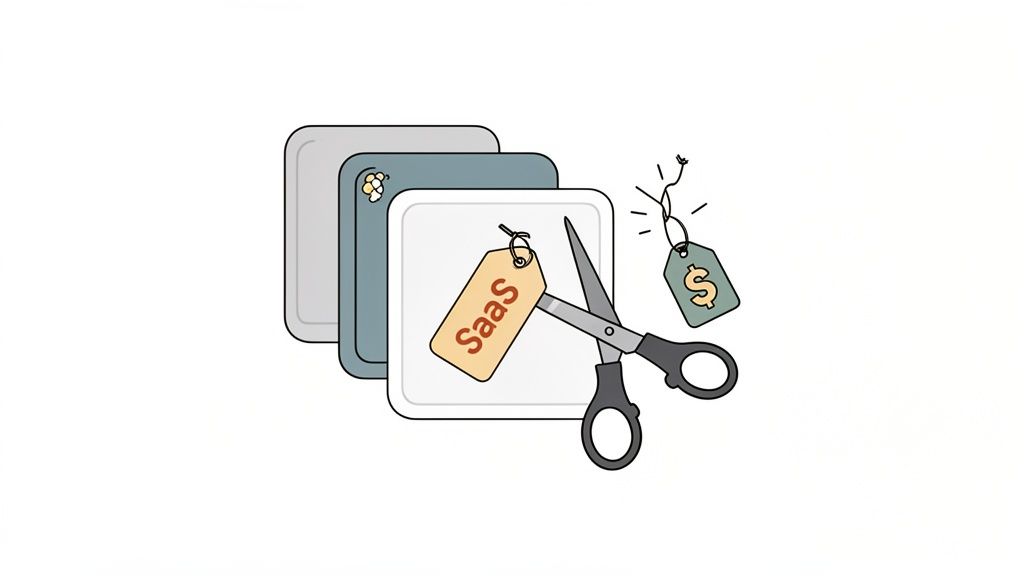
Your tech stack, especially all those SaaS subscriptions, can feel like the cost of admission for a modern business. But if you're not paying close attention, it can quickly become a silent, relentless drain on your cash flow. I learned this the hard way.
Our moment of truth arrived during a quarterly review. We laid out every single subscription on a spreadsheet and discovered we were paying for three different platforms—a project manager, a team collaboration tool, and a client portal—that all did pretty much the same things. It was a classic case of death by a thousand paper cuts, and it was entirely our fault for not keeping an eye on it.
This wasn't just a financial wake-up call; it was a philosophical one. It’s what inspired the core idea behind our own platform, Thareja AI, which unifies dozens of models to stop the madness of juggling multiple specialized tools. By consolidating just those three overlapping tools into one, we immediately cut our monthly software bill by over $800. That’s $9,600 put straight back into our runway for the year.
Your Practical Tech Audit Checklist
Getting a handle on your tech spend doesn't require complex financial software. All you need is a methodical approach and the guts to ask tough questions about every tool you pay for. It’s about being intentional and making sure every dollar you spend on tech is actually driving value.
Here's the simple checklist we developed that you can use to start auditing your own stack today:
Map Every Single Subscription. Make a master list of all your software. Include the cost, the renewal date, and who on your team "owns" it. I guarantee you’ll find surprises here.
Hunt for Feature Overlap. Look at your list and group tools by what they do (e.g., project management, marketing automation, design). This is where you'll spot the redundancies, like paying for two different social media schedulers or multiple cloud storage services.
Find the "Ghost" Licenses. Dig into the admin panel of each tool. It’s shockingly common to find you’re paying for seats for ex-employees or team members who never even logged in. Deactivating these is an instant win.
Check Your Plan Tier vs. Actual Use. Are you on an "Enterprise" plan when your team only uses the "Pro" features? Most SaaS platforms have usage analytics. Use that data to see if you can downgrade to a cheaper plan without losing anything important.
Look for Bundling Deals. Can you get a discount by bundling your CRM with your marketing automation tool from the same company? Vendors often give significant savings to customers who go all-in on their ecosystem.
This process is about more than just cutting checks; it’s about making your entire operation smoother. There's a reason the Cost Reduction Strategy market is booming—it’s projected to nearly double from $6.8 billion to $12.0 billion by 2033, largely because AI and automation are helping businesses find these exact kinds of savings. You can dig into this growing market on HTF Market Insights.
Calculating the Real Business Impact
The true cost of a bloated tech stack isn't just the subscription fee; it's the wasted time, and your team's time is always your most expensive asset.
Think about what a single developer’s hour is worth. Let's do some quick, conservative math.
If a developer earns $100,000 per year, that works out to about $48 per hour. If a clunky process or a slow tool costs them just 30 minutes a day, that’s $24 of lost productivity every single day.
30 minutes/day x 5 days/week x 50 weeks/year = 125 lost hours per year. 125 hours x $48/hour = $6,000 in lost value per developer.
Now, imagine finding a tool that gives that time back. Suddenly, you've recovered $6,000 in value without hiring anyone. If you can do that for just two developers, you're looking at over $10,000 in recovered productivity. This principle applies to every role in your company. For us, investing in the right AI tools for small business was one of the most powerful ways to reclaim these lost hours and pour them back into innovation.
This exercise completely changes the conversation from "How can we spend less?" to "How can we invest smarter?" It proves that choosing the right technology isn't an expense; it’s a direct investment in your team’s efficiency and your company’s bottom line. The key is to see your tech stack not as a fixed cost, but as a dynamic asset portfolio. You have to continuously audit it, optimize it, and make sure it aligns with what your business actually needs. Make your technology work for your budget, not against it.
Driving Growth with Lean Marketing
When you’re starting out, it’s easy to believe great marketing requires a huge budget. I’m here to tell you that’s a myth we had to bust for ourselves. The pressure to spend on ads, sponsorships, and flashy campaigns can feel overwhelming, but our most significant growth didn’t come from a big check. It came from being resourceful, strategic, and deeply connected to our audience.
Lots of founders get trapped in a cycle of pouring money into paid ads, hoping for a quick return. We tried it. Early on, we burned through $5,000 on a targeted ad campaign and got a handful of lukewarm leads in return. It felt like shouting into a void. It was demoralizing to see that money vanish with almost nothing to show for it.
That experience was a painful but necessary lesson. It forced us to rethink how we approached customer acquisition and where our money was—or wasn't—working.
The Power of One Great Piece of Content
Feeling the sting from that failed campaign, we pivoted. Hard. Instead of renting an audience through ads, we decided to build one by providing genuine value. So we spent a full week researching and writing a single, in-depth blog post that solved a specific, painful problem for our target customers.
The result was staggering. That one article, which cost us nothing but our time, generated more qualified, high-intent leads over the next six months than our entire paid campaign. It proved that investing in evergreen content is one of the most cost-effective marketing strategies out there. Best of all, that content continues to work for us today, attracting new visitors with zero ongoing ad spend.
Maximize Your Reach by Repurposing Everything
Creating that high-value content was just the first step. To truly get our time's worth, we adopted a "create once, distribute forever" mentality. That single blog post became the source for a dozen other pieces of marketing material.
Here’s how we broke it down:
Key insights became individual social media posts for LinkedIn and X.
The main arguments were turned into a short, engaging video script.
We pulled out a powerful statistic and created a simple infographic.
The core ideas formed the basis of an email newsletter for our subscribers.
This approach maximized the return on our initial time investment, allowing us to maintain a constant presence across multiple channels without having to constantly create new content from scratch. You can discover more about maximizing your content's impact by exploring effective content marketing automation tools.
Your best marketing shouldn't feel like an expense; it should feel like building an asset. A great blog post, a helpful guide, or a strong community are assets that appreciate in value over time.
Focus on Metrics That Actually Matter
In a lean marketing environment, vanity metrics like "likes" and "impressions" don’t pay the bills. We learned to obsess over two numbers that tell the real story of our financial health: Customer Acquisition Cost (CAC) and Lifetime Value (LTV). The goal is simple: keep your CAC as low as possible while making your LTV as high as possible.
Tracking these metrics revealed something powerful. Our community-building efforts—hosting free webinars, engaging in relevant online forums, and directly answering user questions on social media—had a ridiculously low CAC. These weren't just leads; they were fans who provided invaluable product feedback and became our most vocal advocates.
As you refine your marketing, it's also critical to explore effective strategies to reduce customer acquisition cost without stalling your growth. By focusing on organic channels, you attract users who are genuinely interested in what you offer, which almost always leads to higher LTV. Every marketing dollar becomes a strategic investment, not just a shot in the dark.
The takeaway is this: Lean marketing forces you to be more creative, more empathetic, and more focused on real value. It’s not about having the biggest budget; it’s about having the smartest strategy. This approach doesn't just cut costs—it builds a more resilient and authentic brand.
Rethinking Your Staffing and Productivity

Your team is your single greatest asset, but payroll is almost always your largest and most daunting expense. The conventional wisdom for cutting this cost often feels brutal and binary: layoffs or hiring freezes. We found a third path—one that focused on maximizing our team's output and building a flexible, resilient workforce without sacrificing our core people.
This isn't about squeezing more hours out of them or treating them like numbers on a spreadsheet. It’s about removing the friction, automating the grunt work, and creating an environment where talented people can finally focus on the high-value, strategic work that actually drives the business forward.
Adopting a Flexible Hybrid-Team Model
Early on, we realized we couldn't afford to hire a full-time expert for every single function we needed. We had a core team of passionate generalists, but we constantly ran into projects that required specialized skills—like a complex data visualization or a specific type of backend development.
Our solution was to build a hybrid model. We kept our small, dedicated core team and cultivated a trusted network of skilled freelancers and contractors. When a new project popped up, we could instantly scale our capabilities by bringing in the exact expertise we needed, for exactly as long as we needed it.
This approach had a massive financial impact. We avoided taking on the fixed overhead of new salaries, benefits, and payroll taxes. Instead of adding an $80,000 annual salary for a role we only needed for three months, we could bring on a top-tier freelancer for a $20,000 project fee. That’s a clean $60,000 in savings, and it gave us access to a far wider talent pool.
Central to this is understanding how to reduce labor costs through strategic planning, not just headcount reduction. This flexible structure became our key to staying lean while executing at a high level.
Investing in Tools That Give Time Back
The most powerful way to slash hidden staffing costs is to arm your team with tools that eliminate low-value work. Every hour spent on manual data entry, tedious research, or formatting reports is an hour not spent on creative problem-solving or talking to customers.
We made a conscious choice to invest in technology that acted as a force multiplier for our team. For instance, we started using AI to handle the initial research and first drafts for our content marketing. This was a game-changer. What used to be a multi-day slog of gathering sources and outlining an article became a task that took just a few hours.
The real-world result? We cut our average content creation time by 40%. This wasn't just a time-saver; it allowed our small marketing team to double their output without burning out. That's a direct, measurable return that translated into faster growth. For any small team, exploring the right project management tools for teams can unlock similar massive gains.
The goal isn't just to make your team more efficient; it's to make their work more meaningful. When you automate the tedious parts of their job, you free up their cognitive energy for the creative and strategic work they were actually hired to do.
This focus on operational efficiency is becoming a major economic driver. In fact, the market for Cost Reduction Services is projected to nearly double from $123.6 million to $242.4 million by 2032, propelled by the same AI and data analytics we used to boost our productivity. You can discover more insights about this trend from Coherent Market Insights.
The Real Impact of Small Productivity Gains
Let's break down the financial impact of a seemingly small efficiency gain. Imagine you have a content strategist who earns $75,000 per year, which is about $36 per hour.
Time Saved: A 40% reduction in content creation time saves them roughly 16 hours on a 40-hour task.
Value Recovered: At $36/hour, that’s $576 in recovered value for a single week-long project.
Annual Impact: If they work on similar projects all year, these savings compound into thousands of dollars of reclaimed productivity, all while improving job satisfaction (Harter, Schmidt, & Hayes, 2002).
This isn't just theory; it’s the simple math of how smart investments in people and tools directly translate into a healthier bottom line.
A Mental Model for Staffing Efficiency
Here’s the key takeaway: view your team not just as a cost center, but as an engine for value creation. Your job as a leader is to remove every possible obstacle from their path.
By combining a flexible staffing model with strategic investments in productivity tools, you can dramatically lower your effective labor costs without ever making the painful decision to let someone go. This is how you build a resilient, efficient, and ultimately more profitable organization.
Building Your Efficiency Flywheel
After digging through the tactical trenches of cost-cutting—from auditing every last SaaS subscription to rethinking our entire staffing model—I’ve started seeing it all through a single, powerful lens: The Efficiency Flywheel. This isn't just some catchy phrase. It’s the operating system that connects every strategy we've discussed, turning cost management from a painful, reactive project into a continuous, self-powering cycle of growth.
For years, I treated cost reduction as a one-off event. It was the emergency button we pushed when cash got tight. That was my biggest mistake. The real breakthrough came when we stopped seeing efficiency as a restriction and started seeing it as the very engine of our business. Honestly, that mindset shift was the single most important factor in our long-term financial health and resilience.
How the Flywheel Spins
The concept is simple but incredibly effective. Every smart, cost-saving action you take adds a little push to the flywheel, making the next push just a bit easier. This isn't just about pinching pennies; it’s about strategically plowing those gains right back into the business, creating momentum that snowballs over time.
Think of it like this:
Identify Waste: You spot an unused software license or an inefficient manual process. This is the initial effort.
Implement Improvement: You cancel that subscription or automate the task. This action takes focused energy.
Measure the Impact: You see a direct saving—let’s say $200/month or 5 hours/week.
Reinvest the Gains: That freed-up cash or time gets immediately funneled into a high-impact area, like a small marketing experiment or developing a new feature.
That reinvestment makes the business stronger, which in turn makes it easier to spot the next inefficiency. With each turn of the flywheel, your company gets leaner, faster, and more capital-efficient. It’s the heart of lean management: a constant push to eliminate waste and create more value with fewer resources.
More Than Just Savings
Adopting this mindset has a real, tangible impact that goes far beyond the balance sheet. It creates a culture of ownership and ingenuity. When your team sees their small efficiency suggestions directly fueling the projects they’re actually excited about, cost management stops being an act of deprivation and becomes an act of creation. It's no surprise that studies consistently show engaged employees who feel a sense of purpose are more innovative and productive (Harter, Schmidt, & Hayes, 2002).
The ultimate goal here is to build a business where efficiency isn't a department or a project, but a shared value. It’s the strategic enabler that fuels your mission, protects your runway, and builds a durable, profitable company that can weather any storm.
This flywheel isn't just a tactic for survival. It's a blueprint for building something that lasts. It turns the painful necessity of cutting costs into a powerful engine for innovation and growth.
Ready to build your own efficiency flywheel? A great place to start is by unifying your tech stack and getting rid of redundant tools. Thareja Technologies Inc. integrates over 50 AI models into a single, cost-effective platform, giving your team the power to innovate without the bloat. Discover how you can consolidate and save today.